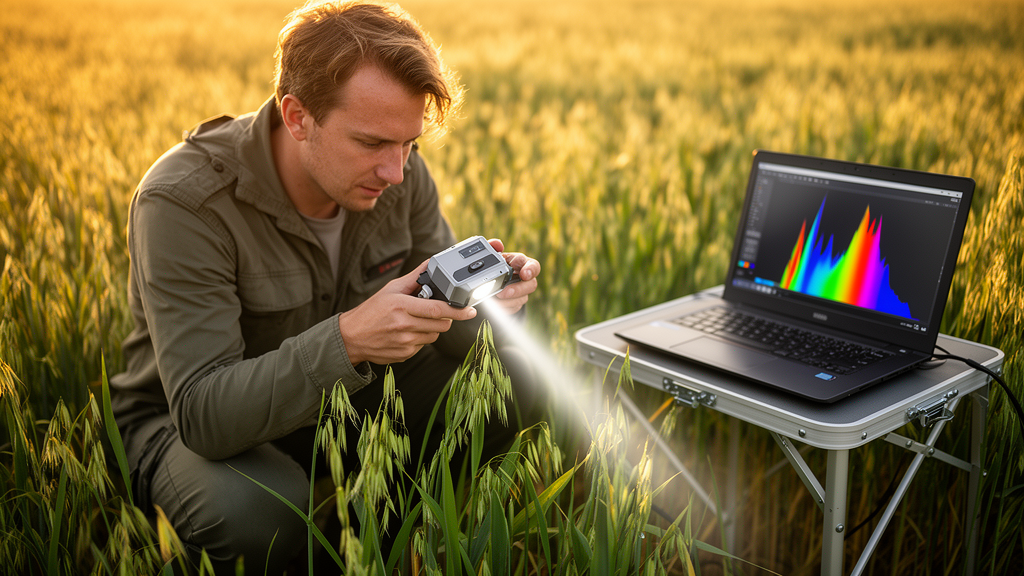
A methodological study published in Plant Methods on 26 October 2026 presents a reproducible and interpretable workflow for SPAD-based leaf chlorophyll status phenotyping from hyperspectral reflectance, using oat (Avena sativa L.) as its representative use case. The workflow addresses a persistent methodological challenge in leaf hyperspectral phenotyping: datasets with limited biological samples relative to high-dimensional spectral variables, where strong band redundancy, limited robustness under developmental shift, and weak interpretability of feature-importance analyses complicate modeling.
The underlying dataset was deliberately modest in biological scale. The researchers worked from 200 sampled oat leaves, from which 1,142 retained region-of-interest-level modeling samples were derived, each described by 125 spectral bands spanning 400 to 1000 nanometers. Five independent growth-stage validation batches allowed the team to evaluate how well models trained at one developmental stage performed at another. Against this backdrop, the full workflow achieved a coefficient of determination of 0.8575, with a standard deviation of 0.0021 across repetitions, while reducing spectral dimensionality by 80 percent.
Dimensionality reduction in the workflow proceeds in two stages. A Lasso screening step first prunes redundant bands, and a successive projections algorithm then refines the surviving bands. The two-stage design targets band redundancy before any regression model is fitted, addressing the strong band redundancy that the authors identify as a central difficulty in limited-sample hyperspectral datasets.
For the modeling stage, the study employed tabular deep learning optimized for structured spectral predictors. The chosen architecture, TabM-v2, was trained with Mixup and stochastic weight averaging. In comparative benchmarking under this limited-sample, structured-spectral regime, TabM-v2 achieved the highest in-distribution accuracy. The benchmarking also surfaced a more parsimonious alternative: a compact pipeline combining Lasso, successive projections, and a support vector regressor provided stronger cross-stage transferability at intermediate growth stages, offering a leaner route when transfer across developmental stages matters alongside in-distribution accuracy.
One of the study’s more careful contributions concerns validation itself. Because many region-of-interest measurements can be drawn from a single leaf, random splitting at the ROI level risks pseudo-replication, in which the model is effectively tested on fragments of leaves it saw during training. To address the hierarchical structure of ROI-level measurements, the researchers performed strict leaf-grouped validation, in which all ROIs from the same reconstructed leaf identity were assigned exclusively to either the training or the testing set. Performance remained comparable to ROI-level random splitting, indicating that within-leaf pseudo-replication did not substantially inflate the reported accuracy.
Interpretability received explicit attention through a multi-level interpretation scheme spanning feature, region, and dependency analyses. Across the workflow, the green, red-edge, and near-infrared regions were consistently identified as dominant contributors to prediction. The dependency analysis added a structural observation: the red-edge region acted as the central dependency hub in the feature-dependency structure.
The workflow’s limits are stated as plainly as its strengths. When models were evaluated across the five independent growth-stage validation batches, transferability was strongest at intermediate growth stages but reduced under marked developmental shift. At the maturity stage, all models fell below a coefficient of determination of 0.15, which the authors define as a critical operational boundary of the workflow. Equally important, the reference trait is SPAD-based chlorophyll status, a relative index rather than an absolute biochemical chlorophyll concentration, which constrains how the predictions should be interpreted.
What the study ultimately offers is less a single breakthrough model than a documented methodological workflow: benchmarked spectral preprocessing, two-stage band selection, tabular deep learning with stabilization techniques, leaf-grouped validation, and layered interpretation, all under limited sample conditions. The authors are explicit that broader validation across genotypes, sites, years, and devices remains necessary before the workflow can be considered general. For a field in which small datasets, redundant spectra, and fragile cross-stage models are common, a reproducible recipe with a clearly defined validation boundary is itself a meaningful methodological result.
Subject of Research: A reproducible hyperspectral phenotyping workflow for estimating SPAD-based leaf chlorophyll status in oat under limited sample conditions
Article Title: A reproducible and interpretable workflow for leaf hyperspectral phenotyping under limited sample conditions with hierarchical validation and cross-stage evaluation
Article References: Bao, A., Ji, T., Liu, J., Pan, X., Gao, T., Bai, H., & Zhou, H. (2026). A reproducible and interpretable workflow for leaf hyperspectral phenotyping under limited sample conditions with hierarchical validation and cross-stage evaluation. Plant Methods. https://doi.org/10.1186/s13007-026-01611-9
Image Credits: AI Generated
DOI: 10.1186/s13007-026-01611-9
Keywords: hyperspectral imaging, plant phenotyping, chlorophyll, SPAD, oat, machine learning, tabular deep learning, band selection, cross-stage validation, reproducibility, interpretability, Plant Methods
News Source: Blake Davidson. (October 26, 2026). Oat leaf hyperspectral workflow hits R2 of 0.8575 with 80% fewer bands. Scienmag.