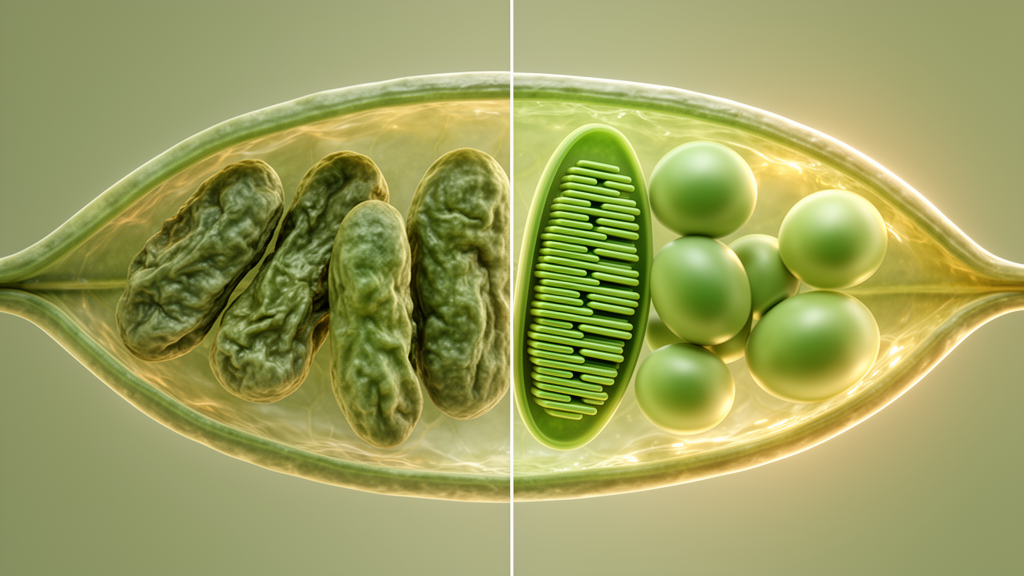
When water returns after a long dry spell, the photosynthetic membranes inside the leaves of the drought-tolerant oil crop Jatropha curcas do something remarkable: they spring back to their original spacing within hours. That is the central finding of a new study published in Plant Cell Reports, in which researchers tracked the chloroplasts of Jatropha seedlings through 19 days of water withdrawal and a carefully timed rewatering sequence. Using transmission electron microscopy and small-angle neutron scattering, the team showed that drought squeezes the stacked thylakoid membranes inside grana closer together by 2 to 4 nanometers, and that this compression reverses remarkably quickly once plants are rewatered, within half an hour to one hour in the spongy parenchyma and within five hours in the palisade tissue. The authors propose that this rapidly reversible membrane remodeling is what allows the plant to rebuild its drought-affected photosynthetic apparatus and resume photosynthesis once water becomes available.
Jatropha curcas, a member of the Euphorbiaceae family, is a moderate stem-succulent tree cultivated mostly in Asia, Africa and Latin America and promoted as a biodiesel crop for arid and semi-arid regions. Its drought tolerance rests on water-saving traits that include stem succulence, early stomatal closure, reduced growth and a low level of crassulacean acid metabolism, which stores carbon dioxide taken up at night as malic acid so that stomata can stay closed during the day. While earlier work had examined the photosynthetic activity of drought-stressed and rewatered Jatropha, no previous study had investigated how drought and recovery affect leaf anatomy, chloroplast ultrastructure and thylakoid architecture in this species, even though the integrity of chloroplast structure and function underpins photosynthetic performance and, ultimately, the biosynthesis of biofuel feedstock.
The experiment was conducted on 46-day-old seedlings grown in a controlled chamber with day temperatures of 28 degrees Celsius, a 12-hour photoperiod and moderate light intensities. Drought was imposed by withholding water for 19 days, during which the soil relative water content fell from roughly 89 percent to 12 percent. Plants were then rewatered abundantly, and leaves were sampled at 0.5, 1, 3, 5 and 24 hours as well as at 3 and 21 days after rehydration, with well-watered control plants harvested at matching time points. The same leaves were first used for in vivo activity measurements and then sampled for the invasive structural and biochemical analyses, allowing structural and functional changes to be followed on a common timeline.
A striking feature of the results is how well the leaves held on to their water. Despite visible wilting of the leaf petioles, which disappeared quickly after rewatering, the relative water content of the leaf mesophyll remained essentially unchanged throughout the drought period and the early recovery phase, hovering around 88 to 94 percent. Light microscopy confirmed that leaf thickness and overall anatomy, including the amphistomatic epidermis, the single-layered palisade parenchyma and the spongy parenchyma with its large intercellular air spaces, showed no visible changes under stress. The photosynthetic pigments were similarly stable, with no significant changes in total chlorophyll content or in the carotenoid-to-chlorophyll ratio, although the chlorophyll a/b ratio declined during drying and only returned to control values after 21 days of recovery.
Beneath this preserved exterior, however, the chloroplasts were quietly restructuring. Quantitative image analysis showed that drought-stressed chloroplasts became significantly smaller, with average length and width each decreasing by roughly 0.8 to 0.9 micrometers, which increased their length-to-width ratio because the lens-shaped organelles were already narrower than they were long. More significantly, the granum repeat distance, the periodic spacing of stacked thylakoid membranes, decreased by 2 to 4 nanometers under drought. This shrinkage was detected independently by transmission electron microscopy on chemically fixed samples and by small-angle neutron scattering on living leaf tissue, and the two methods showed the same trend, lending robustness to the finding. The number of thylakoid layers per granum did not change, indicating that the membranes packed more tightly rather than losing their stacked organization. Starch grains, occasionally present in control plastids, were absent from the chloroplasts of all drought-stressed plants examined.
One of the most novel observations concerns the two photosynthetic tissue layers of the leaf. In control plants, the granum repeat distances of palisade and spongy parenchyma chloroplasts were similar, but drought compressed the grana of palisade chloroplasts significantly more than those of the spongy layer, and the palisade grana also needed longer to recover, reaching control spacing only after five hours of rewatering compared with one hour in the spongy tissue. The authors suggest this may reflect the different anatomy of the two layers, with the adaxial palisade cells rehydrating more slowly than the spongy parenchyma, which is surrounded by large intercellular cavities refilled with water vapor as transpiration restarts. To the authors’ knowledge, this is the first report of differences in drought sensitivity and recovery speed of granum repeat distance between these mesophyll layers.
Biochemical analysis of isolated thylakoid membranes by blue native polyacrylamide gel electrophoresis revealed that the photosynthetic complexes were adjusted asymmetrically under drought. Photosystem I and the light-harvesting complex II remained unchanged, whereas photosystem II complexes decreased, raising the PSI/PSII and LHCII/PSII ratios. Because the absolute amounts of PSII complexes fell and the disassembly of PSII supercomplexes did not proportionally increase the smaller PSII forms, a fraction of PSII must have degraded. Notably, within the reduced PSII supercomplex pool, the largest forms carrying strongly and moderately attached LHCII trimers were proportionally enriched, suggesting that these larger supercomplexes are more stable under drought and possibly preserved in a quenched state. Meanwhile, the pool of free LHCII trimers increased, likely released from disassembled supercomplexes, and this enlarged free antenna pool may contribute to enhanced energy dissipation and protection against photo-oxidative damage.
These structural and compositional shifts were mirrored in photosynthetic function. Chlorophyll-a fluorescence measurements showed a moderate but significant decrease in the Fv/Fm ratio and an increase in the minimum fluorescence level Fo after 19 days of water withholding, consistent with partial energetic disconnection of LHCII from PSII and the presence of inactive or degraded PSII centers. Non-photochemical quenching, the process that dissipates excess light energy as heat, increased markedly during drought and declined only gradually after rewatering. Circular dichroism spectroscopy added a further layer: the psi-type CD band at around 675 nanometers, which arises from the chiral macro-organization of pigment-protein complexes in the stacked membranes, was significantly diminished by drought, consistent with the denser granum packing, and was almost fully restored within five hours of rewatering while the other psi-type bands remained essentially unchanged.
The recovery timeline is the most striking aspect of the study. Structural parameters rebounded fastest: the Bragg peak position in the neutron scattering curves shifted back toward larger repeat distances within 30 minutes of rewatering, granum organization and chloroplast shape were largely restored within 0.5 to 1 hour, and the chiral macro-organization signal recovered within five hours. Functional and compositional recovery lagged well behind. The Fv/Fm ratio, non-photochemical quenching, the chlorophyll a/b ratio and the composition of most chlorophyll-protein complexes returned to control levels only between 3 and 21 days after rewatering, implying that repair involves de novo synthesis of damaged thylakoid components rather than a quick reversible adjustment. Three days after rewatering, the researchers also observed a significant decrease in plastid size with small, rounded plastids appearing, which they associate with chloroplast division or the reaccumulation of starch grains as growth restarts.
The authors place these findings in a broader comparative context. In the drought-tolerant species Ctenanthe setosa, studied previously by the same group, thylakoid structure and protein composition were better preserved during long drought, but granum repeat distance recovered only about ten hours after rewatering. They speculate that the very fast structural recovery in Jatropha may be a prerequisite for the more extensive repair processes needed to restore photosynthetic activity, since the cleavage of damaged proteins and insertion of newly synthesized components into the thylakoids are probably facilitated in membranes with restored spacing. The study has limitations that the authors acknowledge: it was performed on young seedlings in a growth chamber, the neutron scattering curves could not be placed on an absolute scale because the total thickness of the measured leaf segments varied, and existing structural models for non-infiltrated leaves are too limited to extract detailed thylakoid parameters. Even so, the convergence of electron microscopy, neutron scattering, spectroscopy and proteomics on the same picture makes the conclusion compelling: the remarkable flexibility of thylakoid architecture, shrinking under drought and springing back within hours, appears to be a key mechanism by which Jatropha curcas withstands prolonged water shortage and resumes photosynthesis and growth once water returns.
Subject of Research: Rapid reversible thylakoid remodeling underpins drought resilience and recovery of the photosynthetic apparatus in Jatropha curcas
Article Title: Fast structural remodeling of Jatropha curcas thylakoids upon recovery underpins chloroplast resilience to drought
Article References: Hembrom, R., Sapeta, H., Zsiros, O., Markó, M., Nagy, G., Sárvári, É., Solti, Á., Oliveira, M. M., Garab, G., & Solymosi, K. (2026). Fast structural remodeling of Jatropha curcas thylakoids upon recovery underpins chloroplast resilience to drought. Plant Cell Reports, 45(11), Article 344. https://doi.org/10.1007/s00299-026-04019-w
Image Credits: AI Generated
DOI: 10.1007/s00299-026-04019-w
Keywords: Jatropha curcas, drought stress, chloroplast ultrastructure, thylakoid membranes, granum repeat distance, small-angle neutron scattering, photosystem II, non-photochemical quenching, rewatering recovery, plant cell reports, biofuel crops, palisade parenchyma
News Source: Alan Morgan. (October 26, 2026). Drought-squeezed Jatropha chloroplasts snap back within hours of rewatering. Scienmag.