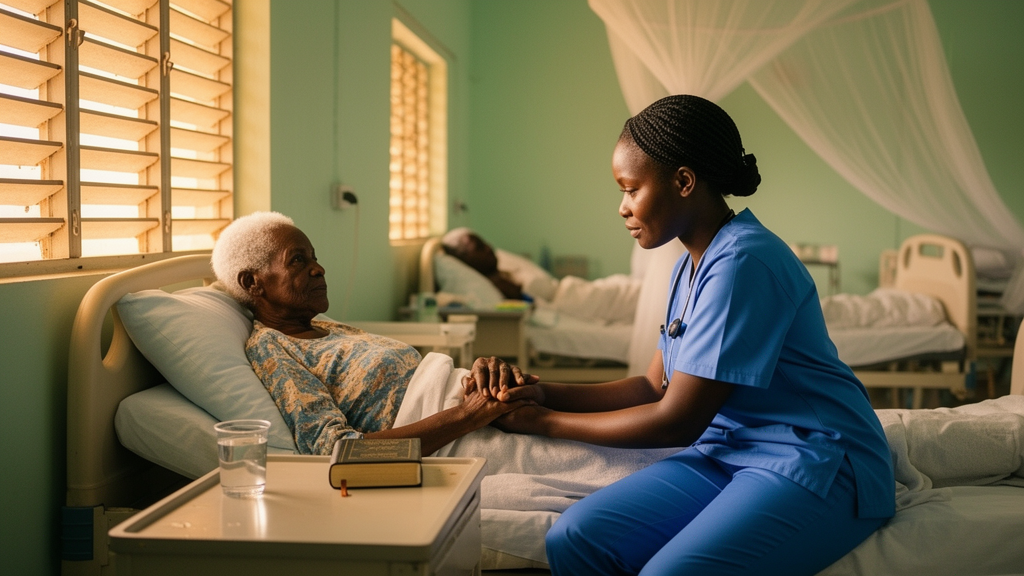
In the oncology wards of Ghana’s largest referral hospital, nurses do far more than administer chemotherapy and monitor vital signs. A new study published in Supportive Care in Cancer reveals that these frontline caregivers routinely navigate one of medicine’s most intangible domains: the spiritual lives of patients facing cancer. The research, led by M. E. Adjei of the Ghana College of Nurses and Midwives, offers one of the most detailed portraits yet of how nurses in a resource-constrained African health system attempt to address the existential anguish that accompanies a cancer diagnosis.
The study employed a descriptive phenomenological design, a qualitative approach that seeks to capture lived experience in its rawest form. Using purposive sampling, the researchers recruited 20 nurses from a major referral hospital in Ghana and conducted face-to-face and telephone interviews. The interviews were then analysed using Colaizzi’s phenomenological method, a rigorous seven-step analytical framework that moves from identifying significant statements to formulating meanings, clustering themes, and ultimately describing the essential structure of the participants’ experience. This methodological choice matters: rather than measuring spiritual care with surveys, the team sought to understand what it actually feels like to provide it, from the inside.
What emerged is a picture of spiritual care as a deeply complex and contextually constrained process. Cancer diagnoses, the researchers note, often give rise to profound existential concerns related to meaning, identity, and mortality. Patients confronting advanced disease frequently ask questions that no drug can answer: Why me? What will happen to my family? What comes after death? Nurses in the study described standing at the intersection of these questions and their own professional training, which rarely prepares them for conversations about the soul.
One of the most striking findings concerns the relational and ethical tensions nurses must navigate. Participants reported encountering differences in beliefs between themselves and their patients, a particularly salient challenge in Ghana, where religious life spans Christianity, Islam, and traditional African spiritual practices. A nurse cannot simply impose her own faith framework on a suffering patient; instead, she must discern what spirituality means to that individual and respond in a way that respects the patient’s worldview. At the same time, nurses described witnessing patients’ existential distress, moments of anguish over mortality and meaning that demanded a response even when the nurse felt ill-equipped to provide one.
These interpersonal challenges unfolded against a backdrop of severe systemic constraints. The nurses described time pressures that left little room for the slow, open-ended conversations that spiritual support requires. They reported a lack of institutional support, including the absence of formal protocols, dedicated chaplaincy integration, or supervisory structures that would legitimise spiritual care as part of the nursing role. Limited infrastructure compounded the problem: in wards where staffing is thin and equipment scarce, attending to a patient’s inner life can feel like a luxury the system cannot afford. The study’s findings echo earlier international research, including a large online survey by McSherry and Jamieson, which documented widespread uncertainty among nurses globally about the nature of spirituality and how it should be addressed in clinical practice.
Yet the study is far from a catalogue of failure. Despite these obstacles, the nurses actively sought to enhance the spiritual dimension of their care. Participants described pursuing interdisciplinary collaboration, working alongside chaplains, clergy, and colleagues from other professions when patients’ needs exceeded what nursing alone could address. They called for training to build spiritual care competency, recognising that the willingness to engage with a patient’s faith or existential crisis is not the same as having the skill to do so well. And they advocated for greater institutional integration, urging hospital leadership to embed spiritual support formally within oncology services rather than leaving it to individual improvisation.
The scientific significance of this work lies partly in its setting. Most published research on spiritual care in oncology originates from North America, Europe, and parts of Asia, where health systems differ dramatically from those in sub-Saharan Africa. A focus group study across nine countries by Selman and colleagues highlighted how patients’ and caregivers’ spiritual needs and preferences vary across cultures, yet evidence from African oncology settings has remained sparse. Studies from Nigeria, including an assessment of spiritual care practices among nurses caring for cancer patients in a tertiary hospital, have begun to fill this gap, and the new Ghanaian data add a crucial West African perspective. The findings suggest that spiritual care in oncology is not a fixed protocol but a dynamic and negotiated practice, shaped moment by moment by relational dynamics, ethical judgement, and structural realities.
This conceptualisation carries practical weight. If spiritual care is negotiated rather than prescribed, then improving it requires more than adding a checklist to nursing documentation. The authors argue that strengthening its integration demands contextually relevant institutional support, meaning policies and resources designed for the realities of Ghanaian hospitals rather than imported wholesale from wealthier systems. Capacity-building through targeted education is essential, as is an interdisciplinary approach that treats spiritual care as a shared responsibility among nurses, chaplains, physicians, social workers, and community faith leaders. Prior research supports the clinical value of this effort: systematic reviews have linked spiritual care interventions to improved quality of life and spiritual well-being among patients with terminal illness, and studies of advanced cancer patients have shown that religious and spiritual factors are associated with patient-reported outcomes including anxiety, depressive symptoms, fatigue, and pain.
The study also illuminates the personal cost borne by nurses themselves. Providing spiritual support without training, time, or institutional backing places nurses in a position of moral and emotional strain: they perceive a need they feel obligated to meet, yet lack the tools to meet it adequately. This tension, described in the literature as a barrier to holistic practice, may contribute to burnout and attrition in oncology nursing, a field already challenged by workforce shortages worldwide. Recognising spiritual care as a legitimate, supported component of the nursing role, rather than an invisible extra, could therefore benefit practitioners as much as patients.
As cancer incidence continues to rise across Africa, the question of how health systems address the whole person, body, mind, and spirit, becomes increasingly urgent. This Ghanaian phenomenological study makes clear that the answer will not come from technology or infrastructure alone. It will come from understanding the lived experiences of the nurses who stand beside patients in their darkest hours, and from building institutions that finally give those nurses the time, training, and support to care for what no monitor can measure. The research was approved by the Korle-Bu Teaching Hospital’s Ethics Review Committee in May 2025 and conducted in accordance with the principles of the Declaration of Helsinki, with all participants providing informed consent.
Subject of Research: Lived experiences of nurses in providing spiritual care in oncology settings in Ghana: a descriptive phenomenological study
Article Title: Lived experiences of nurses in providing spiritual care in oncology settings in Ghana: a descriptive phenomenological study
Article References: Adjei, M. E., Cobbah, S., Mumuni, H. I., & Iddrisu, M. (2026). Lived experiences of nurses in providing spiritual care in oncology settings in Ghana: a descriptive phenomenological study. Supportive Care in Cancer, 34(10), Article 934. https://doi.org/10.1007/s00520-026-11147-2
Image Credits: AI Generated
DOI: 10.1007/s00520-026-11147-2
Keywords: Lived, experiences, nurses, providing, spiritual, care, oncology, settings, Ghana, descriptive, phenomenological, scientific research
News Source: Nathaniel Bowman. (October 19, 2026). Nurses in Ghana reveal the hidden struggle of spiritual care in cancer wards. Scienmag.