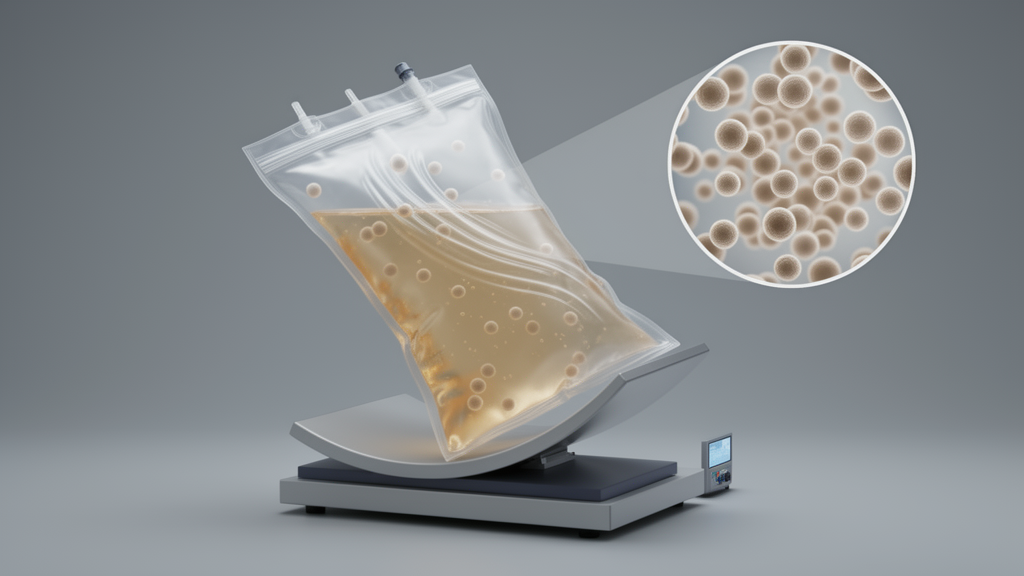
Rocking disposable bioreactors have become workhorses of modern bioprocessing: sterile plastic culture bags that tilt gently back and forth on a rocking platform, sloshing cells, media, and oxygen through a wave-like motion. They are cheap, single-use, and gentle in appearance, which is precisely why they are favored for shear-sensitive animal cell cultures. Yet a new computational and experimental study from Warsaw University of Technology, published in Applied Microbiology and Biotechnology, reveals a hidden danger lurking inside these seemingly placid vessels. While the average shear rate that cells experience remains comfortably low, localized microzones of extreme shear can exceed lethal thresholds by more than an order of magnitude, potentially shredding cell membranes and sabotaging cultures grown under intensified rocking conditions.
The research team, led by Kamil Wierzchowski and Łukasz Makowski, set out to answer a deceptively simple question: what shear rates do cells actually encounter in a rocking bioreactor, and how do those rates affect cell survival? The answer matters because rocking bioreactors are increasingly used for growing lymphocytes, stem cells, and other fragile cell types that cannot tolerate the impeller-driven turbulence of stirred tanks. Understanding the hydrodynamic microenvironment is essential for anyone attempting to scale up production of cell therapies or biologics in disposable systems.
To characterize the fluid dynamics, the researchers built a two-dimensional Computational Fluid Dynamics model employing the Volume of Fluid method. This approach tracks the interface between the liquid culture medium and the gas headspace inside the culture bag, allowing the simulation to capture the sloshing wave motion that defines rocking bioreactor operation. The model simulated the culture bag under various rocking angles and frequencies, computing velocity fields, mixing behavior, and shear rate distributions throughout the liquid volume. Crucially, the team validated their numerical predictions against experimental mixing time measurements, achieving an absolute mean percentage difference of 29.2 percent. The model demonstrated high predictive accuracy at very low and very high Reynolds numbers, though its performance degraded somewhat at medium Reynolds numbers, a limitation the authors acknowledge openly.
The shear rate findings are striking. Averaged shear rates across the liquid volume remained below 22.5 s⁻¹ under all studied rocking conditions, values that would seem entirely benign for animal cell cultures. But the local maximum shear rates told a very different story. Under intensified rocking, these localized peaks soared past 30,000 s⁻¹, dramatically exceeding the lethal threshold of 1500 s⁻¹ that the team identified for HL-60 lymphocytes. This means that even though the bulk fluid appears gentle, cells passing through narrow microzones near the bag walls, the wave crest, or the gas-liquid interface can be subjected to shear stresses hundreds of times greater than what the average suggests.
To determine exactly where cell death begins, the researchers used a rotational rheometer to expose HL-60 lymphocytes to controlled shear rates. Their experiments revealed a clear dose-response relationship: cell viability begins to decline at shear rates above 1000 s⁻¹, as cell membranes start to rupture. Above 1500 s⁻¹, the team observed total disintegration of cells. The mechanism is mechanical destruction rather than metabolic exhaustion: hydrodynamic stress physically tears apart the lipid bilayer that encloses each cell, releasing intracellular contents into the medium. The researchers confirmed this by measuring the activity of lactate dehydrogenase, an enzyme normally confined inside cells, in the culture supernatant. Elevated LDH activity served as a molecular fingerprint of membrane damage, correlating directly with the shear conditions the cells had experienced.
The consequences for actual cell culture are significant. When the team grew HL-60 lymphocytes in a rocking disposable bioreactor under conditions where local shear rates consistently exceeded lethal thresholds, they observed impaired cell growth and increased release of intracellular enzymes. The problem was particularly acute during intensified rocking, when higher rocking angles and frequencies were used to improve mixing and oxygen transfer. This creates a fundamental trade-off: the very conditions that enhance mixing intensification and mass transfer also generate the hydrodynamic hotspots that kill shear-sensitive cells.
This trade-off is not merely an academic curiosity. Rocking disposable bioreactors are widely used in biopharmaceutical manufacturing for growing mammalian cell lines, producing viral vectors, and expanding cell therapies. As the industry shifts toward personalized medicine and cell-based treatments, the ability to reliably culture fragile lymphocytes in disposable systems becomes increasingly important. HL-60 cells, a human promyelocytic leukemia cell line derived from a patient with acute promyelocytic leukemia, serve as a well-characterized model for lymphocyte-like cells in this context. Their sensitivity to hydrodynamic stress makes them an ideal sentinel for identifying conditions that would harm other shear-sensitive cell types.
The computational framework developed by the Warsaw team provides a valuable tool for navigating this optimization problem. By simulating shear rate distributions under different operating parameters, researchers can identify rocking angles and frequencies that balance mixing efficiency against hydrodynamic stress. The model can also guide bioprocess scale-up, helping engineers predict how changes in bag geometry, liquid volume, and rocking dynamics will affect the shear microenvironment as processes move from laboratory to production scale. Rather than relying on trial-and-error experimentation, the numerical approach allows systematic exploration of the design space before any cells are placed at risk.
The study also highlights the importance of looking beyond averaged hydrodynamic parameters when assessing bioreactor suitability for shear-sensitive cultures. Traditional scale-up criteria often rely on average shear rates or power input per volume, which can mask the localized extremes that actually determine cell fate. The finding that local maximum shear rates can exceed lethal thresholds while averages remain benign suggests that cell damage in rocking bioreactors may be far more common than previously appreciated. For bioprocess engineers, this means that successful application of rocking disposable bioreactors for fragile cell cultures requires a strategic balance between mixing intensification and the mitigation of lethal local shear effects, informed by detailed computational analysis of the true hydrodynamic microenvironment that cells experience.
Subject of Research: Numerical analysis of shear rate in a rocking bioreactor and its impact on HL-60 lymphocytes
Article Title: Numerical analysis of shear rate in a rocking bioreactor and its impact on HL-60 lymphocytes
Article References: Wierzchowski, K., Krzosa, R., Pawlukiewicz, S., Pilarek, M., & Makowski, Ł. (2026). Numerical analysis of shear rate in a rocking bioreactor and its impact on HL-60 lymphocytes. Applied Microbiology and Biotechnology. https://doi.org/10.1007/s00253-026-14076-6
Image Credits: AI Generated
DOI: 10.1007/s00253-026-14076-6
Keywords: Numerical, analysis, shear, rate, rocking, bioreactor, impact, HL-60, lymphocytes, scientific research
News Source: Drew Townsend. (October 19, 2026). Numerical analysis of shear rate in a rocking bioreactor and its impact on HL-60 lymphocytes. Scienmag.