A new species of Asian horned toad has been discovered hiding in the mountain streams of Nanshan National Park in southwestern Hunan Province, China, and its name carries a poetic twist: Boulenophrys youran, drawn from a classical Chinese verse about gazing serenely at Nanshan. The species, described in the journal Zoosystematics and Evolution, was confirmed through a combination of genetic analysis, detailed body measurements, and even high-resolution scans of the frogs’ skeletons, revealing yet another branch on a rapidly diversifying tree of Asian horned toads.
The discovery stems from field surveys conducted between 2019 and 2025, during which researchers from Hunan Normal University collected twelve Boulenophrys specimens from Chengbu Miao Autonomous County and Xinning County at elevations between roughly 1,040 and 1,750 meters above sea level. The animals were found in flowing montane streams and on nearby forest floors within subtropical evergreen broad-leaved forest, often perched on rocks near the water. Morphologically, the specimens showed traits placing them in the B. omeimontis species group, including small horn-like tubercles along the upper eyelid margin, relatively smooth dorsal skin bearing distinct black spines, and obvious vocal sac morphology in males.
To determine whether the frogs represented a species already known to science, the team turned to phylogenetics. They extracted genomic DNA from muscle tissue and amplified two mitochondrial gene fragments, the partial 16S ribosomal RNA gene and the cytochrome c oxidase subunit I gene, or COI. Sequences from 77 recognized Boulenophrys species, plus two outgroup taxa from the related genus Xenophrys, were aligned and analyzed using both Bayesian inference and maximum likelihood methods. The two approaches produced identical tree topologies, and the undescribed species formed a clearly monophyletic clade with maximal statistical support, a Bayesian posterior probability of 1.00 and a bootstrap value of 100, distinct from its sister lineage.
The genetic distances tell an interesting story about speciation in this group. Uncorrected interspecific p-distances between the new species and its closest congeners ranged from 3.8 to 5.5 percent for COI, with the smallest gap, 3.8 percent, separating it from B. fanjingmontis. For 16S rRNA, the distances were far lower, between 0.9 and 1.4 percent. Such limited divergence in 16S rRNA is common within the B. omeimontis group, where some species pairs show distances as low as 0.3 percent. The researchers attribute this to the limited phylogenetic signal of the gene fragment and the fast speciation rate of the genus, a pattern of rapid radiation that can hinder complete lineage sorting and leave closely related species genetically intertwined even as they diverge physically.
That genetic ambiguity makes the morphological evidence all the more important. The new species is relatively large for the group, with adult males measuring 45.3 to 51.1 millimeters in snout-vent length and adult females 55.6 to 58.2 millimeters. Its head is wider than long, its tongue is feebly notched posteriorly, and it lacks vomerine teeth while retaining vomerine ridges. Its hindlimbs are slender, with heels overlapping when the legs are folded and the tibiotarsal articulation extending beyond the snout tip when the leg is stretched forward. The toes carry weak webbing and wide lateral fringes, and breeding males bear dense, moderate black conical nuptial spines on the inner two fingers, a sexually dimorphic trait that proved especially valuable for telling the new species apart from its relatives.
The team measured twenty-one morphometric characters on each specimen with digital calipers and subjected the data to principal component analysis, calculating each character as a ratio to snout-vent length and log-transforming the values to reduce allometric effects. The first two principal components together explained 78.1 percent of the total morphological variance, with the first component alone accounting for 68.8 percent and driven largely by head width, hindlimb length, thigh length, and foot dimensions. In the resulting morphospace, the new species separated clearly from B. fanjingmontis, B. sangzhiensis, and B. yezhongensis. However, two congeners, B. dalaolingensis and B. qianbeiensis, could not be distinguished by PCA alone, underscoring the morphological convergence that has long confounded species delimitation in this rapidly radiating genus.
Analysis of variance filled that gap. The statistical tests revealed significant differences between the new species and B. dalaolingensis in snout-vent length, head length, head width, snout length, internasal distance, and tibia length, and significant differences from B. qianbeiensis in ten characters including snout-vent length, eye diameter, upper eyelid width, and tympanum diameter. Comparisons with the other close relatives were equally decisive. The new species is smaller than B. fanjingmontis and B. sangzhiensis, lacks the prominent toe webbing of B. spinata, and differs from B. yezhongensis in nuptial spine size, toe fringes, tongue notching, and leg extension. Taken together with the absence of vomerine teeth, which distinguishes it from 25 congeners, and its overlapping heels and wide lateral fringes, which separate it from dozens more, the diagnostic case is comprehensive.
The skeletal evidence added a further layer of confirmation. The researchers subjected the holotype and one paratype to micro-CT scanning at 55 kilovolts and 0.17 milliamperes, reconstructing three-dimensional images of the skull and vertebral column. The skeletons showed the characteristic Boulenophrys architecture: maxillae overlapping the quadratojugal with well-developed maxillary teeth, small separated nasal bones articulating with the sphenethmoid and frontoparietal, eight presacral vertebrae with imbricate neural arches, a sacrum with wide diapophyses and a monocondylar sacrococcygeal articulation, and a femur slightly longer than the tibia. These features were consistent across the examined specimens and matched the genus-level diagnosis.
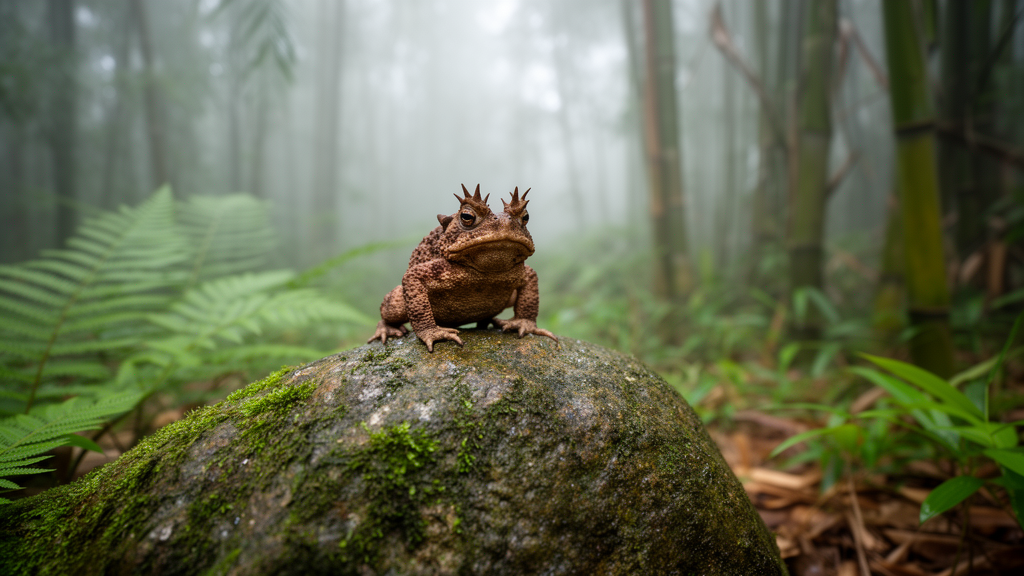
In life, the frogs are strikingly patterned. The dorsum is yellowish brown with irregular dark-brown patches, a butterfly-shaped marking with a light edge sits between the eyes, and the iris is copper-brown. The throat and anterior chest are purple-brown with three black longitudinal stripes edged in white, while the posterior flanks are orange with white spots and black blotches, and the groin, inner thighs, and shank surfaces glow red-orange. Coloration varies considerably among individuals: one male displays a dark-brown to black dorsum with a grayish-white venter, while another is olive green without dark-brown patches. Females are larger than males, and the toe fringes are well-developed in males but less distinct in females and juveniles.
The species name youran derives from the Chinese word meaning tranquil or composed, referencing the verse from Tao Yuanming’s classical poem Drinking Wine No. 5, which depicts picking chrysanthemums by the eastern fence and gazing serenely at Nanshan. The name alludes to the type locality and evokes the pristine, undisturbed montane streams the toads inhabit. Females with mature eggs and calling males were observed from April to June, and the nuptial pads of males collected in September lacked distinct spines, suggesting a period of reproductive inactivity. The new species occurs sympatrically with the smaller B. shunhuangensis, which preferentially inhabits narrow headwater streams, while B. youran occupies different microhabitats. Because its known range is confined to Nanshan National Park, where most of its habitat falls within the protected area, the researchers recommend further investigation of its population size and ecology to better estimate its conservation status. The discovery also highlights the underexplored amphibian diversity of the transitional zone between the Nanling and Xuefeng Mountains, a topographically complex landscape where cryptic species were expected to be found.
Subject of Research: Taxonomy and evolutionary biology of Asian horned toads
Article Title: A new species of the genus Boulenophrys ( Anura , Megophryidae ) from Nanshan National Park, Hunan Province, China
Article References: Xiao, B., Zhu, L., Wang, L., Li, H., Maimaiti, A., Li, S., Zhang, G., Liu, W., Fei, D., Liao, C., Tang, X., Shi, S., & Mo, X. (2026). A new species of the genus Boulenophrys (Anura, Megophryidae) from Nanshan National Park, Hunan Province, China. Zoosystematics and Evolution, 102(1), 53-70. https://doi.org/10.3897/zse.102.175092
Image Credits: AI Generated
Keywords: Boulenophrys, horned toad, new species, Hunan Province, phylogenetics, China biodiversity, species, genus, Anura, Megophryidae, Nanshan, National
News Source: Drew Townsend. (October 19, 2026). New horned toad species named after ancient Chinese poem discovered in Hunan national park. Scienmag.