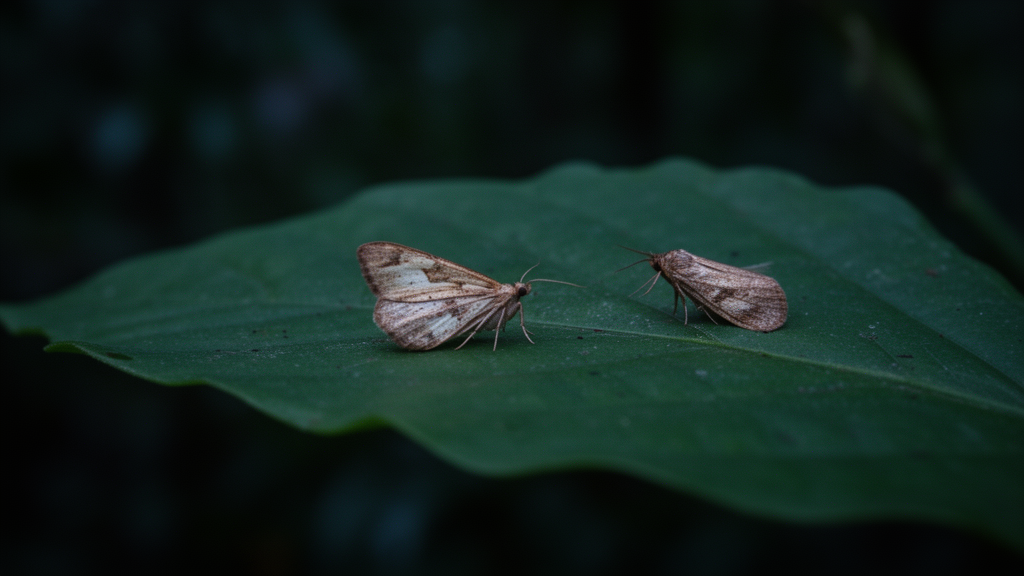
Deep in the montane forests of southern China, some of the smallest moths on Earth have been quietly evading science. Now a team of Chinese lepidopterists has formally brought two of them into the light: a brand-new species of the miniature moth genus Araeopteron, named Araeopteron zheganensis, and a new subspecies, Araeopteron nigrizonatum chinensis, recorded from four provinces across the country’s subtropical south. The discovery, published in the open-access Biodiversity Data Journal, offers a rare and detailed look at a lineage so small and so cryptic that even seasoned field biologists can walk past it without ever knowing it exists.
The genus Araeopteron was established in 1893 by the British entomologist George Hampson, with Araeopteron pictale from Sri Lanka as its type species. Since then, its taxonomic placement has shifted repeatedly as the classification of the vast superfamily Noctuoidea was reorganised. Early researchers proposed several synonymous genera — Araeopterum, Essonistis, Thelxinoa and Araeoptera — all of which were eventually folded back into Araeopteron. Only with the rise of modern phylogenetics did the group find its current home: the tribe Araeopteronini within the subfamily Boletobiinae of the family Erebidae.
What makes these moths so remarkable is their size. With wingspans of just 11 to 13 millimetres, they rank among the smallest members of the entire Noctuoidea lineage. Their fore-wings are slender and elongate, while the hind-wings are much shorter and triangular, with a concave outer margin below the apex. A distinctive black reniform spot on the fore-wing, combined with highly specialised male and female genital structures, provides a stable set of morphological signatures that taxonomists use to recognise the genus. More than 70 species are currently known, distributed mainly across tropical and subtropical regions of the world, and China has so far recorded 13 of them.
Yet even that number is almost certainly an underestimate. The new study, led by researchers at Northeast Forestry University in Harbin, suggests that the actual species richness of Araeopteron remains poorly explored in many regions, and that continued fieldwork will keep revealing previously undescribed taxa. The two new Chinese additions described in this paper — one entirely new to science and one a geographic subspecies of a moth previously known only from Japan — reinforce that point emphatically.
The fieldwork behind the discovery relied on a deceptively simple technique: light trapping. Using a 220-volt, 450-watt high-pressure mercury lamp, the researchers attracted adult moths from the forests of Zhejiang, Jiangxi, Yunnan, Fujian and Chongqing. Both new taxa show pronounced phototactic behaviour, with adults active mainly during July and August for the new species and from July to September for the new subspecies. This summer-to-early-autumn activity window suggests that these moths time their adult emergence to coincide with the warmest and most humid months of the year in southern China’s montane forests.
Once the specimens were back in the laboratory, the real taxonomic detective work began. Following standard Lepidoptera preparation procedures, the researchers spread and set the wings, then dissected the genitalia using conventional techniques. Abdomens were macerated in a 15 percent potassium hydroxide solution to soften the tissues, after which the genital structures were separated and the vesica of the aedeagus was everted. The dissected parts were dehydrated through a graded ethanol series, stained with eosin, cleared in xylene and mounted on permanent slides using neutral balsam. Adult habitus photographs were taken with a Nikon Z8 camera, while genitalia images were captured with an AO-HK830-0318 microscope. All images were stacked using Helicon Focus software and optimised in Adobe Photoshop 2025, producing the crisp comparative illustrations that underpin the paper’s diagnoses.
The new species, Araeopteron zheganensis, was collected from Laofoyan Village in Jiangshan County, Zhejiang Province, and from Liujiaping Village in Jinggangshan, Jiangxi Province. Its specific epithet combines the conventional abbreviations of the two provinces — Zhe and Gan — honouring the provenance of the type specimens. The male holotype and paratype are deposited in the Insect Collection of Northeast Forestry University. The species is immediately recognisable by the black-and-white longitudinal stripes running along the costal margin of the fore-wing from the base to the distal half, a feature absent in its closest relative, A. simaoensis, described just this year from Yunnan. The reniform stigma is pale yellowish-brown rather than black, and the male genitalia differ distinctly: the uncus is short and slightly curved rather than long and strongly curved, the costal process is subquadrate rather than semicircular, and the cornuti are formed as long, tufted setae rather than indistinct granular projections.
The second new taxon, Araeopteron nigrizonatum chinensis, is a subspecies of a moth whose nominate form is restricted to Japan. The Chinese population was recorded from Gutianshan National Nature Reserve in Quzhou, Zhejiang Province, and from the Mt. Simian area in Jiangjin, Chongqing, with additional records from Yunnan and Fujian. While the adults look superficially similar to the Japanese nominate subspecies, the male and female genitalia reveal marked differences. In the new subspecies, the cucullus is gently arcuate and evenly curved rather than strongly curved, the sacculus process has an anterior ridge connected to the concavity rather than unconnected, and the sacculus concavity narrows strongly from the outer to the inner side rather than gradually towards the base. In the female genitalia, the ductus bursae is straight and slightly sclerotised rather than constricted with prismatic longitudinal ridges, and the signum is narrowly brush-shaped with fewer branches rather than badminton-shuttlecock-shaped and broader.
These differences are more than academic. Subspecies designations in Lepidoptera often signal populations on independent evolutionary trajectories, shaped by geographic isolation across the mountainous landscapes of southern China. The fact that the nominate subspecies of A. nigrizonatum is confined to Japan while the Chinese population occupies a distinct range across four provinces suggests a long history of separation, potentially driven by the complex topography and climatic gradients of East Asia. As molecular phylogenetics continues to refine the classification of Noctuoidea, such morphologically distinct populations may eventually warrant full species status in their own right.
For now, both new taxa remain known only from adult specimens, and their host plants and broader ecological characteristics are entirely unknown. The female of A. zheganensis has not yet been found, leaving a conspicuous gap in the species’ description. But the study’s authors are clear about the bigger picture: the diversity of Araeopteron remains insufficiently explored, and its actual species richness is likely underestimated across much of Asia. As light trapping and modern imaging techniques continue to open windows into the world of these miniature moths, more hidden species are almost certainly waiting to be discovered in the forests of southern China and beyond.
Subject of Research: Taxonomy and biodiversity of miniature moth genus Araeopteron in southern China
Article Title: Description of a new species of the genus Araeopteron Hampson, 1893 ( Erebidae , Boletobiinae ) from China, with a new subspecies of A. nigrizonatum Hirano, 2021
Article References: Yao, C.-H., Li, C.-D., & Han, H.-L. (2026). Description of a new species of the genus Araeopteron Hampson, 1893 (Erebidae, Boletobiinae) from China, with a new subspecies of A. nigrizonatum Hirano, 2021. Biodiversity Data Journal, 14, Article e200131. https://doi.org/10.3897/bdj.14.e200131
Image Credits: AI Generated
Keywords: Araeopteron, Erebidae, Boletobiinae, new species, China, Lepidoptera, taxonomy, biodiversity, light trapping, genitalia morphology, Description, species
News Source: Drew Townsend. (October 19, 2026). Two New Araeopteron Moths Described from Southern China Expand a Tiny, Hidden Lineage. Scienmag.