

• HOME
  • NEWS
  • EXPLORE
    • CAREER
      • Companies
      • Jobs
    • EVENTS
    • iGEM
      • News
      • Team
    • PHOTOS
    • VIDEO
    • WIKI
  • BLOG
  • COMMUNITY
    • FACEBOOK
    • INSTAGRAM
    • TWITTER
Thursday, June 25, 2026
BIOENGINEER.ORG
No Result
View All Result
  • Login
  • HOME
  • NEWS
  • EXPLORE
    • CAREER
      • Companies
      • Jobs
        • Lecturer
        • PhD Studentship
        • Postdoc
        • Research Assistant
    • EVENTS
    • iGEM
      • News
      • Team
    • PHOTOS
    • VIDEO
    • WIKI
  • BLOG
  • COMMUNITY
    • FACEBOOK
    • INSTAGRAM
    • TWITTER
  • HOME
  • NEWS
  • EXPLORE
    • CAREER
      • Companies
      • Jobs
        • Lecturer
        • PhD Studentship
        • Postdoc
        • Research Assistant
    • EVENTS
    • iGEM
      • News
      • Team
    • PHOTOS
    • VIDEO
    • WIKI
  • BLOG
  • COMMUNITY
    • FACEBOOK
    • INSTAGRAM
    • TWITTER
No Result
View All Result
Bioengineer.org
No Result
View All Result
Home NEWS Science News Biology

NSF grant to help Zhang lab build better muscle with synthetic biology

Bioengineer by Bioengineer
July 29, 2022
in Biology
Reading Time: 2 mins read
0
Titin polymer
Share on FacebookShare on TwitterShare on LinkedinShare on RedditShare on Telegram

Fuzhong Zhang, professor of energy, environmental and chemical engineering at the McKelvey School of Engineering, has developed a synthetic biology platform to produce muscle fibers that are strong, tough and can absorb energy in ways very similar to the real thing. His research team went on to explore genetic changes that may lead to improved material performance.
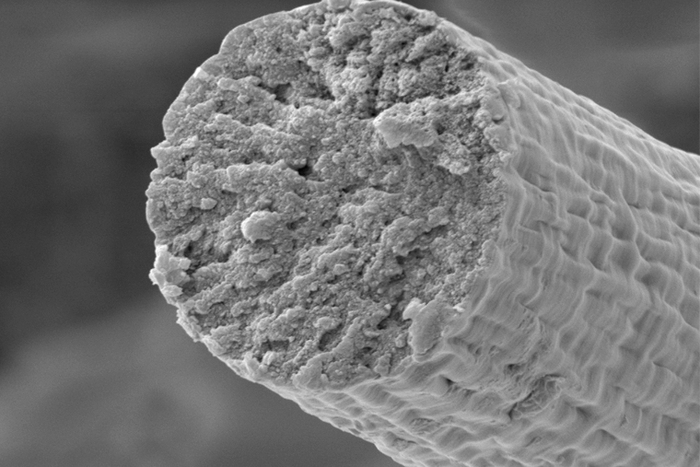
Titin polymer

Credit: Fuzhong Zhang/Wustl

Fuzhong Zhang, professor of energy, environmental and chemical engineering at the McKelvey School of Engineering, has developed a synthetic biology platform to produce muscle fibers that are strong, tough and can absorb energy in ways very similar to the real thing. His research team went on to explore genetic changes that may lead to improved material performance.

Why stop there?

The National Science Foundation (NSF) has awarded Washington University in St. Louis’ Zhang lab a $458,490 grant to continue this line of research. His team can now take a closer look at the muscle protein titin to understand what genetic changes to titin are associated with particular material traits.

“We’d like to use our synthetic biology platform as a tool to understand how synthetic muscle fiber works and make better materials,” Zhang said. His team also will use their tools to examine muscle fibers from long-extinct animals.

Zhang’s lab uses a synthetic biology approach to produce synthetic muscle fibers from genetically engineered bacteria. The group published their tool and properties of the first-generation synthetic muscle fibers last year in the journal Nature Communications. They now plan to use their system to fine-tune titin’s protein sequence, then to understand how those sequence changes affect the properties of muscle fibers. 

“We will make fibers with defined protein sequences and examine how strong and how tough they are. We’ll then be able to map the material properties to their sequences,” he said. “We can use that data to create muscle fibers with particular properties by searching for new titin proteins,” he said, which includes those from from long-extinct animal species.


Share12Tweet8Share2ShareShareShare2

Related Posts

Decoding the Secret Code of a Crucial Immune Sensor

June 24, 2026

Decades of Data Reveal Which Orcas Call Puget Sound Home

June 24, 2026

Copal Tree Genetics Reveal Tropical Forest Connectivity

June 24, 2026

How Intestinal Mucus Influences Klebsiella pneumoniae Colonization and Antibiotic Effectiveness

June 24, 2026

POPULAR NEWS

  • Saying Goodbye to PGY-6: Pediatric Fellowship Realities

    103 shares
    Share 41 Tweet 26
  • Multi-Hospital Study Reveals Long Covid Burden Is Twice as High as Current Estimates

    92 shares
    Share 36 Tweet 23
  • Detection of EDCs in Breast Milk and Infant Urine Up to Six Months Highlights Early Exposure Risks

    77 shares
    Share 31 Tweet 19
  • New Drug Candidate Developed at McMaster Shows Potential for Treating Brain Cancer

    58 shares
    Share 23 Tweet 15

About

We bring you the latest biotechnology news from best research centers and universities around the world. Check our website.

Follow us

Recent News

Asian Working Group Revises Sarcopenia Criteria 2019-2025

AI-Powered Platform Advances Structure-Based Drug Discovery

BALatrine Reduces Helminth Infections: Central Java Trial

Subscribe to Blog via Email

Enter your email address to subscribe to this blog and receive notifications of new posts by email.

Join 82 other subscribers
  • Contact Us

Bioengineer.org © Copyright 2023 All Rights Reserved.

Welcome Back!

Login to your account below

Forgotten Password?

Retrieve your password

Please enter your username or email address to reset your password.

Log In
No Result
View All Result
  • Homepages
    • Home Page 1
    • Home Page 2
  • News
  • National
  • Business
  • Health
  • Lifestyle
  • Science

Bioengineer.org © Copyright 2023 All Rights Reserved.