• HOME
  • NEWS
  • EXPLORE
    • CAREER
      • Companies
      • Jobs
    • EVENTS
    • iGEM
      • News
      • Team
    • PHOTOS
    • VIDEO
    • WIKI
  • BLOG
  • COMMUNITY
    • FACEBOOK
    • INSTAGRAM
    • TWITTER
Sunday, May 10, 2026
BIOENGINEER.ORG
No Result
View All Result
  • Login
  • HOME
  • NEWS
  • EXPLORE
    • CAREER
      • Companies
      • Jobs
        • Lecturer
        • PhD Studentship
        • Postdoc
        • Research Assistant
    • EVENTS
    • iGEM
      • News
      • Team
    • PHOTOS
    • VIDEO
    • WIKI
  • BLOG
  • COMMUNITY
    • FACEBOOK
    • INSTAGRAM
    • TWITTER
  • HOME
  • NEWS
  • EXPLORE
    • CAREER
      • Companies
      • Jobs
        • Lecturer
        • PhD Studentship
        • Postdoc
        • Research Assistant
    • EVENTS
    • iGEM
      • News
      • Team
    • PHOTOS
    • VIDEO
    • WIKI
  • BLOG
  • COMMUNITY
    • FACEBOOK
    • INSTAGRAM
    • TWITTER
No Result
View All Result
Bioengineer.org
No Result
View All Result
Home NEWS Science News Chemistry

NRL launches space weather instrument on NASA satellite

Bioengineer by Bioengineer
October 11, 2019
in Chemistry
Reading Time: 2 mins read
0
IMAGE
Share on FacebookShare on TwitterShare on LinkedinShare on RedditShare on Telegram

IMAGE

Credit: NASA


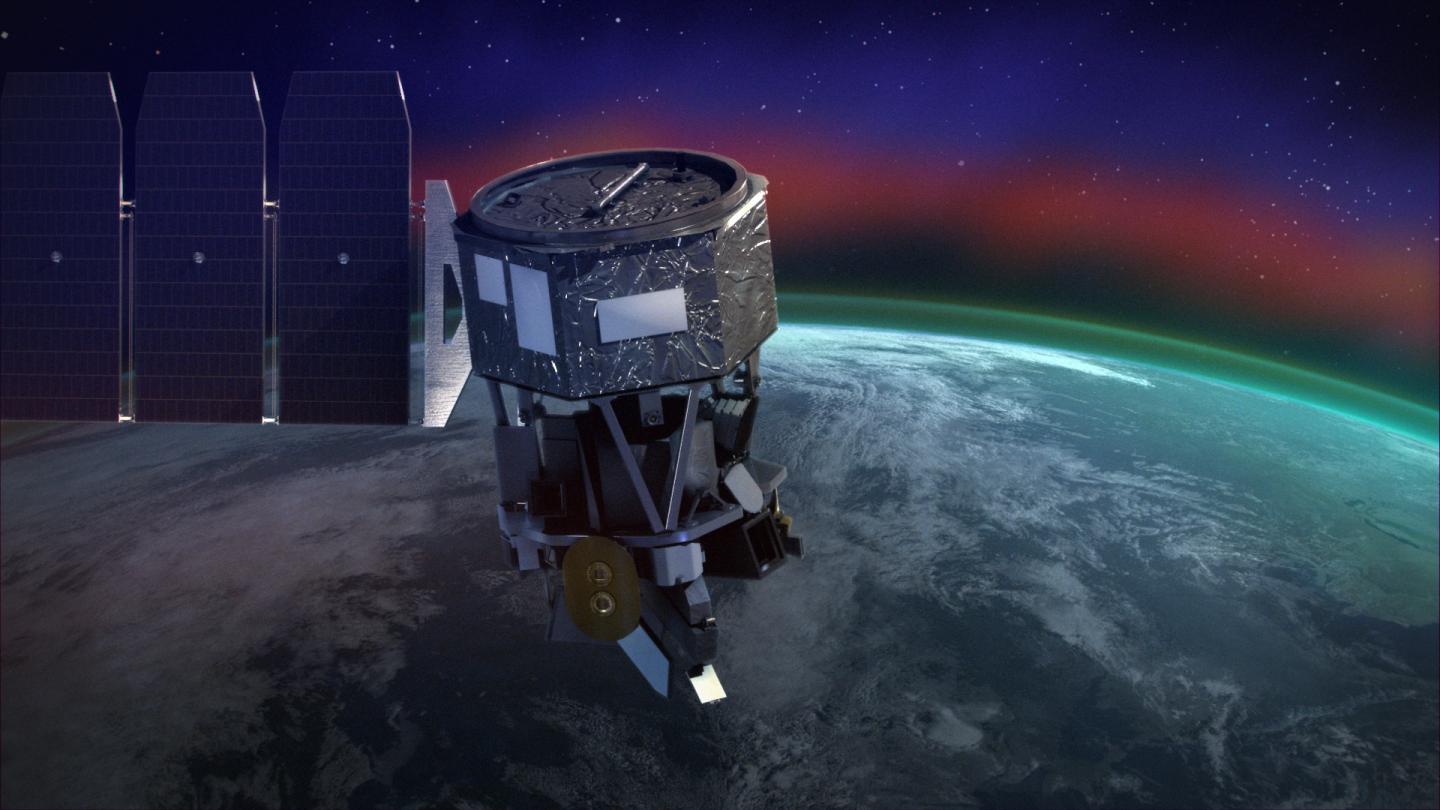
WASHINGTON — A U.S. Naval Research Laboratory (NRL) instrument aboard NASA’s Ionospheric Connection Explorer (ICON) satellite will deliver unprecedented information to help scientists investigate how both terrestrial and solar weather impact the ionosphere, the ionized region of Earth’s upper atmosphere. ICON launched from Cape Canaveral, Florida, Oct. 10.

NRL’s MIGHTI (Michelson Interferometer for Global High-Resolution Thermospheric Imaging) will measure wind and temperature profiles and contribute to a critical data set for scientists as they study how energy and dynamics from the lower atmosphere propagate into the space environment.

From its large day-to-day variability to extreme conditions during solar-driven magnetic storms, the ionosphere governs how radio waves propagate and can lead to severe disruptions of radio communications and GPS signals for both the public and the military. Radio signals travel through the ionosphere, or they reflect off the ionosphere to make them reach past Earth’s horizon for the purposes of communication and long-range radar.

“The ionosphere is where Earth ends or where space begins, and we haven’t studied it nearly enough to fully understand how it works and to make reliable predictions,” said Christoph Englert, lead investigator for MIGHTI.

The ionosphere, which overlaps the atmosphere’s mesosphere, thermosphere and exosphere layers, remains somewhat of a mystery to scientists. This border separating Earth from space lies between 30 and 600 miles above the Earth’s surface and is too high for science balloons to reach, and large parts of the region are too low for traditional satellites to fly in.

That’s why NASA wants to explore it from the inside with the ICON satellite, traveling within the ionosphere at an orbit about 350 miles above the Earth’s surface. As one of four scientific instruments aboard the ICON satellite, MIGHTI’s observations will give scientists a better understanding of how weather from the Earth and Sun affect the motion and structure of the neutral and ionized upper atmosphere.

In the years prior to this mission, NRL developed two instruments using similar optical techniques, one for the STS-112 space shuttle mission in 2002 and the other, the SHIMMER instrument, for STPSat-1, launched in 2007. These instruments studied atmospheric chemistry below 60 miles.

MIGHTI is a project developed by NRL in Washington, D.C. and the St. Cloud State University in St. Cloud, Minnesota. The broader collaboration within NRL leveraged the expertise of researchers across multiple Divisions, including Space Science, Spacecraft Engineering, Remote Sensing, Plasma Physics, and Marine Meteorology.

About the U.S. Naval Research Laboratory

The U.S. Naval Research Laboratory is a scientific and engineering command dedicated to research that drives innovative advances for the Navy and Marine Corps from the seafloor to space and in the information domain. NRL is located in Washington, D.C., with major field sites in Stennis Space Center, Mississippi, Key West, Florida, and Monterey, California, and employs approximately 2,500 civilian scientists, engineers and support personnel.

###

Media Contact
Mary Estacion
[email protected]
202-404-6422

Original Source

https://www.nrl.navy.mil/news/releases/nrl-launches-space-weather-instrument-nasa-satellite

Tags: AstrophysicsExperiments in SpaceSatellite Missions/ShuttlesSpace/Planetary ScienceStars/The Sun
Share14Tweet9Share2ShareShareShare2

Related Posts

Miniature Sensor Uses Light to Detect Touch — Chemistry

Miniature Sensor Uses Light to Detect Touch

May 8, 2026
Iron Minerals Determine Whether Dissolved Organic Matter Fuels Microbes or Becomes Long-Term Carbon Storage — Chemistry

Iron Minerals Determine Whether Dissolved Organic Matter Fuels Microbes or Becomes Long-Term Carbon Storage

May 8, 2026

Kate Evans Appointed Associate Lab Director for Biological and Environmental Systems Science at ORNL

May 8, 2026

Advancing Multiscale Modeling and Overcoming Operational Challenges in Autothermal COâ‚‚-to-Methanol Reactors

May 8, 2026
Please login to join discussion

POPULAR NEWS

  • Research Indicates Potential Connection Between Prenatal Medication Exposure and Elevated Autism Risk

    840 shares
    Share 336 Tweet 210
  • New Study Reveals Plants Can Detect the Sound of Rain

    727 shares
    Share 290 Tweet 181
  • Scientists Investigate Possible Connection Between COVID-19 and Increased Lung Cancer Risk

    68 shares
    Share 27 Tweet 17
  • Salmonella Haem Blocks Macrophages, Boosts Infection

    61 shares
    Share 24 Tweet 15

About

We bring you the latest biotechnology news from best research centers and universities around the world. Check our website.

Follow us

Recent News

Evaluating Digoxin Use in Patients with Symptomatic Rheumatic Heart Disease

Evaluating the Effectiveness and Safety of Digitalis Glycosides in Treating Heart Failure

Urdu Fall Risk Questionnaire Adapted for Elderly

Subscribe to Blog via Email

Success! An email was just sent to confirm your subscription. Please find the email now and click 'Confirm' to start subscribing.

Join 82 other subscribers
  • Contact Us

Bioengineer.org © Copyright 2023 All Rights Reserved.

Welcome Back!

Login to your account below

Forgotten Password?

Retrieve your password

Please enter your username or email address to reset your password.

Log In
No Result
View All Result
  • Homepages
    • Home Page 1
    • Home Page 2
  • News
  • National
  • Business
  • Health
  • Lifestyle
  • Science

Bioengineer.org © Copyright 2023 All Rights Reserved.