Spacecraft DAPPER will study “dark ages” of the universe in radio waves
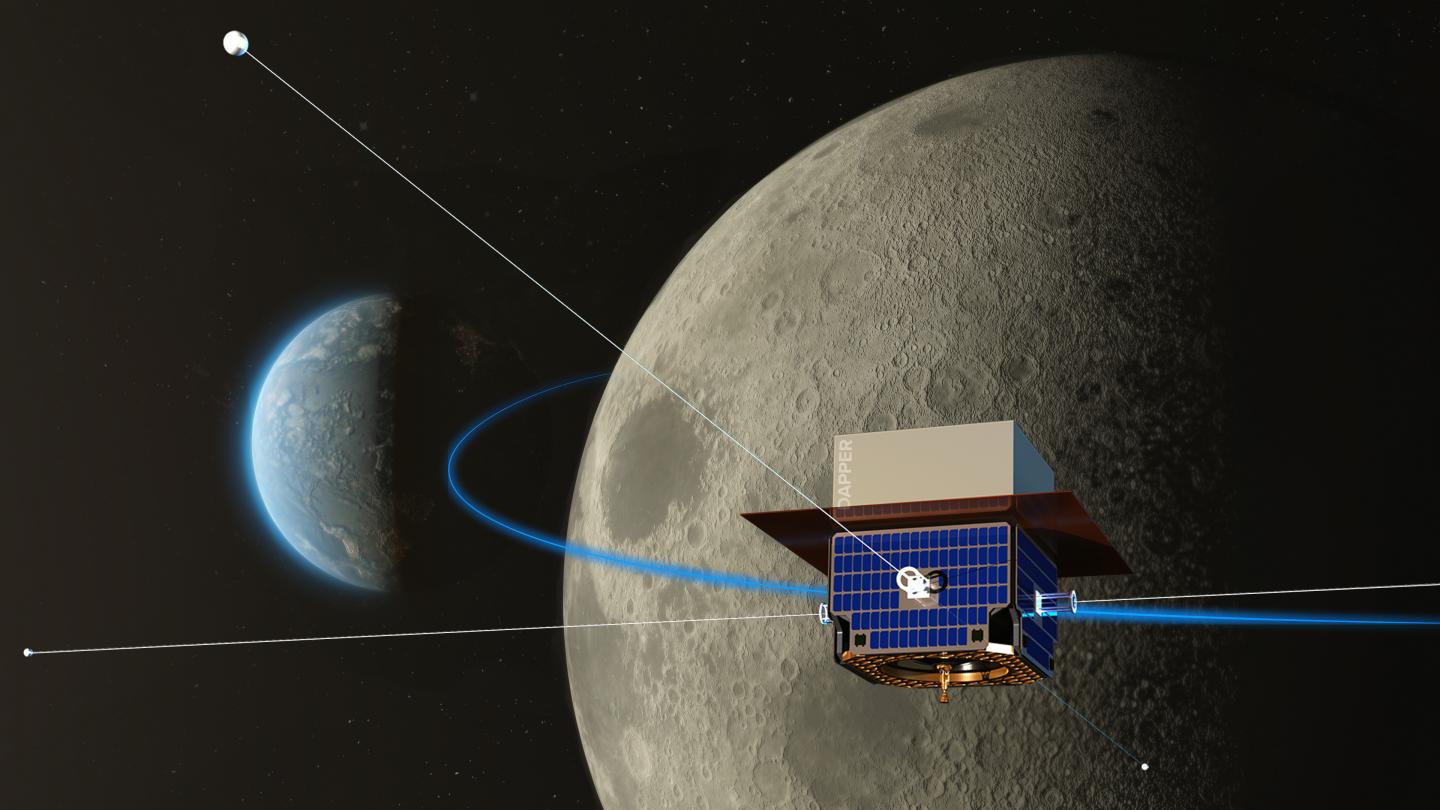
Credit: NRAO/AUI/NSF, Sophia Dagnello
The National Radio Astronomy Observatory (NRAO) has joined a new NASA space mission to the far side of the Moon to investigate when the first stars began to form in the early universe.
The universe was dark and foggy during its “dark ages,” just 380 thousand years after the Big Bang. There were no light-producing structures yet like stars and galaxies, only large clouds of hydrogen gas. As the universe expanded and started to cool down, gravity drove the formation of the stars and black holes, which ended the dark ages and initiated the “cosmic dawn,” tens of millions of years later.
To learn more about that dark period of the cosmos and understand how and when the first stars began to form, astronomers are trying to catch energy produced by these hydrogen clouds in the form of radio waves, via the so-called 21-centimeter line.
But picking up signals from the early universe is extremely challenging. They are mostly blocked by the Earth’s atmosphere, or drowned out by human-generated radio transmissions. That’s why a team of scientists and engineers have decided to send a small spacecraft to lunar orbit and measure this signal while traversing the far side of the Moon, which is radio-quiet.
The spacecraft, called the Dark Ages Polarimetry Pathfinder (DAPPER), will be designed to look for faint radio signals from the early universe while operating in a low lunar orbit. Its specialized radio receiver and high-frequency antenna are currently being developed by a team at the NRAO’s Central Development Laboratory (CDL) in Charlottesville, Virginia, led by senior research engineer Richard Bradley.
“No radio telescope on Earth is currently able to definitively measure and confirm the very faint neutral hydrogen signal from the early universe, because there are so many other signals that are much brighter,” said Bradley. “At CDL we are developing specialized techniques that enhance the measurement process used by DAPPER to help us separate the faint signal from all the noise.” This project builds upon the work of Marian Pospieszalski who developed flight-ready low noise amplifiers at the CDL in the 1990s for the highly-successful Wilkinson Microwave Anisotropy Probe (WMAP), a spacecraft that gave the most precise figure yet for the age of the universe.
DAPPER will be part of the NASA Artemis program with the goal of landing “the first woman and the next man” on the Moon by 2024. It will likely be launched from the vicinity of the Lunar Gateway, the planned space station in lunar orbit intended to serve as a communication hub and science laboratory. Because it is able to piggy-back off of the surging interest in sending humans to lunar soil, DAPPER will be much cheaper to build and more compact than a full-scale NASA mission.
NRAO will spend the coming two years designing and developing a prototype for the DAPPER receiver, after which it will go to the Space Sciences Laboratory at UC Berkeley for space environmental testing.
“NRAO is very pleased to be working on this important initiative,” said Tony Beasley, director of the NRAO and Associated Universities Inc. vice president for Radio Astronomy Operations. “DAPPER’s contributions to the success of NASA’s ARTEMIS mission will build on the rapid growth of space-based radio astronomy research we’ve seen over the past decade. As the leading radio astronomy organization in the world, NRAO always looks for new horizons, and DAPPER is the start of an exciting field.”
DAPPER is a collaboration between the universities of Colorado-Boulder and California-Berkeley, the National Radio Astronomy Observatory, Bradford Space Inc., and the NASA Ames Research Center. Jack Burns of the University of Colorado Boulder is Principal Investigator and Science Team Chair. Project website for DAPPER: https:/
The National Radio Astronomy Observatory is a facility of the National Science Foundation, operated under cooperative agreement by Associated Universities, Inc.
###
Media Contact
Iris Nijman
[email protected]
Original Source
https:/