Zebrafish in the pet trade are asymptomatic carriers of previously undescribed microbes, including a novel virus that causes hemorrhaging in infected laboratory fish, Marlen Rice from the University of Utah, US, and colleagues report in the open-access journal PLOS Biology, publishing May 23rd.
Credit: Keir Balla (CC-BY 4.0, https://creativecommons.org/licenses/by/4.0/)
Zebrafish in the pet trade are asymptomatic carriers of previously undescribed microbes, including a novel virus that causes hemorrhaging in infected laboratory fish, Marlen Rice from the University of Utah, US, and colleagues report in the open-access journal PLOS Biology, publishing May 23rd.
Zebrafish (Danio rerio) are a common laboratory research animal, and they are also widely available as pets. In research laboratories, they are kept in specialized aquaculture facilities to prevent infectious disease, but zebrafish are occasionally imported from the pet trade into laboratory colonies.
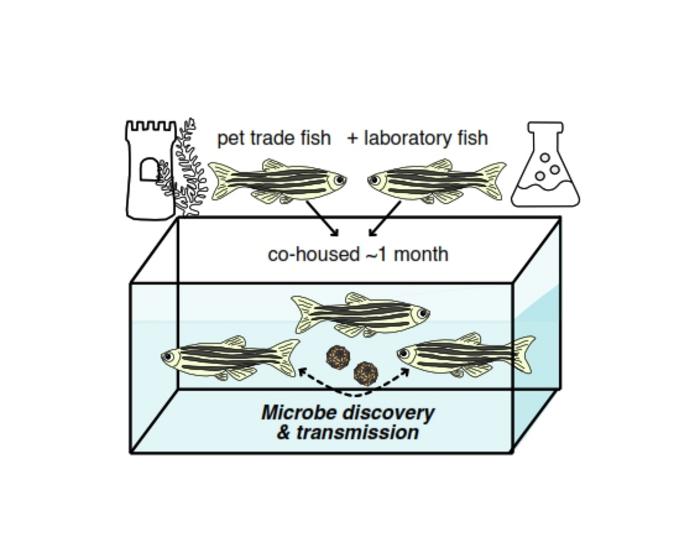
Researchers used metatranscriptomic sequencing of zebrafish from a laboratory population and three pet shops in Salt Lake valley to compare the microbes associated with fish reared in different environments. They identified many microbes in pet trade fish that were not present in laboratory populations, including a novel virus in the Birnaviridae family, which the authors named Rocky Mountain birnavirus (RMBV). To investigate RMBV transmission between fish from different populations, they housed laboratory-reared zebrafish in the same tank as pet trade zebrafish. After around a month, three of the laboratory fish had developed hemorrhaging and tested positive for RMBV. In contrast, RMBV-infected fish from the pet trade showed no symptoms of disease. Transcriptome sequencing of tissues from the fish showed that RMBV infection increased expression of genes involved in the anti-viral immune response and inflammation.
This study shows that the pet trade is a source of viruses and parasites that are not commonly found in laboratory zebrafish. Viruses circulating in apparently healthy zebrafish from the pet trade can transmit to laboratory zebrafish and cause severe disease. Differences in life history, genetics or infection stage may explain why RMBV caused symptoms in laboratory but not pet trade fish. Further sampling of zebrafish in the pet trade is likely to reveal many more novel microbes, the authors say.
The authors add, “Zebrafish are popular research organisms in the laboratory that were originally sourced from the pet trade. We found that the microbes associated with pet trade animals include previously undescribed viruses and other pathogens that can transmit to laboratory animals and potentially be used for investigations of infections with relevance to human health and aquaculture.”
#####
In your coverage, please use this URL to provide access to the freely available paper in PLOS Biology: http://journals.plos.org/plosbiology/article?id=10.1371/journal.pbio.3002606
Citation: Rice MC, Janik AJ, Elde NC, Gagnon JA, Balla KM (2024) Microbe transmission from pet shop to lab-reared zebrafish reveals a pathogenic birnavirus. PLoS Biol 22(5): e3002606. https://doi.org/10.1371/journal.pbio.3002606
Author Countries: United States
Funding: This work was supported by grants awarded by the National Institutes of Health to K.M.B. (5T32AI055434), N.C.E. (R35GM134936), and to J.A.G. (R35GM142950), and by a grant from the Chan Zuckerberg Initiative to N.C.E. and J.A.G. (DAF2020-218441). The funders played no role in the study design, data collection and analysis, decision to publish, or preparation of the manuscript.
Journal
PLoS Biology
DOI
10.1371/journal.pbio.3002606
Method of Research
Experimental study
Subject of Research
Animals
COI Statement
Competing interests: The authors have declared that no competing interests exist.