

• HOME
  • NEWS
  • EXPLORE
    • CAREER
      • Companies
      • Jobs
    • EVENTS
    • iGEM
      • News
      • Team
    • PHOTOS
    • VIDEO
    • WIKI
  • BLOG
  • COMMUNITY
    • FACEBOOK
    • INSTAGRAM
    • TWITTER
Saturday, June 27, 2026
BIOENGINEER.ORG
No Result
View All Result
  • Login
  • HOME
  • NEWS
  • EXPLORE
    • CAREER
      • Companies
      • Jobs
        • Lecturer
        • PhD Studentship
        • Postdoc
        • Research Assistant
    • EVENTS
    • iGEM
      • News
      • Team
    • PHOTOS
    • VIDEO
    • WIKI
  • BLOG
  • COMMUNITY
    • FACEBOOK
    • INSTAGRAM
    • TWITTER
  • HOME
  • NEWS
  • EXPLORE
    • CAREER
      • Companies
      • Jobs
        • Lecturer
        • PhD Studentship
        • Postdoc
        • Research Assistant
    • EVENTS
    • iGEM
      • News
      • Team
    • PHOTOS
    • VIDEO
    • WIKI
  • BLOG
  • COMMUNITY
    • FACEBOOK
    • INSTAGRAM
    • TWITTER
No Result
View All Result
Bioengineer.org
No Result
View All Result
Home NEWS Science News

Novel noncovalent bond blocks repulsive odor of isocyanides

Bioengineer by Bioengineer
June 11, 2020
in Science News
Reading Time: 2 mins read
0
IMAGE
Share on FacebookShare on TwitterShare on LinkedinShare on RedditShare on Telegram

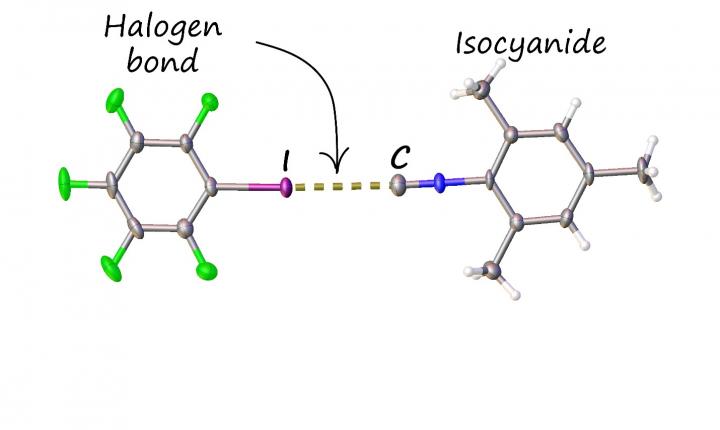
Novel noncovalent bond blocks repulsive odor of isocyanides, key reagents in organic synthesis
IMAGE

Credit: SPbU

The suggested approach makes storage of these substances safer and more convenient while preserving key chemical properties that make isocyanides essential in many synthetic applications, such as the production of pharmaceuticals and functional materials.

Isocyanides are an important class of organic compounds owing to a wide range of chemical transformations they can undergo. These molecules are employed for the synthesis of various pharmaceuticals, polymers, catalysts, and luminophores. Widespread use of isocyanides in chemistry and chemical industry is, however, hampered by their extremely foul odor, described by some researchers as “mind-boggling”, “horrid” and even “murderous”. Luca Turin, one of the leading experts in fragrance chemistry, called isocyanides “the Godzilla of scent”. This odor is so terrible that the United States patented the use of isocyanides (generally low on the toxicity scale) as a non-lethal chemical weapon.

While studying isocyanides, chemists from St. Petersburg State University discovered the ability of these compounds to form adducts with certain iodine-containing organic compounds. The components of the adducts are connected noncovalently by so-called halogen bonds. The latter by their nature resemble hydrogen bonds, which connect the two strands of the DNA double helix.

‘The formation of a halogen bond with a carbon atom is in itself an unexpected discovery’, said Alexander Mikherdov, the first author of the paper, an Assistant Professor of the Institute of Chemistry at St. Petersburg State University. ‘Most importantly though, the formation of this bond led to a substantial reduction of the extremely unpleasant odor of isocyanides in their adducts. Quantitative GC-MS studies indicate up to an almost 50-fold decrease in the air concentration of isocyanide, and thus a dramatic mitigation of odor. In practice, this means that isocyanides, in the form of their adducts, no longer require a ventilated fume hood or any special precautions to work with, instead becoming benchtop reagents. It makes the chemist’s job a lot easier!’

In the future, isocyanide adducts such as those described in the study may prove to be a more convenient alternative to the usual ‘odorous’ isocyanides, since they could be stored without special precautions. The adducts can still be used in chemical transformations leading to various important compounds and materials.

###

Media Contact
Daria Skorospelova
[email protected]

Related Journal Article

http://dx.doi.org/10.1038/s41467-020-16748-x

Tags: Chemistry/Physics/Materials SciencesIndustrial Engineering/ChemistryPharmaceutical/Combinatorial Chemistry
Share12Tweet8Share2ShareShareShare2

Related Posts

Tracking Lanthanide-Labeled Microplastics in Plants

June 25, 2026

POSTECH Researchers Slash Cost of Reconstituted Cell-Free Systems by 95%

June 25, 2026

AI and Physics Collaborate to Design Advanced Hydrogen Storage Materials

June 25, 2026

Natural Hallucinogens: Evolution’s Ecological Tools, Not Mere Chemical Byproducts

June 25, 2026
Please login to join discussion

POPULAR NEWS

  • Saying Goodbye to PGY-6: Pediatric Fellowship Realities

    103 shares
    Share 41 Tweet 26
  • Multi-Hospital Study Reveals Long Covid Burden Is Twice as High as Current Estimates

    92 shares
    Share 36 Tweet 23
  • Detection of EDCs in Breast Milk and Infant Urine Up to Six Months Highlights Early Exposure Risks

    77 shares
    Share 31 Tweet 19
  • New Drug Candidate Developed at McMaster Shows Potential for Treating Brain Cancer

    58 shares
    Share 23 Tweet 15

About

We bring you the latest biotechnology news from best research centers and universities around the world. Check our website.

Follow us

Recent News

Tracking Lanthanide-Labeled Microplastics in Plants

POSTECH Researchers Slash Cost of Reconstituted Cell-Free Systems by 95%

AI and Physics Collaborate to Design Advanced Hydrogen Storage Materials

Subscribe to Blog via Email

Success! An email was just sent to confirm your subscription. Please find the email now and click 'Confirm' to start subscribing.

Join 82 other subscribers
  • Contact Us

Bioengineer.org © Copyright 2023 All Rights Reserved.

Welcome Back!

Login to your account below

Forgotten Password?

Retrieve your password

Please enter your username or email address to reset your password.

Log In
No Result
View All Result
  • Homepages
    • Home Page 1
    • Home Page 2
  • News
  • National
  • Business
  • Health
  • Lifestyle
  • Science

Bioengineer.org © Copyright 2023 All Rights Reserved.

