Credit: IOCB Prague
An international research team headed by Michal Hocek of the Institute of Organic Chemistry and Biochemistry of the Czech Academy of Sciences (IOCB Prague) and Charles University and Ciara K. O’Sullivan of Universitat Rovira i Virgili (URV) in Spain have developed a novel method for labeling DNA, which in the future can be used for sequencing DNA by means of electrochemical detection. The researchers presented their results in the Journal of the American Chemical Society.
A DNA molecule comprises four basic building blocks, nucleotides. The genetic information carried within the molecule is determined by the order of the nucleotides. Knowledge of the order of these building blocks, which is known as the DNA sequence, is necessary for disease diagnostics and forensic DNA analysis, for example. Despite the great progress in recent years, the current DNA sequencing methods, typically based on fluorescent labelling, are still time-consuming and relatively expensive techniques, which have some limitations. Therefore, scientists are intensively searching for new approaches to simplify and accelerate sequencing.
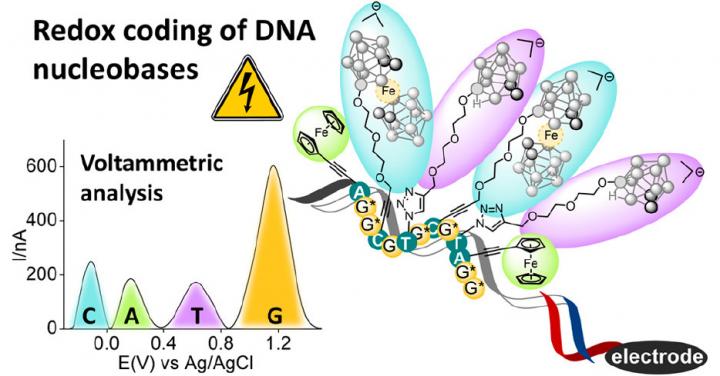
One promising approach is the use of electrochemical detection and so-called redox labels, which are compounds that can be oxidized or reduced on electrodes. A multidisciplinary team of researchers from IOCB Prague, URV, the Faculty of Science of Charles University, the Polish Academy of Sciences, and the Institute of Biophysics of the Czech Academy of Sciences, with students David Kodr and Cansu Pinar Yenice as first authors, has now succeeded in designing and synthesizing artificial nucleotides with special attached redox labels that can be oxidized on a gold or carbon electrode at a specific potential to produce a measurable and analytically useful signal. These labels are carboranes, cage structures composed of boron and carbon atoms, into which other metal atoms can be incorporated, such as iron or cobalt, affecting their resulting electrochemical properties.
The modified nucleotides have been engineered so that the enzyme DNA polymerase, which uses available nucleotide building blocks to build DNA within a cell, can incorporate them into a newly synthesized DNA strand. Thus, the researchers have succeeded in preparing a strand of DNA comprising modified nucleotides. At the same time, each of the four types of nucleotide carries its own unique label allowing for its subsequent identification. And therein lay the primary pitfall of the project; until now, researchers had always only managed to label and measure one, at most two, types of redox-labelled nucleotides in a single strand of DNA.
Because each of the modified nucleotides carries its own label, which during electrochemical detection gives a specific oxidation signal at varying potentials, the individual types of nucleotides can be distinguished. Moreover, the size of each signal is dependent on the number of copies of the given nucleotide in the DNA, which then makes it possible to quickly determine the relative representation of individual nucleotides in the measured DNA.
The newly developed electrochemical coding of DNA bases offers a range of advantages, such as simpler and more affordable instrumentation and faster analysis. The method holds promise for DNA sequencing and diagnostic applications as well as for development of new DNA chips.
###
The original article: Kodr, D.; Yenice, C. P.; Simonova, A.; Safti?, D. P.; Pohl, R.; Sýkorová, V.; Ortiz, M.; Havran, L.; Fojta, M.; Lesnikowski, Z. J.; O’Sullivan, C. K.; Hocek, M. Carborane- or Metallacarborane-Linked Nucleotides for Redox Labeling. Orthogonal Multipotential Coding of all Four DNA Bases for Electrochemical Analysis and Sequencing. Journal of the American Chemical Society 2021, 143, 7124-7134. https:/
Media Contact
Dusan Brinzanik
[email protected]
Original Source
https:/
Related Journal Article
http://dx.