Like the blood coursing through our veins, electrons in the heart of our microchips breathe life into our computers. In the race to accelerate and downsize our electronics, there is a growing demand for new techniques and materials to redefine our current technological approaches.
Credit: SUTD
Like the blood coursing through our veins, electrons in the heart of our microchips breathe life into our computers. In the race to accelerate and downsize our electronics, there is a growing demand for new techniques and materials to redefine our current technological approaches.
Associate Professor Yang Shengyuan and his team from the Singapore University of Technology and Design (SUTD) collaborated with Research Assistant Professor Cong Xiao from the University of Hong Kong to investigate a never-before-observed phenomenon in electron transport. The results of their investigation were recently published as ‘Intrinsic nonlinear planar Hall effect’ in Physical Review Letters.
“Transport properties of materials are fundamental to our understanding of materials and possible applications,” said Associate Professor Yang, who explained that the process of electron transport can be attributed to extrinsic and intrinsic contributions. While extrinsic mechanisms arise from structural and geometrical properties such as defects and impurities, intrinsic mechanisms arise purely from the characteristics of the material itself. “Intrinsic contribution is like the information on the identity card of each material,” he elaborated.
In the study, the team developed an extended theoretical framework and applied it under various conditions in different materials to search for materials with novel behaviour. They found that a range of particular crystal structures had the necessary symmetries needed to manifest a new phenomenon—the intrinsic nonlinear planar Hall effect (NPHE).
In conventional materials used in electronics, applying a voltage between two points causes electrons to flow between them. The flow increases linearly with voltage, which allows for the precise control needed in calculations and data storage. However, in the presence of a magnetic field, the transport of electrons across the material can behave in unusual ways. The effects of magnetic fields on electron transport are collectively known as Hall effects. They induce a current that do not necessarily travel in the direction of the applied voltage, which has led to the development of hypersensitive magnetic field sensors.
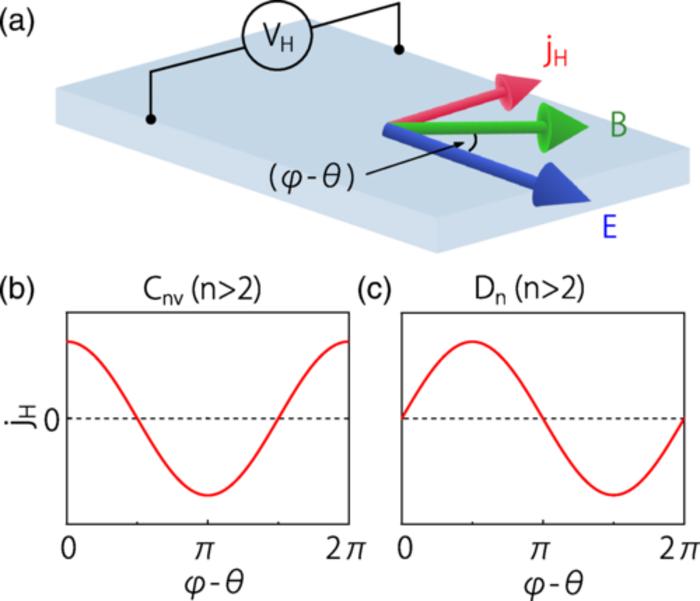
Previous research studied the planar Hall effect (PHE), where the magnetic field, applied electric voltage, and induced current all lie on the same plane. However, most of these phenomena are extrinsic and do not exploit the inherent properties of the material itself. Additionally, these effects typically have linear behaviours, where the induced current scales proportionally with the voltage applied. In order to subvert conventional electronics, nonlinear complex behaviours in materials are more highly sought after.
The intrinsic NPHE discovered by Associate Professor Yang’s team allows for a much wider range of possible crystals that would demonstrate nonlinear complex behaviours, unlike other PHEs, which only develop under a very tightly restricted subset of crystal structures.
As an added bonus, the team found that the size of the intrinsic NPHE changes depending on the directions of the applied magnetic field and electric voltage. This creates an additional knob of controllability in possible applications by a simple rotation. Optimistic in how the effect could be exploited in today’s devices, Associate Professor Yang suggested the process could lead to new designs in nonlinear rectifiers or terahertz detectors for long-range communications.
To demonstrate the veracity of their proposed mechanism, the team looked to well-known materials that exhibit the necessary symmetries required. The growing interest in two-dimensional (2D) materials for compact and efficient electronics served as an excellent starting point for their search. Consisting of crystalline monolayers of atoms stacked into a sandwich-like structure, these materials often have electronic properties that make them desirable for use in components like transistors.
First synthesised in 2017 and under active research since then, the 2D monolayer MoSSe was found to have the necessary crystal structure to demonstrate the proposed mechanism of Associate Professor Yang’s team. Starting their calculations ground-up from basic fundamentals, the team discovered that a significant intrinsic NPHE response could develop in the material under the right conditions.
Given the wider community’s current interest in investigating this material, the team is hopeful that their theory would soon be backed by experimental evidence. Meanwhile, Associate Professor Yang is already looking towards other novel transport phenomena.
“Our main goal is to understand the fundamental physics of materials and to know what effects can happen in nature,” he highlighted. “We will predict new effects, develop theories for them, and propose possible applications.”
Journal
Physical Review Letters
DOI
10.1103/PhysRevLett.130.126303
Article Title
Intrinsic Nonlinear Planar Hall Effect
Article Publication Date
23-Mar-2023