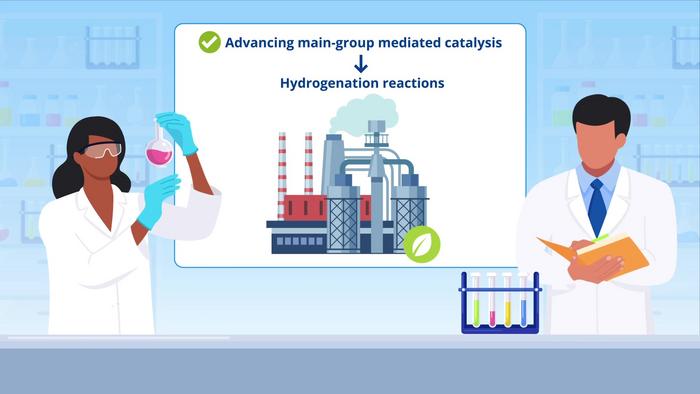
In a groundbreaking advancement in the field of catalysis, researchers have unveiled a sodium-doped, transition metal-free amorphous silicon-boron-nitride (SiBN) ceramic designed for hydrogen activation and catalysis. This innovative material emerges as a sustainable alternative to conventional metal-based catalysts, which have long been staples in industries ranging from petrochemicals to agriculture. By focusing on abundant elements such as silicon, boron, and nitrogen, the research provides a promising avenue toward a more sustainable and cost-effective approach to catalysis.
The significance of this study lies in its novel application of frustrated Lewis pair (FLP) chemistry, a concept that revolutionized small molecule activation since its introduction in the mid-2000s. An FLP consists of a Lewis acid and a Lewis base that cannot fully react due to spatial or electronic hindrances, thereby maintaining a highly reactive state. This unique characteristic permits FLPs to engage with stable molecules—such as hydrogen and carbon dioxide—that are typically resistant to activation. The researchers aimed to harness this chemistry to develop a catalyst that capitalizes on the dynamic interactions within the SiBN matrix.
Utilizing a polymer-derived ceramic (PDC) process, the research team successfully integrated sodium and boron into the silica scaffold, resulting in a sodium-doped SiBN ceramic that exhibits remarkable reactivity and selectivity. The polymer precursor used, a nitrogen-containing organosilicon polymer known as polysilazane, played a critical role in facilitating the formation of specific Lewis acid-base interactions. Upon thermal conversion, the resulting a-SiN scaffold enables precise control over pore sizes, creating nanoconfined reaction fields that significantly enhance the catalyst’s performance.
Key to the success of this work was the adaptation of molecular-based FLPs within a solid-state matrix. Unlike traditional defective heterogeneous FLPs, which struggle with reactivity and stability tuning, this new approach more easily adjusts reactivity by modifying the surrounding chemical environment. This pivotal structural feature facilitates efficient catalysis, especially under challenging conditions where traditional catalysts may falter.
The research team conducted extensive experiments to unveil how the sodium-doped SiBN interacts with hydrogen at a molecular level through advanced spectroscopic techniques. Their findings revealed a striking increase in reactivity among both the boron and nitrogen sites in the presence of hydrogen. Notably, hydrogen molecules induce significant transformations in the boron-nitrogen moiety, altering its coordination and creating frustrated Lewis acid (FLA) sites. This interaction leads to a complex pattern of reversible hydrogen adsorption and desorption, emphasizing the material’s potential as a catalyst for sustainable hydrogen-based processes.
Adding to the excitement, the study observed that the unique architecture of the sodium-doped SiBN ceramic grants it exceptional thermal stability—an essential trait for catalysts employed in demanding industrial settings. This high thermal resistance allows it to operate efficiently in vital chemical reactions, including hydrogenation processes, which are critical in various sectors, including energy and chemical manufacturing.
This endeavor also highlights the importance of international collaboration in scientific research. The study brought together an exceptional range of expertise, including contributions from Japan’s Nagoya Institute of Technology, France’s University of Limoges, and India’s Indian Institute of Technology Madras. Such collaborative initiatives are vital in fostering innovation and enabling cross-disciplinary explorations in cutting-edge fields like catalysis.
The research team’s findings have stirred considerable interest within the scientific community, as evidenced by its designation as a “Hot Paper” soon after publication and the growing anticipation around its implications for future research. The paper detailing these advancements is set to appear in a prominent scientific journal, underscoring the significance of their work in progressing the field of sustainable catalysis.
As industries worldwide seek greener and more efficient chemical processes, the research presents a concrete step toward reimagining catalytic systems that can operate effectively without relying on conventional metals. With its foundation in accessible materials and innovative methodologies, this study exemplifies how fundamental chemistry can address pressing industrial challenges while promoting sustainability in technology.
The future appears bright for the sodium-doped SiBN ceramic, as ongoing investigations continue to explore its full potential across various chemical processes. The interest that this work has ignited serves as a testament to science’s ability to innovate and adapt in the face of global challenges. As catalysis evolves, embracing novel concepts like frustrated Lewis pairs will remain crucial to advancing the field and providing solutions to complex problems.
In summary, the research conducted at Nagoya Institute of Technology offers a compelling glimpse into the next generation of catalytic materials. By breaking away from traditional metal-centric approaches and focusing on abundant elements, the team has set the stage for a transformative shift toward more sustainable and efficient industrial practices. Their findings not only contribute to the scientific understanding of catalysis but also pave the way for practical applications that could significantly impact the energy and chemical sectors.
Subject of Research: Heterogeneous catalysis using sodium-doped amorphous silicon-boron-nitride ceramics.
Article Title: Novel Lewis Acid-Base Interactions in Polymer-Derived Sodium-Doped Amorphous Si−B−N Ceramic: Towards Main-Group-Mediated Hydrogen Activation.
News Publication Date: November 11, 2024.
Web References: Angewandte Chemie International Edition.
References: The study was published in Volume 63, Issue 46 of Angewandte Chemie International Edition.
Image Credits: Professor Yuji Iwamoto from Nagoya Institute of Technology, Japan.
Keywords
Sustainable catalysis, sodium-doped SiBN ceramic, frustrated Lewis pairs, hydrogen activation, polymer-derived ceramics, industrial applications.
Tags: boron chemistryfrustrated Lewis pairsgreen chemistryhydrogen activationindustrial applicationsinternational research collaborationnanoconfined reaction fieldspolymer-derived ceramicssodium-doped SiBN ceramicsustainable catalysisthermal stabilitytransition metal-free catalysts