To paraphrase Mark Twain, reports of declining phytoplankton in the North Atlantic may have been greatly exaggerated. A prominent 2019 study used ice cores in Antarctica to suggest that marine productivity in the North Atlantic had declined by 10% during the industrial era, with worrying implications that the trend might continue.
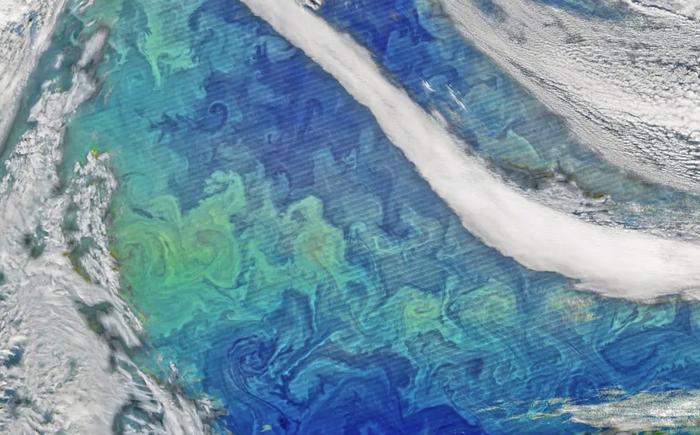
Credit: NASA
To paraphrase Mark Twain, reports of declining phytoplankton in the North Atlantic may have been greatly exaggerated. A prominent 2019 study used ice cores in Antarctica to suggest that marine productivity in the North Atlantic had declined by 10% during the industrial era, with worrying implications that the trend might continue.
But new research led by the University of Washington shows that marine phytoplankton — on which larger organisms throughout the marine ecosystem depend — may be more stable than believed in the North Atlantic. The team’s analysis of an ice core going back 800 years shows that a more complex atmospheric process may explain the recent trends.
The study was published the week of Nov. 13 in the Proceedings of the National Academy of Sciences.
Tiny floating photosynthetic organisms known as phytoplankton form the base of the marine ecosystem. These microscopic creatures are also important to the planet as a whole, producing roughly half the oxygen in Earth’s atmosphere.
Since phytoplankton are hard to count, scientists attempt to measure their abundance in other ways. Phytoplankton emit dimethyl sulfide, an odorous gas that gives beaches their distinctive smell. Once airborne, the dimethyl sulfide converts to methanesulfonic acid, or MSA, and sulfate. These eventually fall out onto land or snow, making ice cores one way to measure past population sizes.
“Greenland ice cores show a decline in MSA concentrations over the industrial era, which was concluded to be a sign of declining primary productivity in the North Atlantic,” said lead author Ursula Jongebloed, a UW doctoral student in atmospheric sciences. “But our study of sulfate in a Greenland ice core shows that MSA alone can’t tell us the whole story when it comes to primary productivity.”
Since the mid-1800s, factories and tailpipes have also been spewing sulfur-containing gases into the air. Those gases have slightly different forms of sulfur atoms that make it possible to distinguish the marine and land-based sources in ice cores.
The new study goes further back than the previous study by measuring several sulfur-containing molecules in an ice core from central Greenland with layers spanning the years 1200 to 2006. The authors show that human-generated pollutants changed the atmosphere’s chemistry. This, in turn, altered the fate of the gases emitted by phytoplankton.
“When looking at the ice cores, we found that sulfate derived from phytoplankton increased during the industrial era,” Jongebloed said. “In other words, the decline in MSA is ‘offset’ by the simultaneous increase in phytoplankton-derived sulfate, indicating that phytoplankton-derived sulfur emissions have remained stable overall.”
When that balance is included in the calculations, the phytoplankton populations seem fairly stable since the mid-1800s. The researchers caution, however, that marine ecosystems remain under threat from many directions.
“Measuring both MSA and phytoplankton-derived sulfate gives us a fuller picture of how the emissions from marine primary producers have changed — or not changed — over time,” said senior author Becky Alexander, a UW professor of atmospheric sciences.
“Ice core measurements along with other independent estimates of phytoplankton abundance (such as chlorophyll measurements) and paired with modeling studies (which help us estimate how atmospheric chemistry and climate change over time) can help us understand how marine productivity has changed in the past and how productivity might change in the future.”
Other co-authors are research scientist Andrew Schauer, doctoral student Shuting Zhai and former undergraduates Sara Salimi and Shana Edouard at the UW; Jihong Cole-Dai and Carleigh Larrick at South Dakota State University; William Porter and Linia Tashmim at the University of California, Riverside; and Lei Geng at the University of Science and Technology of China.
The study was funded by the National Science Foundation and the National Natural Science Foundation of China.
###
For more information, contact Jongebloed at [email protected] or Alexander at [email protected].
Journal
Proceedings of the National Academy of Sciences
DOI
10.1073/pnas.2307587120
Method of Research
Experimental study
Subject of Research
Not applicable
Article Title
Industrial-era decline in Arctic methanesulfonic acid is offset by increased biogenic sulfate aerosol
Article Publication Date
13-Nov-2023