• HOME
  • NEWS
  • EXPLORE
    • CAREER
      • Companies
      • Jobs
    • EVENTS
    • iGEM
      • News
      • Team
    • PHOTOS
    • VIDEO
    • WIKI
  • BLOG
  • COMMUNITY
    • FACEBOOK
    • INSTAGRAM
    • TWITTER
Tuesday, July 7, 2026
BIOENGINEER.ORG
No Result
View All Result
  • Login
  • HOME
  • NEWS
  • EXPLORE
    • CAREER
      • Companies
      • Jobs
        • Lecturer
        • PhD Studentship
        • Postdoc
        • Research Assistant
    • EVENTS
    • iGEM
      • News
      • Team
    • PHOTOS
    • VIDEO
    • WIKI
  • BLOG
  • COMMUNITY
    • FACEBOOK
    • INSTAGRAM
    • TWITTER
  • HOME
  • NEWS
  • EXPLORE
    • CAREER
      • Companies
      • Jobs
        • Lecturer
        • PhD Studentship
        • Postdoc
        • Research Assistant
    • EVENTS
    • iGEM
      • News
      • Team
    • PHOTOS
    • VIDEO
    • WIKI
  • BLOG
  • COMMUNITY
    • FACEBOOK
    • INSTAGRAM
    • TWITTER
No Result
View All Result
Bioengineer.org
No Result
View All Result
Home NEWS Science News Biology

Norovirus has two alternative capsid structures which change before infection

Bioengineer by Bioengineer
July 6, 2020
in Biology
Reading Time: 3 mins read
0
IMAGE
Share on FacebookShare on TwitterShare on LinkedinShare on RedditShare on Telegram

Researchers from the National Institute for Physiological Sciences and Kitasato University in Japan discover that mouse norovirus has two capsid structures and changes from one to the other before infection. Human norovirus also exhibited two similar caps
IMAGE

Credit: Kazuyoshi Murata

Okazaki, Japan – Human noroviruses are a major cause of gastroenteritis outbreaks worldwide. They cause approximately 200,000 deaths each year in developing countries. However, no effective vaccine or antiviral agent for noroviruses yet exists because cell culture methods to produce noroviruses are very limited and there is a lack of the viral structural knowledge about the virus.

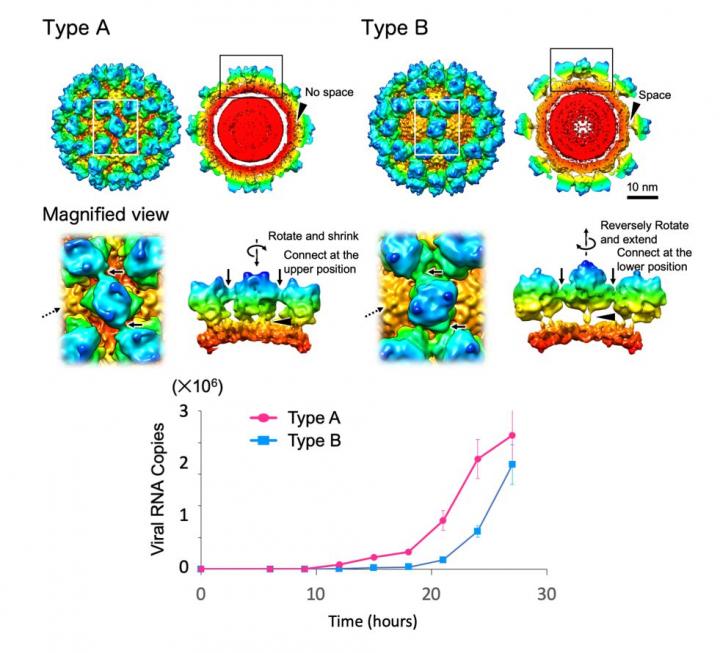
In this study, the researchers have investigated the mouse norovirus structures using cryo-electron microscopy and discovered that the noroviruses present two alternative capsid structures (type A and type B) (Fig. 1 top). Noroviruses are covered by two layered proteinaceous domains, an outer protruding (P) domain and an inner shell (S) domain. Type A shows tight interaction between the two domains, with no space between them, while type B displays the P domain dislocated above the S domain with a space between them. This result has raised the questions, “How do these capsid structures switch?” and “Why do noroviruses need two capsid structures?”.

Further investigations showed that the two structures of mouse norovirus particles switch depending on aqueous conditions. Viral particles showed the type A structure in lower pH solutions including metal ions, while type B structure was favored in higher pH solutions lacking metal ions. Type A was formed by rotation and shrinkage of the P domain and stabilized with an interaction between neighbors at the upper part, while type B was formed by the reverse rotation and extension of the P domain and stabilized with an interaction between neighbors at the lower part (Fig 1 middle).

Mouse noroviruses showing two structures were individually infected into cultured cells. Type B particles showed four hours delay of propagation comparing to type A particles (Fig. 1 bottom). Another experiment found that type B particles showed less adsorption to host cell surface than type A particles. It was concluded that mouse noroviruses change their structure from B to A before infection.

“Why do noroviruses need two structures?” This has not been clarified, but the researchers speculate that it is used to evade the host animal’s immune system. Noroviruses are transmitted primarily through the oral route, and infect cells of the small intestine. Noroviruses may evade the immune system with the type B structure, and approach the small intestine. Then, they finally infect cells by changing to the type A structure (Fig. 2).

The research reveals a part of viral structural change and infection mechanism of mouse noroviruses. Two capsid structures were also identified in the human norovirus VLP, but it has not elucidated the switching mechanism of the structure yet. It is hypothesized that a similar mechanism is also used in human norovirus. Further investigation will clarify the switching mechanism of the structure and infection manner of human norovirus, hopefully assisting development of therapeutic drugs and vaccines in the future.

###

Media Contact
Kazuyoshi Murata
[email protected]

Original Source

https://journals.plos.org/plospathogens/article?id=10.1371/journal.ppat.1008619

Related Journal Article

http://dx.doi.org/10.1371/journal.ppat.1008619

Tags: BiologyCell BiologyVirology
Share12Tweet8Share2ShareShareShare2

Related Posts

Here are a few rewritten headlines for a science magazine post, each with a slightly different tone: Intriguing & poetic: How do organs sculpt themselves? Sea stars hold the secret Direct & research-focused: Sea stars reveal the hidden rules of organ formation Metaphorical & inviting: Tiny architects beneath the waves: What sea stars teach us about building organs Short & punchy: Star-shaped clues to how our organs take shape Question-led: Could a sea star show us how organs form? Elegant & feature-style: The body’s blueprint, glimpsed in a sea star’s arm

July 6, 2026
Bacteria evolve faster with unconventional gene copies — Biology

Bacteria evolve faster with unconventional gene copies

July 6, 2026

Neighbours rewire soil feedback via root microbiome shifts

July 6, 2026

Evolution-Inspired Biosensors Revolutionize Lipid Tracking in Real Time

July 2, 2026
Please login to join discussion

POPULAR NEWS

  • Detection of EDCs in Breast Milk and Infant Urine Up to Six Months Highlights Early Exposure Risks

    77 shares
    Share 31 Tweet 19
  • New Drug Candidate Developed at McMaster Shows Potential for Treating Brain Cancer

    58 shares
    Share 23 Tweet 15
  • Saying Goodbye to PGY-6: Pediatric Fellowship Realities

    103 shares
    Share 41 Tweet 26
  • KTU Researchers Explore Ultrasound’s Role in Enhancing Blood Flow Beyond Diagnostics

    53 shares
    Share 21 Tweet 13

About

We bring you the latest biotechnology news from best research centers and universities around the world. Check our website.

Follow us

Recent News

Flame retardant BDE-209 targets molecularly linked to ulcerative colitis

Ultra-high frequency particle impacts mimic rockbursts to shatter hard rock

Kidney transplant outcomes in older adults studied by German researchers

Subscribe to Blog via Email

Enter your email address to subscribe to this blog and receive notifications of new posts by email.

Join 83 other subscribers
  • Contact Us

Bioengineer.org © Copyright 2023 All Rights Reserved.

Welcome Back!

Login to your account below

Forgotten Password?

Retrieve your password

Please enter your username or email address to reset your password.

Log In
No Result
View All Result
  • Homepages
    • Home Page 1
    • Home Page 2
  • News
  • National
  • Business
  • Health
  • Lifestyle
  • Science

Bioengineer.org © Copyright 2023 All Rights Reserved.