• HOME
  • NEWS
  • EXPLORE
    • CAREER
      • Companies
      • Jobs
    • EVENTS
    • iGEM
      • News
      • Team
    • PHOTOS
    • VIDEO
    • WIKI
  • BLOG
  • COMMUNITY
    • FACEBOOK
    • INSTAGRAM
    • TWITTER
Thursday, January 15, 2026
BIOENGINEER.ORG
No Result
View All Result
  • Login
  • HOME
  • NEWS
  • EXPLORE
    • CAREER
      • Companies
      • Jobs
        • Lecturer
        • PhD Studentship
        • Postdoc
        • Research Assistant
    • EVENTS
    • iGEM
      • News
      • Team
    • PHOTOS
    • VIDEO
    • WIKI
  • BLOG
  • COMMUNITY
    • FACEBOOK
    • INSTAGRAM
    • TWITTER
  • HOME
  • NEWS
  • EXPLORE
    • CAREER
      • Companies
      • Jobs
        • Lecturer
        • PhD Studentship
        • Postdoc
        • Research Assistant
    • EVENTS
    • iGEM
      • News
      • Team
    • PHOTOS
    • VIDEO
    • WIKI
  • BLOG
  • COMMUNITY
    • FACEBOOK
    • INSTAGRAM
    • TWITTER
No Result
View All Result
Bioengineer.org
No Result
View All Result
Home NEWS Science News

Non-adiabatic dynamics of strongly driven diffusive Josephson junctions

Bioengineer by Bioengineer
December 4, 2019
in Science News
Reading Time: 2 mins read
0
IMAGE
Share on FacebookShare on TwitterShare on LinkedinShare on RedditShare on Telegram

IMAGE

Credit: University of Jyväskylä/Pauli Virtanen


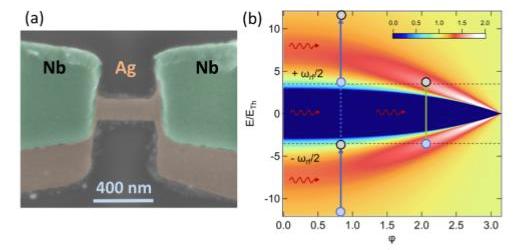
Understanding how microwave absorption changes the transport properties of diffusive Josephson junctions is at the forefront of interest in the quantum transport community. It is especially relevant for the current efforts to address the current-phase relation in topological Josephson junctions and more generally the microwave transport in quantum devices. Researchers from the University of Paris-Saclay, the University of Regensburg (Germany) and the University of Jyvaskyla; (Finland) have delivered a combined experimental and theoretical work which reveal the profound nature of quantum transport in strongly driven diffusive Josephson junctions. Results are published in Physical Review Research in October.

At sufficiently low temperatures, superconductors cannot absorb microwave radiation of energy smaller than the superconducting energy gap D. In Josephson weak links instead, where two superconductors (S) are weakly coupled through a long diffusive metallic wire (N), radiation can be absorbed in N because the induced gap in the density of states or minigap is considerably smaller than D.

In a recent article the researchers’ team have studied the out-of-equilibrium dynamical state induced by the absorption of high frequency microwave photons in diffusive Superconductor-Normal metal-Superconductor (SNS) junction. To characterize this state, the researchers pioneered a harmonic-resolved ac-Josephson spectroscopy technique which allows to access the harmonic content of the current-phase relation under microwave radiation.

With this approach, which does not require a specialized on-chip circuitry, they could see that a strong anharmonicity of the current-phase relation arises under illumination, especially at high frequency when inelastic transitions across the induced minigap are favored. This novel regime goes well beyond the standard Eliashberg theory and is understood because of the modifications of the supercurrent-carrying Andreev spectrum induced by non-adiabatic transitions.

These findings shed light on the complex mechanisms involved in irradiated mesoscopic superconductors and has important implications in Andreev-based quantum computing prospects.

###

Link to the article in Physical Review Research 1, 032009 (2019): https://journals.aps.org/prresearch/abstract/10.1103/PhysRevResearch.1.032009

For further information:

Professor Tero Heikkilä, University of Jyvaskyla;, Finland, [email protected], tel. +358408054804

University researcher Pauli Virtanen, University of Jyvaskyla, Finland, [email protected]

Communications officer Tanja Heikkinen, [email protected], tel +35850 581 8351

Media Contact
Tero Heikkilä
[email protected]
358-408-054-804

Original Source

https://journals.aps.org/prresearch/abstract/10.1103/PhysRevResearch.1.032009

Related Journal Article

http://dx.doi.org/10.1103/PhysRevResearch.1.032009

Tags: Chemistry/Physics/Materials SciencesMaterialsNanotechnology/MicromachinesSuperconductors/Semiconductors
Share12Tweet8Share2ShareShareShare2

Related Posts

blank

Neonatal Neuroplasticity: Linking Brain Science to Care

January 15, 2026

Urban-Rural Gaps in Perceived Quality of Aging Services

January 15, 2026

Tirzepatide Resolves MASH Without Worsening Fibrosis

January 15, 2026

PPM1A Dysfunction Intensifies DPN via NF-κB/NLRP3 Pathway

January 15, 2026
Please login to join discussion

POPULAR NEWS

  • Enhancing Spiritual Care Education in Nursing Programs

    155 shares
    Share 62 Tweet 39
  • PTSD, Depression, Anxiety in Childhood Cancer Survivors, Parents

    147 shares
    Share 59 Tweet 37
  • Robotic Ureteral Reconstruction: A Novel Approach

    76 shares
    Share 30 Tweet 19
  • Study Reveals Lipid Accumulation in ME/CFS Cells

    53 shares
    Share 21 Tweet 13

About

BIOENGINEER.ORG

We bring you the latest biotechnology news from best research centers and universities around the world. Check our website.

Follow us

Recent News

Neonatal Neuroplasticity: Linking Brain Science to Care

Urban-Rural Gaps in Perceived Quality of Aging Services

Tirzepatide Resolves MASH Without Worsening Fibrosis

Subscribe to Blog via Email

Enter your email address to subscribe to this blog and receive notifications of new posts by email.

Join 71 other subscribers
  • Contact Us

Bioengineer.org © Copyright 2023 All Rights Reserved.

Welcome Back!

Login to your account below

Forgotten Password?

Retrieve your password

Please enter your username or email address to reset your password.

Log In
No Result
View All Result
  • Homepages
    • Home Page 1
    • Home Page 2
  • News
  • National
  • Business
  • Health
  • Lifestyle
  • Science

Bioengineer.org © Copyright 2023 All Rights Reserved.