Gas sensors built from hematite, the common iron oxide mineral known to chemists as α-Fe2O3, may owe much of their behavior to a surprisingly subtle quantum object: a small polaron, an electron that drags the surrounding lattice atoms into a distorted pocket around itself as it hops from one iron site to the next. A new computational study now traces, atom by atom, what happens to these charge carriers when a molecule of nitrogen dioxide lands on the mineral’s surface. The answer, published in the Springer journal Discover Sensors, is stark: the adsorbed NO2 pulls the electron out of its polaron state entirely, effectively switching off this route of electrical conduction.
Using density functional theory corrected with a Hubbard U term, a technique that allows electrons to remain localized on individual atoms where simpler methods would smear them out, the team modeled both the bulk crystal and a carefully constructed slab of the Fe-terminated (0001) surface, the face of hematite most relevant to gas sensing. The calculations employed the VASP code with the PBE functional, a 500 eV plane-wave cutoff, and a Hubbard parameter of 4.3 eV chosen to match earlier studies of the material.
The first benchmark the researchers set themselves was the activation energy for small-polaron hopping in bulk hematite. In this material, charge transport does not proceed through band-like conduction as in silicon; instead, charge carriers localize on iron sites, converting Fe3+ ions into Fe2+ centers, and migrate by thermally activated hops between neighboring lattice positions. Using the nudged elastic band method with a climbing image to locate the transition state, the team computed an activation energy of 0.12 eV for a hop between adjacent iron ions within the same basal plane of the crystal. That figure lands almost exactly on the experimental estimate of 0.118 eV, a match the authors describe as excellent and which they take as confirmation that their computational framework captures the real transport mechanism.
Other calculated properties also lined up with known data. The iron atoms were found to be ferromagnetically coupled within the basal plane but antiferromagnetically coupled along the crystallographic c-axis. Notably, when the researchers repeated the polaron calculations without the Hubbard correction, using plain PBE, the excess electron refused to localize at all, remaining delocalized across the simulation cell. The self-interaction error inherent in standard functionals artificially raises the energy of localized states, so without the correction the polaron simply does not exist on paper.
With the bulk behavior validated, the team turned to the surface. They added an excess electron to a large Fe48O72 slab and found that the polaron is energetically more comfortable at the Fe-terminated (0001) surface than in the interior of the crystal, by 0.12 eV. In other words, the very charge carriers responsible for conduction in hematite preferentially migrate toward the gas-solid interface, precisely where analyte molecules arrive. The authors note that entropy works against this preference to some degree, since there are far more available sites inside the crystal than on its surface, but the energetic pull toward the surface is clear in the calculations.
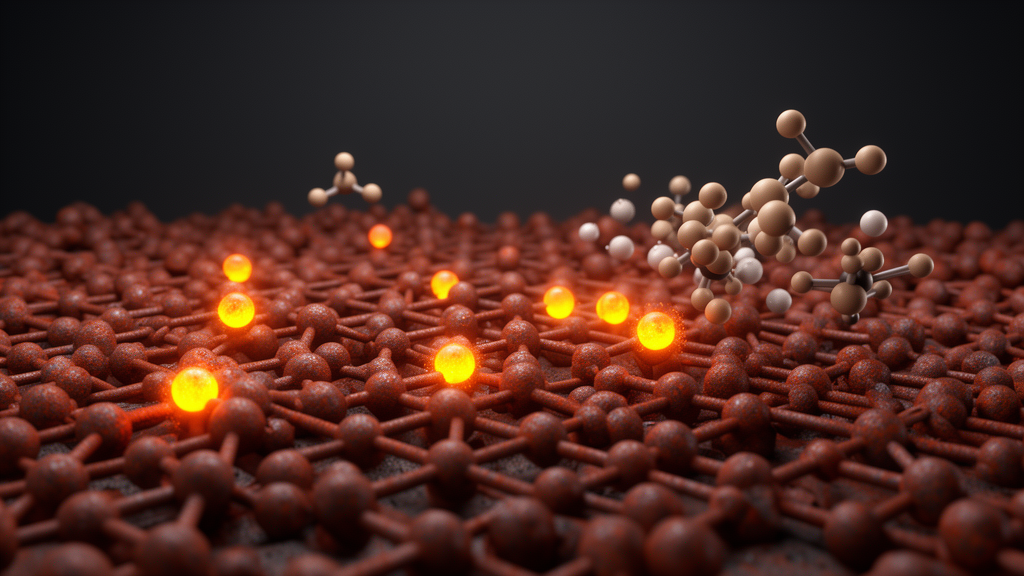
Then came the decisive step: a NO2 molecule was adsorbed on the surface, directly at the site of the polaron. The computed adsorption energy, minus 2.16 eV, indicates a strong bond between the molecule and the surface. Bader charge analysis revealed the reason for that strength: 0.72 electrons are transferred from the oxide to the adsorbed molecule. That transfer is enough to remove the localized electron responsible for the polaron, eliminating the Fe2+ site and, with it, the polaronic conduction pathway. The admolecule, in effect, swallows the charge carrier.
The implications for sensing follow directly from the physics. Because conduction in hematite proceeds by hopping between localized states, removing even a fraction of those states can disrupt the connectivity of the entire conduction network. Since the calculations show polarons congregating at the surface, adsorption-induced charge transfer there can strongly modulate the material’s electrical resistance. The authors argue that this provides a direct microscopic explanation for a well-known experimental observation: hematite-based sensors, which behave as n-type semiconductors, show an increase in resistance when exposed to oxidizing gases such as NO2. The gas does not merely perturb the surface; it removes the carriers that carry the current.
The study also sketches a dynamic picture of how this quenching might unfold. If a NO2 molecule initially lands on a neighboring Fe3+ site rather than directly on the polaron, the low migration barrier of 0.12 eV suggests the surface polaron can readily hop toward the adsorption site, where the charge transfer then stabilizes the adsorbed molecule while simultaneously destroying the polaronic state. The authors emphasize that the mechanism is not merely local: because hopping transport depends on networks of localized states, quenching polarons at the surface can have consequences for transport through the whole material. They add that the Fe-terminated (0001) surface is particularly favorable both for stabilizing polarons and for binding NO2 strongly, which suggests that surface morphology, defect density and crystallographic orientation could substantially alter sensing performance, consistent with experimental reports that nanostructured hematite shows enhanced sensitivity.
The authors are candid about the limits of their approach. The PBE + U approximation with their chosen Hubbard parameter underestimates the material’s band gap by about 0.5 eV, and they note that more accurate but far more expensive methods, such as explicit self-interaction corrections or hybrid functionals mixing in screened Fock exchange, would improve the description. They also list a range of real-world complexities that the present model does not include: surface hydroxylation, intrinsic defects, oxygen vacancies, adsorbed oxygen species, humidity, grain boundaries, operating temperature and the exposed crystallographic facet could all modify adsorption energetics and polaron transport. A systematic investigation of these effects, particularly different surface defects and adsorbed species, is flagged as a natural next step, as is a theoretical comparison of different surface orientations and a closer look at subsurface polaron localization.
One further consideration concerns which phase of iron oxide actually does the sensing. The authors note that in some synthesis routes, such as gas-phase production of nanoparticles, iron oxide systems can initially form the maghemite phase, γ-Fe2O3, rather than hematite. Maghemite is metastable, however, and is well established to transform into the thermodynamically stable α-Fe2O3 phase, especially at the elevated temperatures at which gas sensors typically operate. Unless the sensing material is deliberately kept as maghemite over the device’s lifetime, the sensing behavior in practical devices will therefore largely be governed by hematite, which is precisely the phase the new calculations address. Within that scope, the study offers a concrete design principle: because the active charge carriers sit at the surface where gas adsorption occurs, controlling the polaron population through surface structure, defect engineering and phase composition may be a direct route to better iron oxide gas sensors. The work remains a computational prediction, validated against bulk experimental benchmarks but not yet tested directly at the surface, and the authors present it as a microscopic framework for interpreting hematite sensing signals rather than a demonstration of a finished device.
Subject of Research: Computational study of how adsorbed NO2 quenches polaron-mediated charge transport at the hematite surface
Article Title: Polaron conductivity in α-Fe2O3 quenched by adsorbed NO2
Article References: Ghosh, T. K., Jónsson, E. Ö., Steinhauer, S., Grammatikopoulos, P., & Jónsson, H. (2026). Polaron conductivity in α-Fe2O3 quenched by adsorbed NO2. Discover Sensors, 2(1), Article 55. https://doi.org/10.1007/s44397-026-00085-7
Image Credits: AI Generated
DOI: 10.1007/s44397-026-00085-7
Keywords: hematite, alpha-Fe2O3, polaron, DFT+U, NO2, gas sensing, charge transport, adsorption, surface science, density functional theory, metal oxide semiconductors, electron transfer
News Source: Denise Maddox. (October 28, 2026). NO2 Adsorption Quenches Polaron Conduction in Hematite, Simulations Show. Scienmag.