


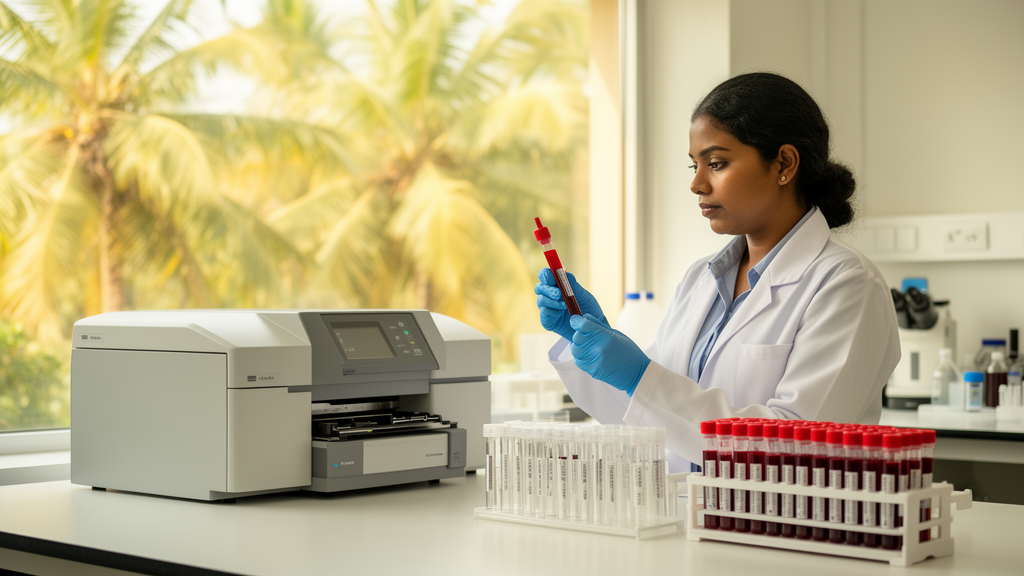
People living along India’s Kerala coast have long absorbed some of the highest natural background radiation levels on Earth, thanks to monazite-rich beach sand laced with uranium and thorium. A new whole-exome sequencing study now reports that decades of chronic, multi-generational exposure to this radiation have not left a detectable burden of extra germline mutations in their blood cells. The findings, published in the journal Genes and Environment, come from researchers at the Bhabha Atomic Research Centre and collaborating institutions who compared healthy men from high level natural radiation areas (HLNRAs) with matched controls from adjacent normal level areas (NLNRAs).
The study focused on twelve randomly selected, healthy male donors, six from each group. Individual dosimetry, performed with Geiger-Muller tube-based survey meters placed in each participant’s home and adjusted for age- and sex-specific occupancy factors, showed that the HLNRA group received a mean annual absorbed dose of 31.8 ± 5.4 mGy per year, while the NLNRA controls averaged just 0.9 ± 0.2 mGy per year, roughly a thirty-fold difference. Mean ages were closely matched at 43.0 years in both groups, and all participants were male, which allowed the researchers to rule out age and sex as confounding factors in mutation frequency. Written consent and lifestyle information, including smoking, alcohol use and medical radiation exposures, were collected under ethics approval from the Medical Ethics Committee at BARC.
From peripheral blood mononuclear cells, the team isolated genomic DNA and prepared exome libraries that were sequenced in paired-end mode on an Illumina HiSeq 2500 platform, achieving a mean coverage of roughly sixty-fold. Reads were mapped to the human reference genome hg38 using the Sarek pipeline, and germline variants were called with two independent tools, Strelka and GATK HaplotypeCaller, with only variants supported by both callers retained. To isolate a possible radiation signature, the researchers filtered out common polymorphisms with a minor allele frequency above one percent recorded in the gnomAD and genomeAsia100K databases.
After filtering, 17,431 variants remained, comprising 15,695 single nucleotide variants (SNVs) and 1,736 small insertions or deletions (indels). The exposed and control groups carried remarkably similar totals: 8,624 mutations (7,744 SNVs and 880 indels) in the HLNRA group versus 8,807 mutations (7,951 SNVs and 856 indels) in the NLNRA group. Average per-person SNV counts were likewise nearly identical, at 1,290 SNVs (28.4 per megabase) in the exposed group and 1,325 SNVs (29.2 per megabase) in controls. Non-synonymous missense mutations made up the largest mutation class in both groups, at about 20 percent, and the genomic distribution of variants across regulatory, intronic, ncRNA and splicing regions was broadly comparable.
Protein-affecting mutations, which include missense, frameshift, stop-gained, in-frame deletion and splice-site changes, also showed no significant difference between groups, with 1,925 in the exposed group and 2,082 in controls. Pathway analysis using the Reactome database revealed that genes carrying these mutations in each group were involved in similar critical functions, including DNA repair, immune response, chromatin organization, RNA splicing and cell-cell communication. Notably, when the researchers compared their variants against a curated list of cancer predisposition and DNA damage response genes, the exposed group actually carried fewer affected cancer predisposition genes, seven versus twenty in the control group, with only BRCA2, NBN and related repair genes represented.
Predictive tools reinforced this picture. Using REVEL, which scores missense variants for pathogenicity, the team identified around 145 potentially pathogenic mutations in the exposed group versus 187 in controls, with no increase in variants linked to carcinogenesis among the radiation-exposed men. The AloFT tool predicted 25 loss-of-function stop-gain mutations with high impact in the exposed group compared with 37 in controls. Taken together, the authors conclude that chronic low-dose radiation exposure at these levels did not measurably increase the germline mutational burden or the load of potentially harmful protein-altering variants.
One signal did stand out. Principal component analysis of five-nucleotide sequence contexts showed elevated C to T frequencies in the exposed group at contexts such as CA[C>T]GG and CC[C>T]GG. Because methylated cytosine at CpG sites readily deaminates to uracil, producing C to T changes, the authors suggest this pattern may reflect differential DNA methylation at CpG islands in the exposed population, possibly an epigenetic response to chronic low-dose radiation. They note that their own unpublished methylation data on selected DNA repair genes, and prior promoter methylation studies after acute irradiation, are consistent with this interpretation, though they caution that larger cohorts and genome-wide methylation profiling are needed to substantiate it.
The results align with a broader body of evidence from Kerala and other high background radiation regions. Epidemiological studies cited by the authors have found no increase in congenital malformations, adverse pregnancy outcomes, hereditary anomalies or cancer incidence in the Kerala HLNRAs, or in China’s Yangjiang region. Cytogenetic and molecular assays, including gamma-H2AX and 53BP1 foci analysis, have generally not shown dose-dependent increases in DNA double-strand breaks in Kerala’s exposed population, and earlier studies there reported efficient repair of DNA breaks, although a few studies in China and Ramsar, Iran, and one recent Kerala study limited to female inhabitants, reported elevated chromosomal aberrations in small samples. Transgenerational whole-genome sequencing of children born to Chernobyl clean-up workers and atomic bomb survivors likewise found no significant increase in germline de novo mutations.
The authors are careful about scope. The study is limited by its small sample size, only six donors per group, partly because individuals receiving background doses above 20 mGy per year constitute only about 0.5 percent of the HLNRA population, making participants from the highest-exposure clusters inherently scarce. Whole-exome sequencing also captures only protein-coding and nearby functional regions, not the full spectrum of alterations in regulatory or non-coding DNA. The observed C to T enrichment at CpG sites remains an association suggestive of methylation-related processes, not a demonstrated causal mechanism, and the authors emphasize that future work should employ whole-genome sequencing alongside genome-wide methylation and epigenetic profiling, with stratified dose categories, to establish definitive dose-response relationships.
Even with those caveats, the study offers a rare direct measurement in humans rather than an extrapolation from mice or drosophila, on which current linear no-threshold risk models have historically relied. By showing that men carrying roughly thirty times the background dose of their neighbors carry no excess of germline SNVs, indels, protein-affecting mutations or predicted pathogenic variants, the work adds concrete population-level evidence to a long-standing debate about the genetic risks of chronic low-dose ionizing radiation, and points toward epigenetic adaptation, rather than accumulating DNA damage, as the more intriguing thread to follow next.
Subject of Research: Germline variant detection by whole-exome sequencing in a human population chronically exposed to high natural background radiation on the Kerala coast
Article Title: Detection of germline variants in human population chronically exposed to high level natural background radiation in Kerala coast
Article References: Jain, V., Saini, D., Sabarinathan, R., & Das, B. (2026). Detection of germline variants in human population chronically exposed to high level natural background radiation in Kerala coast. Genes and Environment, 48(1), Article 5. https://doi.org/10.1186/s41021-026-00352-4
Image Credits: AI Generated
DOI: 10.1186/s41021-026-00352-4
Keywords: germline mutations, whole-exome sequencing, natural background radiation, Kerala coast, low-dose ionizing radiation, monazite, CpG methylation, DNA repair genes, cancer predisposition, radiation genetics, SNVs, HLNRA
News Source: Juliet Wilcox. (October 29, 2026). No Extra Germline Mutations Found in Kerala’s High Natural Radiation Areas. Scienmag.



