• HOME
  • NEWS
  • EXPLORE
    • CAREER
      • Companies
      • Jobs
    • EVENTS
    • iGEM
      • News
      • Team
    • PHOTOS
    • VIDEO
    • WIKI
  • BLOG
  • COMMUNITY
    • FACEBOOK
    • INSTAGRAM
    • TWITTER
Friday, March 27, 2026
BIOENGINEER.ORG
No Result
View All Result
  • Login
  • HOME
  • NEWS
  • EXPLORE
    • CAREER
      • Companies
      • Jobs
        • Lecturer
        • PhD Studentship
        • Postdoc
        • Research Assistant
    • EVENTS
    • iGEM
      • News
      • Team
    • PHOTOS
    • VIDEO
    • WIKI
  • BLOG
  • COMMUNITY
    • FACEBOOK
    • INSTAGRAM
    • TWITTER
  • HOME
  • NEWS
  • EXPLORE
    • CAREER
      • Companies
      • Jobs
        • Lecturer
        • PhD Studentship
        • Postdoc
        • Research Assistant
    • EVENTS
    • iGEM
      • News
      • Team
    • PHOTOS
    • VIDEO
    • WIKI
  • BLOG
  • COMMUNITY
    • FACEBOOK
    • INSTAGRAM
    • TWITTER
No Result
View All Result
Bioengineer.org
No Result
View All Result
Home NEWS Science News

NIST sensor experts invent supercool mini thermometer

Bioengineer by Bioengineer
November 17, 2020
in Science News
Reading Time: 2 mins read
0
IMAGE
Share on FacebookShare on TwitterShare on LinkedinShare on RedditShare on Telegram

IMAGE

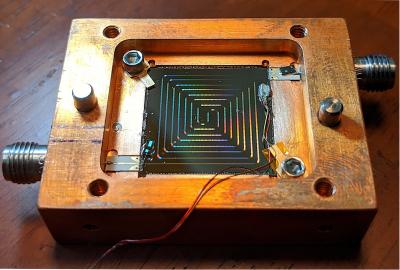
Credit: Wheeler/NIST

Researchers at the National Institute of Standards and Technology (NIST) have invented a miniature thermometer with big potential applications such as monitoring the temperature of processor chips in superconductor-based quantum computers, which must stay cold to work properly.

NIST’s superconducting thermometer measures temperatures below 1 Kelvin (minus 272.15 ?C or minus 457.87 ?F), down to 50 milliKelvin (mK) and potentially 5 mK. It is smaller, faster and more convenient than conventional cryogenic thermometers for chip-scale devices and could be mass produced. NIST researchers describe the design and operation in a new journal paper [https://aip.scitation.org/doi/10.1063/5.0029351].

Just 2.5 by 1.15 millimeters in size, the new thermometer can be embedded in or stuck to another cryogenic microwave device to measure its temperature when mounted on a chip. The researchers used the thermometer to demonstrate fast, accurate measurements of the heating of a superconducting microwave amplifier.

The technology is a spinoff of NIST’s custom superconducting sensors for telescope cameras, specifically microwave detectors delivered for the BLAST balloon [https://sites.northwestern.edu/blast/] and [http://toltec.astro.umass.edu/].

“This was a fun idea that quickly grew into something very helpful,” group leader Joel Ullom said. “The thermometer allows researchers to measure the temperature of a wide range of components in their test packages at very little cost and without introducing a large number of additional electrical connections. This has the potential to benefit researchers working in quantum computing or using low-temperature sensors in a wide range of fields.”

The thermometer consists of a superconducting niobium resonator coated with silicon dioxide. The coating interacts with the resonator to shift the frequency at which it naturally vibrates. Scientists suspect this is due to atoms “tunneling” between two sites, a quantum-mechanical effect.

The NIST thermometer is based on a new application of the principle that the natural frequency of the resonator depends on the temperature. The thermometer maps changes in frequency, as measured by electronics, to a temperature. By contrast, conventional thermometers for sub-Kelvin temperatures are based on electrical resistance. They require wiring routed to room-temperature electronics, adding complexity and potentially causing heating and interference.

The NIST thermometer measures temperature in about 5 milliseconds (thousandths of a second), much faster than most conventional resistive thermometers at about one-tenth of a second. The NIST thermometers are also easy to fabricate in only a single process step. They can be mass produced, with more than 1,200 fitting on a 3-inch (approximately 75-millimeter) silicon wafer.

###

Paper:
J. Wheeler, M.R. Vissers, M. Malnou, J. Hubmayr, J.N. Ullom, and J. Gao. Sub-Kelvin Thermometer for On-Chip Measurements of Microwave Devices Utilizing Two-Level Systems in Superconducting Microresonators. Applied Physics Letters 117, 192601 (2020). DOI: 10.1063/5.0029351 [https://aip.scitation.org/doi/10.1063/5.0029351]

Media Contact
Laura Ost
[email protected]
Tags: Chemistry/Physics/Materials SciencesElectrical Engineering/ElectronicsMaterialsResearch/DevelopmentSuperconductors/SemiconductorsTechnology/Engineering/Computer Science
Share12Tweet8Share2ShareShareShare2

Related Posts

Isolated H2-Reduced Clusters Boost CO2-to-Methanol Catalysis

Isolated H2-Reduced Clusters Boost CO2-to-Methanol Catalysis

March 25, 2026
In-Sensor Cryptography Links Physical Process to Digital Identity

In-Sensor Cryptography Links Physical Process to Digital Identity

March 25, 2026

Can Psychosocial Factors Influence Cancer Risk?

March 23, 2026

Depression Factors in Elderly: Pre vs. Post-COVID Analysis

March 23, 2026
Please login to join discussion

POPULAR NEWS

  • blank

    Revolutionary AI Model Enhances Precision in Detecting Food Contamination

    96 shares
    Share 38 Tweet 24
  • Imagine a Social Media Feed That Challenges Your Views Instead of Reinforcing Them

    1003 shares
    Share 397 Tweet 248
  • Uncovering Functions of Cavernous Malformation Proteins in Organoids

    54 shares
    Share 22 Tweet 14
  • Promising Outcomes from First Clinical Trials of Gene Regulation in Epilepsy

    51 shares
    Share 20 Tweet 13

About

We bring you the latest biotechnology news from best research centers and universities around the world. Check our website.

Follow us

Recent News

In-Sensor Cryptography Links Physical Process to Digital Identity

Can Psychosocial Factors Influence Cancer Risk?

Depression Factors in Elderly: Pre vs. Post-COVID Analysis

Subscribe to Blog via Email

Success! An email was just sent to confirm your subscription. Please find the email now and click 'Confirm' to start subscribing.

Join 78 other subscribers
  • Contact Us

Bioengineer.org © Copyright 2023 All Rights Reserved.

Welcome Back!

Login to your account below

Forgotten Password?

Retrieve your password

Please enter your username or email address to reset your password.

Log In
No Result
View All Result
  • Homepages
    • Home Page 1
    • Home Page 2
  • News
  • National
  • Business
  • Health
  • Lifestyle
  • Science

Bioengineer.org © Copyright 2023 All Rights Reserved.