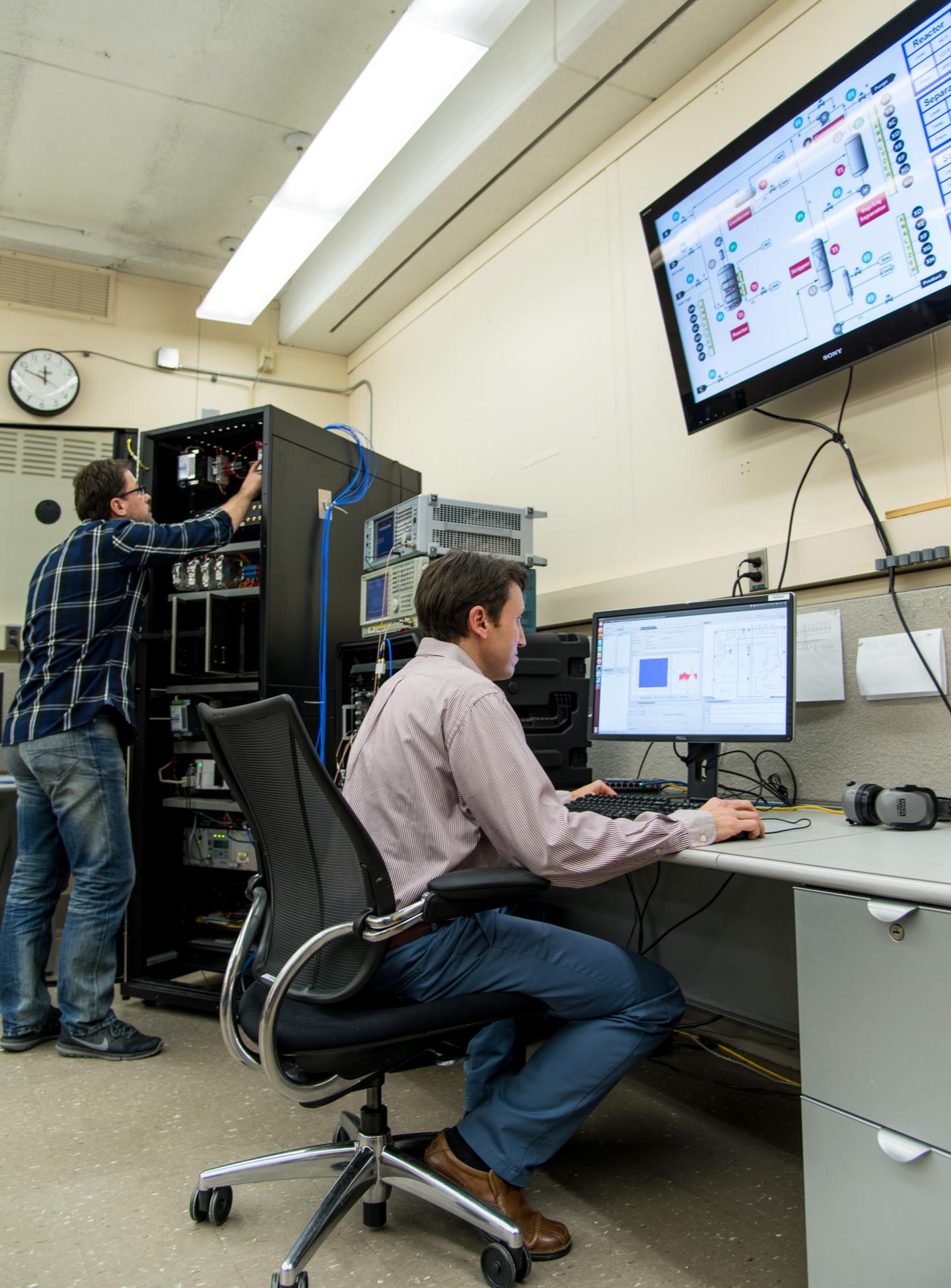
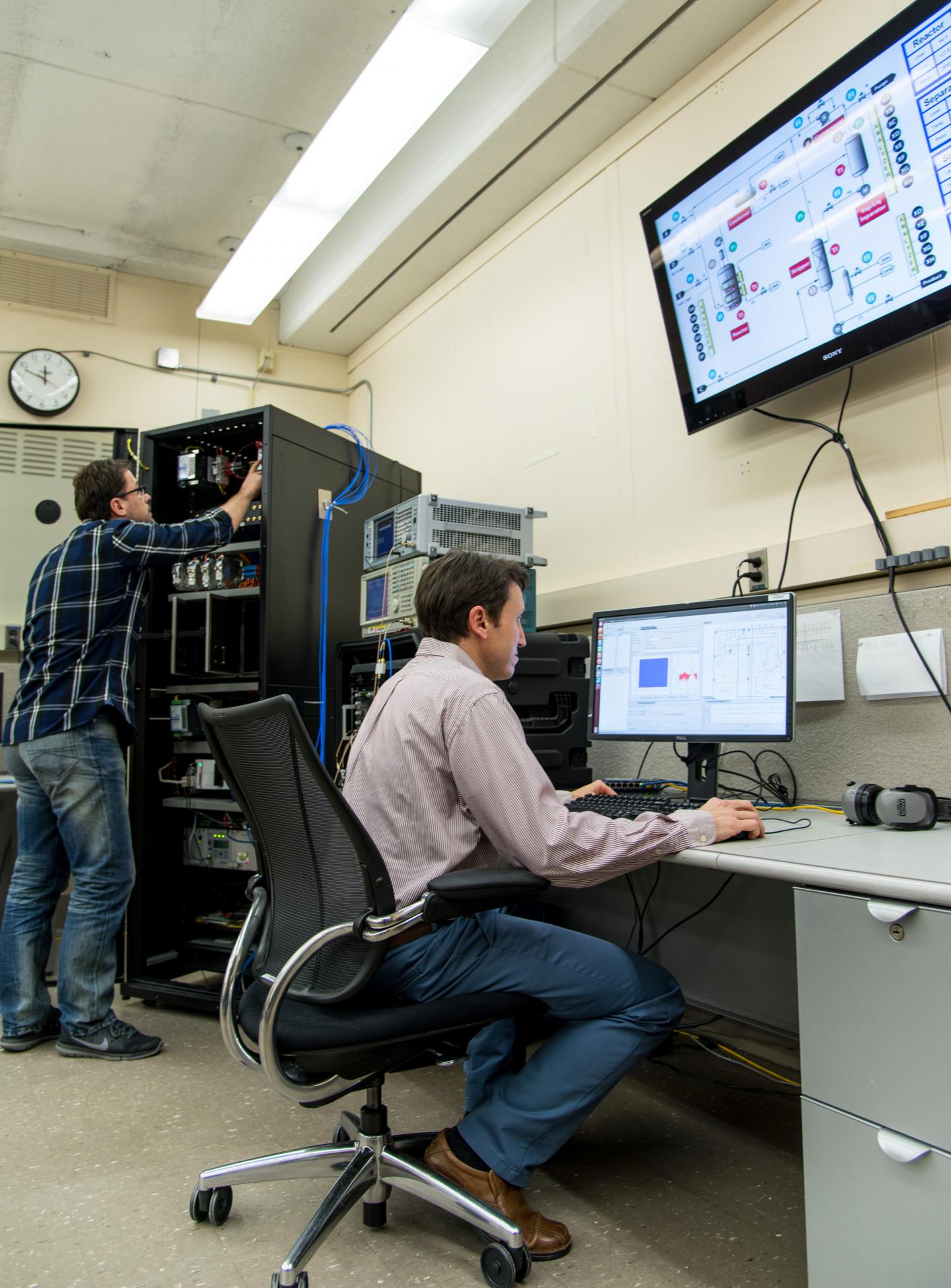
Credit: Fran Webber/NIST
Providing wireless communications in a factory, plant or other industrial environment these days means more than just helping employees talk with each other while they work. By eliminating physical connections such as wires and cables from a facility's communication network, wireless technology offers many manufacturing, chemical processing and municipal (such as water treatment) organizations a means to run their entire operation more efficiently, more productively and at less cost. However, a perceived lack of reliability, integrity and security has hampered the adoption and use of industrial wireless, especially when wireless communication can often be corrupted or disrupted in harsh industrial settings.
Through its Wireless Systems for Industrial Environments project, the National Institute of Standards and Technology (NIST) is working with private-sector collaborators to overcome these obstacles and make industrial wireless communication a more viable choice. The latest milestone in this effort is a newly published study in which rigorous scientific experiments evaluated how well radio frequency (RF) signals propagated in three different factory environments: an automobile transmission assembly facility, a steam generation plant and a machine shop.
"Understanding how RF platforms work or don't work in these harsh environments is the first step toward designing and deploying reliable wireless networks," said NIST's Rick Candell, the lead researcher on the study. "With the data from this research and future tests, we can define factors that can hinder RF propagation–including heat, vibration, reflection, interference and shielding–and then develop measures to address them."
In their study of the three factory settings, Candell and his colleagues looked at three RF propagation characteristics. They made precise measurements of how the signals lost power over distance, dispersed over the factory floor and varied in strength due to absorption or reflection by the specific environment.
"We clearly saw that wireless transmission of data in industrial facilities is completely different from signal propagation in a home or office setting," Candell said. "It's a harsh environment where reflective or absorbent surfaces, interference from competing RF signal traffic and other obstacles must be overcome if we want to deploy secure, integrated wireless platforms that perform dependably."
The researchers performed mathematical and statistical analyses of the data from the three factory experiments and are incorporating them into a NIST test bed designed to replicate a manufacturing environment. This "factory in a box" re-creates the conditions found in a variety of industrial settings, allowing researchers to study the impacts on signal propagation in controlled laboratory conditions.
"The test bed supports the development of measurements and tests to evaluate signal performance, gives us the means to evaluate the usefulness of NIST computer models and simulations of wireless networks, and hopefully, will help us design and road test solutions to current propagation problems," Candell said.
The NIST team also wants to hear from people involved with factories and plants about their specific industrial environments, including details about layout, structural makeup, operations and communications networking, as well as future needs and plans for wireless.
"We hope that more managers will consider letting us conduct field trials of wireless in their facilities, especially ones with outdoor operations such as oil refineries or with possible signal-absorbing materials such as paper mills," Candell said.
###
The Wireless Systems for Industrial Environments project will be featured in a panel session on wireless networking for industrial automation on March 13, 2017, at the IEEE Sensors Applications Symposium (link is external) at Rowan University in Glassboro, New Jersey.
R. Candell, K.A. Remley, J.T. Quimby, D. Novotny, A. Curtin, P.B. Papazian, M. Kashef and J. Diener. Analysis of Radio Propagation Measurements in Three Factories (NIST Technical Note 1951). January 2017. DOI: https://doi.org/10.6028/NIST.TN.1951
Media Contact
Michael E. Newman
[email protected]
301-975-3025
@usnistgov
http://www.nist.gov
############
Story Source: Materials provided by Scienmag