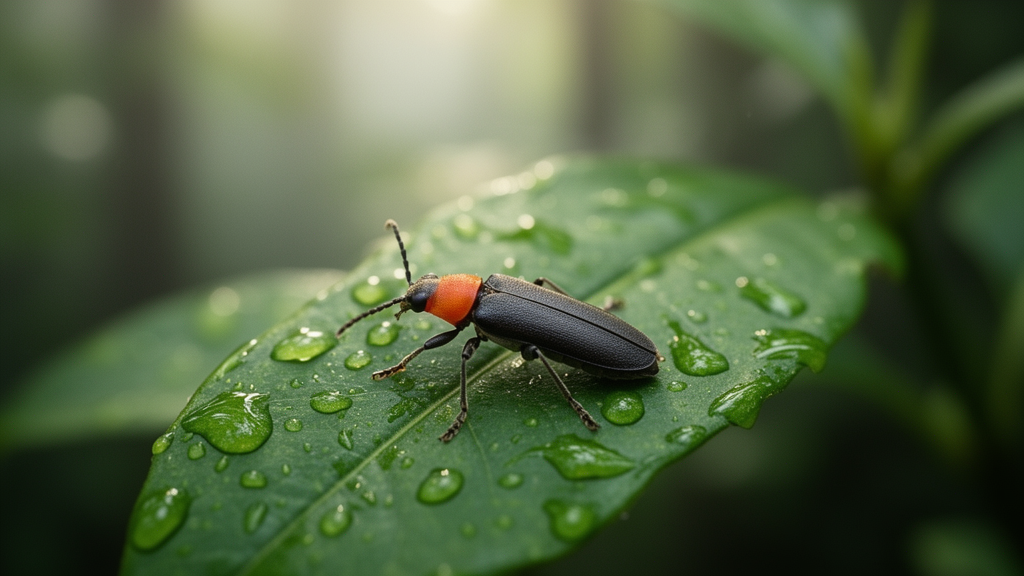
A quiet revolution is unfolding in the world of soldier beetles. In a study published in the Deutsche Entomologische Zeitschrift, researchers Y. Yang, S. Ge, X. Yang and Haoyu Liu have described nine brand-new species of the genus Habronychus, tiny beetles belonging to the family Cantharidae, whose soft elytra and often vivid red-and-black coloration have long fascinated entomologists. The work also provides a fully updated worldwide identification key to the nominate subgenus Habronychus s.str., a tool that will allow scientists across Asia and beyond to confidently distinguish species that were previously lumped together or left unnamed.
The genus Habronychus currently includes 37 recognized species worldwide and is divided into three subgenera: Habronychus s.str., Macrohabronychus and Monohabronychus. While the latter two are restricted to the Himalayan region and Taiwan Island respectively, the nominate subgenus is far more widespread, comprising 21 species whose range stretches from Japan through southern China and adjacent territories. The new study raises that count considerably, adding species from provinces as diverse as Shaanxi, Hubei, Zhejiang, Guangxi, Sichuan, Guizhou and the tropical island of Hainan, as well as one remarkable find from northern Vietnam.
The nine new species are Habronychus divergens, H. nigricollis, H. taizhouensis, H. profundifissus, H. laticornis, H. nigripennis, H. bilineatus, H. rufolineatus and H. hainanensis. Each was diagnosed using a combination of external morphology and, crucially, the fine architecture of the male and female genitalia, structures that in soldier beetles often differ dramatically even between superficially similar species. Alongside the new descriptions, the authors redescribed H. szechwanus, a species first named by Wittmer in 1988, providing detailed illustrations of its habitus, aedeagus, female abdominal sternite VIII and internal reproductive organs.
What makes this work technically significant is the depth of anatomical scrutiny applied. The researchers dissected the genitalia of both sexes, clearing them in a 10 percent sodium hydroxide solution and staining female reproductive systems with hematoxylin to reveal delicate internal structures. At least one specimen of each sex was dissected for every species, and where a species proved widely distributed, individuals from each locality were examined to guard against cryptic variation going unnoticed. Body length was measured from the anterior margin of the clypeus to the elytral apices, while width was taken across the humeral part of the elytra, ensuring consistent, comparable metrics across all taxa.
Habronychus s.str. belongs to what taxonomists call the Stenothemus complex, a group that also includes the related genera Stenothemus and Falsopodabrus. Within this assemblage, the subgenus can be distinguished by a suite of characters: a small body size of roughly 4 to 9 millimeters, a typically reddish brown pronotum and elytra, a subquadrate pronotum whose posterior angles never project, and, most reliably, the presence of a basal digitiform tooth on both the inner and outer claws of the fore and mid legs in both sexes. This tarsal claw signature is considered distinctive and dependable, even when other traits blur the boundaries with neighboring genera.
Among the new species, several stand out for their striking features. H. laticornis, described from a single male collected in tropical forest in Ha Nung, Vietnam, possesses serrate, flattened antennae that widen toward their tips, a trait reflected in its name, which combines the Latin latus (wide) and cornu (horn). H. divergens, found in Shaanxi and Hubei, is named for the diverging ventral processes of its parameres, while H. profundifissus from Sichuan takes its name from the unusually deep emargination between the dorsal plates of its male genitalia. H. bilineatus from Guizhou sports yellow elytra each marked with a black longitudinal band, and H. rufolineatus from Guangxi shows the inverse pattern: black elytra edged in red.
The female reproductive anatomy proved equally informative. In these beetles, the vagina is elongate, with the median oviduct positioned at its ventroapical part, while the diverticulum and spermatheca arise from the apex as thin, tube-shaped structures considerably longer than the accessory gland. The spermatheca itself contains a spiral tube and extends into a short basal tube where the accessory gland opens. In H. szechwanus, for instance, the diverticulum measures approximately 0.9 times the adult body length, an extraordinary proportion that highlights how much taxonomic signal resides in these internal organs. Differences in the relative lengths of the diverticulum, spermathecal duct and spermatheca helped the authors separate closely related species that external appearance alone could not resolve.
Specimens for the study came from an impressive array of collections: the Institute of Zoology of the Chinese Academy of Sciences in Beijing, the Museum of Hebei University in Baoding, the Naturhistorisches Museum Basel in Switzerland, and Sun Yat-Sen University in Guangzhou. Primary types were returned to their lending institutions or deposited in public museums, ensuring the names are anchored to physical specimens that future researchers can re-examine. Photographic documentation was achieved using a Leica M205A stereomicroscope with image stacking software, while line drawings were produced with a camera lucida attached to a Nikon SMZ1500 and refined in CorelDRAW and Adobe Photoshop.
The updated worldwide key is perhaps the study’s most practical contribution. It walks users through a sequence of contrasting choices, from pronotum proportions and antenna shape to elytral coloration and the fine details of the aedeagus, ultimately pinpointing each of the subgenus’s species. One previously recognized species, H. distinctecostatus, was excluded from the key because male specimens remain unavailable, a reminder that even well-catalogued groups harbor gaps. The key now accommodates species from Japan, Taiwan, China and mainland Southeast Asia, providing a single reference point for a subgenus whose diversity has clearly been underestimated.
For a group as small and easily overlooked as these soldier beetles, the discovery of nine species at once is a striking signal of how much biodiversity remains undocumented in Asia’s mountain forests, from the subtropical slopes of Shennongjia in Hubei to the rainforests of Hainan and the tropical woodlands of Vietnam. Each new name represents a lineage that has persisted, unrecognized, through decades of collection activity, waiting for someone with the right tools and patience to look closely at the shape of a claw, the ridges inside a paramere, or the coils of a spermatheca. As molecular and morphological methods continue to converge, entomologists expect many more such revelations from the Cantharidae, a family whose true species richness is only now coming into focus.
Subject of Research: Taxonomy and species description of Habronychus soldier beetles in Asia
Article Title: Contributions to the taxonomy of Habronychus s. str. ( Coleoptera , Cantharidae ): nine new species and an updated worldwide key to the subgenus
Article References: Hua, R., Ge, S., Liu, H., Yang, X., & Yang, Y. (2026). Contributions to the taxonomy of Habronychus s. str. (Coleoptera, Cantharidae): nine new species and an updated worldwide key to the subgenus. Deutsche Entomologische Zeitschrift, 73(2), 363-384. https://doi.org/10.3897/dez.73.188847
Image Credits: AI Generated
Keywords: Habronychus, Cantharidae, soldier beetles, taxonomy, new species, China, Vietnam, entomology, aedeagus, species key, biodiversity, Coleoptera
News Source: Drew Townsend. (October 16, 2026). Nine New Soldier Beetle Species Unveiled from Asia in Major Taxonomic Overhaul. Scienmag.