• HOME
  • NEWS
  • EXPLORE
    • CAREER
      • Companies
      • Jobs
    • EVENTS
    • iGEM
      • News
      • Team
    • PHOTOS
    • VIDEO
    • WIKI
  • BLOG
  • COMMUNITY
    • FACEBOOK
    • INSTAGRAM
    • TWITTER
Thursday, July 2, 2026
BIOENGINEER.ORG
No Result
View All Result
  • Login
  • HOME
  • NEWS
  • EXPLORE
    • CAREER
      • Companies
      • Jobs
        • Lecturer
        • PhD Studentship
        • Postdoc
        • Research Assistant
    • EVENTS
    • iGEM
      • News
      • Team
    • PHOTOS
    • VIDEO
    • WIKI
  • BLOG
  • COMMUNITY
    • FACEBOOK
    • INSTAGRAM
    • TWITTER
  • HOME
  • NEWS
  • EXPLORE
    • CAREER
      • Companies
      • Jobs
        • Lecturer
        • PhD Studentship
        • Postdoc
        • Research Assistant
    • EVENTS
    • iGEM
      • News
      • Team
    • PHOTOS
    • VIDEO
    • WIKI
  • BLOG
  • COMMUNITY
    • FACEBOOK
    • INSTAGRAM
    • TWITTER
No Result
View All Result
Bioengineer.org
No Result
View All Result
Home NEWS Science News Chemistry

Nickel-based catalysts tested at Boca de Jaruco oilfield in Cuba

Bioengineer by Bioengineer
June 11, 2020
in Chemistry
Reading Time: 2 mins read
0
IMAGE
Share on FacebookShare on TwitterShare on LinkedinShare on RedditShare on Telegram

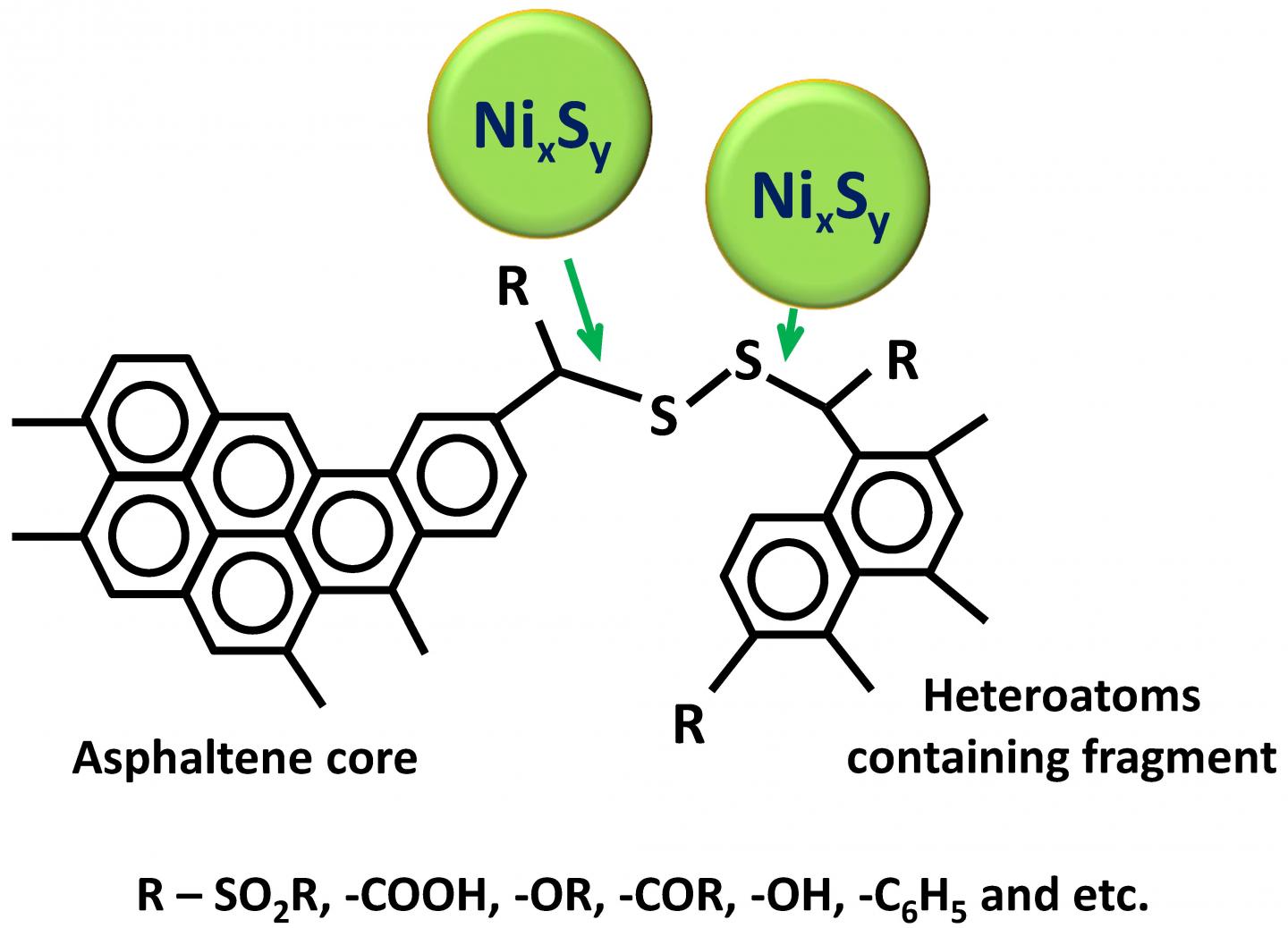
A joint paper by Kazan Federal University and Zarubezhneft appeared as a cover story in Processes.
IMAGE

Credit: Kazan Federal University

Kazan University continues its extensive research into catalysts for non-traditional hydrocarbons – viscous and heavy oils.

In this publication, the authors studied transformations of asphaltenes, the compounds determining the viscosity of petroleum. The provided catalyst proved to be effective for in-situ conversion of asphaltenes.

The nickel-based catalyst precursor was introduced in order to intensify the conversion processes of heavy oil components. The active form of such catalysts–nickel sulfides–are achieved after steam treatment of crude oil at reservoir conditions. The experiments were carried out on a rock sample extracted from the depth of 1900 m. Changes in composition and structure of heavy oil after the conversion were identified using SARA-analysis, Gas Chromatography-Mass Spectroscopy of saturated fractions, FTIR spectroscopy of saturated fractions, and MALDI of resins. It is revealed that catalyst particles provide a reduction in the content of resins and asphaltenes due to the destruction of carbon-heteroatom bonds. Moreover, the destruction of C=Carom. bonds and interactions with aromatic rings are heightened. In contrast, the results of experiments in the absence of catalysts exposed polymerization and condensation of aromatic rings. The most remarkable result to emerge from the thermo-catalytic influence is the irreversible viscosity reduction of produced crude oil enhancing the oil recovery factor. Moreover, the introduction of catalysts increases the gas factor due to additional gas generation as a result of aquathermolysis reactions. The yield of methane gas is significantly high in the experimental runs with oil-saturated rocks rather than crude oil experiments.

Co-author, Senior Research Associate of KFU’s In-Situ Combustion Lab Aleksey Vakhin explains, “This is a continuation of a three-part work by Kazan Federal University and Zarubezhneft which appeared in Petroleum Science and Technology. Those publications covered transformations of petroleum under the influence of various catalysts.”

The results will also be used in a doctoral thesis prepared by another lab employee, Firdaws Aliev.

In addition, 14 metric tons of the experimental aquathermolysis catalyst (trademarked as UniCat) have been produced for field testing.

###

Media Contact
Yury Nurmeev
[email protected]

Original Source

https://kpfu.ru/eng/news-eng/nickel-based-catalysts-tested-at-boca-de-jaruco.html

Related Journal Article

http://dx.doi.org/10.3390/pr8050532

Tags: Chemistry/Physics/Materials SciencesEnergy SourcesIndustrial Engineering/Chemistry
Share12Tweet8Share2ShareShareShare2

Related Posts

Graz University of Technology Deciphers the Structural Secrets of MOF Thin Films — Chemistry

Graz University of Technology Deciphers the Structural Secrets of MOF Thin Films

July 2, 2026
Breaking Thermodynamic Limits: Wavelength-Driven Catalysis Advances Ammonia Synthesis — Chemistry

Breaking Thermodynamic Limits: Wavelength-Driven Catalysis Advances Ammonia Synthesis

July 2, 2026

From Quantum Mechanics to AI-Powered Materials Discovery: MARVEL Marks 12 Years of Transforming Computational Science

July 2, 2026

Djire Recognized with National Award for Outstanding Contributions in Research and Teaching

July 2, 2026
Please login to join discussion

POPULAR NEWS

  • Detection of EDCs in Breast Milk and Infant Urine Up to Six Months Highlights Early Exposure Risks

    77 shares
    Share 31 Tweet 19
  • Saying Goodbye to PGY-6: Pediatric Fellowship Realities

    103 shares
    Share 41 Tweet 26
  • New Drug Candidate Developed at McMaster Shows Potential for Treating Brain Cancer

    58 shares
    Share 23 Tweet 15
  • KTU Researchers Explore Ultrasound’s Role in Enhancing Blood Flow Beyond Diagnostics

    53 shares
    Share 21 Tweet 13

About

BIOENGINEER.ORG

We bring you the latest biotechnology news from best research centers and universities around the world. Check our website.

Follow us

Recent News

Steatosis Drives Liver Metastasis Diversity in CRC

Unlocking the Mysteries of Alzheimer’s Disease

Pensoft Introduces New Peer-Reviewed Journal of Regeneration to Advance Restorative Biology Across Species

Subscribe to Blog via Email

Enter your email address to subscribe to this blog and receive notifications of new posts by email.

Join 83 other subscribers
  • Contact Us

Bioengineer.org © Copyright 2023 All Rights Reserved.

Welcome Back!

Login to your account below

Forgotten Password?

Retrieve your password

Please enter your username or email address to reset your password.

Log In
No Result
View All Result
  • Homepages
    • Home Page 1
    • Home Page 2
  • News
  • National
  • Business
  • Health
  • Lifestyle
  • Science

Bioengineer.org © Copyright 2023 All Rights Reserved.