Adhesion GPCRs belong to the large family of G protein-coupled receptors (GPCRs). There are about 700 variants in humans, which are responsible for sensory impressions, hormonal cycles, controlling the cardiovascular system and more. GPCRs translate stimuli that hit a cell from outside into an intracellular biochemical signal.
Credit: Photo: Dr. Beatriz Blanco-Redondo
Adhesion GPCRs belong to the large family of G protein-coupled receptors (GPCRs). There are about 700 variants in humans, which are responsible for sensory impressions, hormonal cycles, controlling the cardiovascular system and more. GPCRs translate stimuli that hit a cell from outside into an intracellular biochemical signal.
The use of the fruit fly as a model animal allows researchers in this field to gain a deep understanding of human diseases, because the animals are genetically very similar to humans. Scientists estimate that around 75 per cent of the genes involved in human diseases are also found in fruit flies.
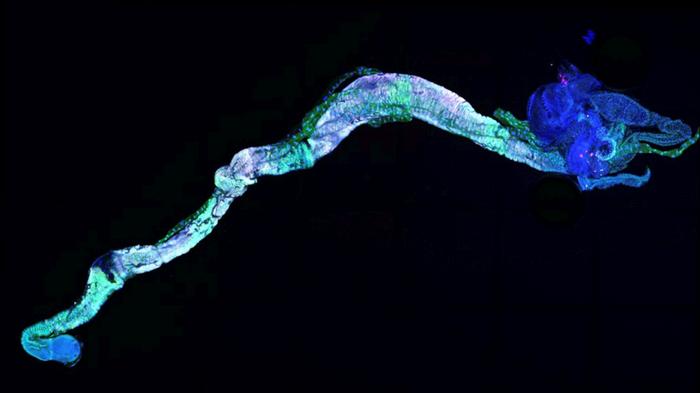
The research team at the Rudolf Schönheimer Institute of Biochemistry at the Faculty of Medicine has discovered three new adhesion GPCR genes in the genome of the fruit fly, or Drosophila. One of them is very old in evolutionary terms, and has been called mayo. In the current publication, the Leipzig scientists demonstrate the functions of this adhesion GPCR using the fruit fly as a living model. “We found that mayo affects the development of the midgut in Drosophila by promoting the growth of enterocytes, the epithelial cells of the intestinal mucosa,” says Dr Beatriz Blanco-Redondo, corresponding author of the study.
In their publication, the Leipzig scientists also show that the loss of mayo in the intestine accelerates the heart rate of the animals and that they develop dangerous palpitations. The results indicate that the functions of the intestine and heart are linked through the role of mayo in the proliferation of enterocytes. These regulate and secondarily govern ion uptake, systemic potassium levels and heart rate.
The researchers at Leipzig University studied animals in which the mayo gene had been switched off. They found that these “knockout animals” displayed elongated guts. A similar genetic picture was observed after overexpression of another adhesion GPCR in mouse intestinal cells, resulting in a mega-intestine. The study shows that adhesion GPCRs are also involved in the development of the gastrointestinal tract in other species and that these phenomena may be relevant in humans.
“We are only at the beginning of this research project. The main goal is to identify the signalling pathway in which the adhesion GPCR mayo is involved in order to find out how it controls intestinal development,” says Tobias Langenhan, Professor of General Biochemistry at the Rudolf Schönheimer Institute and also corresponding author of the study.
This study was supported by Collaborative Research Centre 1423 at Leipzig University, “Structural Dynamics of GPCR Activation and Signaling”, and by the Faculty of Medicine’s programme early career researchers. Important contributions to this publication were made by Research Unit FOR 2149 “Elucidation of Adhesion-GPCR Signalling”, which existed until 2022.
Original publication in Cell Reports:
The adhesion G-protein-coupled receptor mayo/CG11318 controls midgut development in Drosophila. https://doi.org/10.1016/j.celrep.2023.113640
Journal
Cell Reports
DOI
10.1016/j.celrep.2023.113640
Method of Research
Experimental study
Subject of Research
Animals
Article Title
The adhesion G-protein-coupled receptor mayo/CG11318 controls midgut development in Drosophila
Article Publication Date
4-Jan-2024