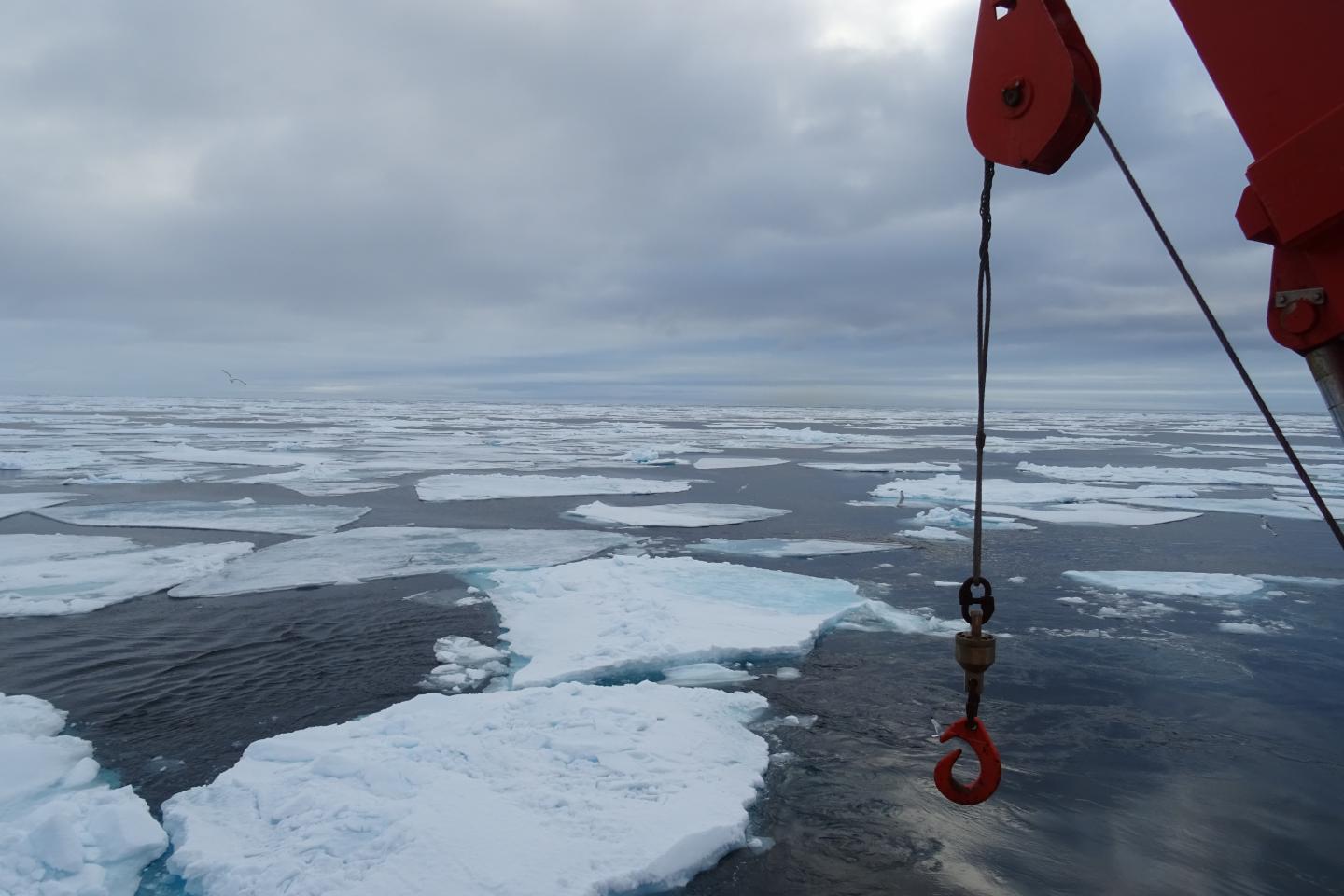
Credit: Hanna Joerss
Per- and polyfluoroalkyl substances (PFAS), found in many household products and food packages, have raised concerns because of their persistence and possible toxicity to people and wildlife. Because the compounds don’t break down naturally, they have become environmental contaminants. Now, researchers reporting in ACS’ Environmental Science & Technology have studied the transport of 29 PFAS into and out of the Arctic Ocean, detecting a newer compound for the first time in Arctic seawater.
After studies indicated that two PFAS — PFOA and PFOS — can cause cancer, a compromised immune response and other health problems in lab animals, the two compounds were voluntarily phased out by industry. However, these legacy compounds are still widely detected in the environment. Intended as a safer replacement for PFOA, HFPO-DA (sold under the trade name GenX) is now thought to pose similar health and persistence concerns. Hanna Joerss and colleagues wanted to investigate the long-range, oceanic transport of legacy and replacement PFAS to the Arctic Ocean — a remote body of water connected to the Atlantic Ocean by the Fram Strait, which is located between Svalbard and Greenland.
Aboard an icebreaker research ship, the team collected water samples along two Fram Strait currents entering and exiting the Arctic Ocean and along a path from Europe’s North Sea to the Arctic Ocean. Using mass spectrometry, the researchers detected 11 PFAS in the ocean water, including PFOA, HFPO-DA and other long- and short-chain PFAS. This was the first time that HFPO-DA had been detected in seawater from a remote region, indicating that the compound can be transported long distances. Higher levels of PFAS were detected in the water exiting the Arctic Ocean compared with the water entering the Arctic from the North Atlantic. The PFAS composition in the outgoing water suggested that more of these compounds arose from atmospheric sources than from ocean circulation.
###
The authors acknowledge funding from the Alfred Wegener Institute for Polar and Marine Research, the National Institute for Environmental Health Sciences Superfund Research Program, and in-kind support from the EISPAC Changing Arctic Ocean program, jointly funded by the UKRI Natural Environment Research Council and the German Federal Ministry of Education and Research.
The paper’s abstract will be available on July 29 at 8 a.m. Eastern time here: http://pubs.
The American Chemical Society (ACS) is a nonprofit organization chartered by the U.S. Congress. ACS’ mission is to advance the broader chemistry enterprise and its practitioners for the benefit of Earth and its people. The Society is a global leader in providing access to chemistry-related information and research through its multiple research solutions, peer-reviewed journals, scientific conferences, eBooks and weekly news periodical Chemical & Engineering News. ACS journals are among the most cited, most trusted and most read within the scientific literature; however, ACS itself does not conduct chemical research. As a specialist in scientific information solutions (including SciFinder® and STN®), its CAS division powers global research, discovery and innovation. ACS’ main offices are in Washington, D.C., and Columbus, Ohio.
ACS encourages journalists to apply for press credentials for the ACS Fall 2020 Virtual Meeting & Expo by contacting [email protected].
To automatically receive news releases from the American Chemical Society, contact [email protected].
Follow us: Twitter | Facebook
Media Contact
Katie Cottingham
[email protected]