


Parts of the planet that are diverse biologically and culturally show even more diversity than you’d expect
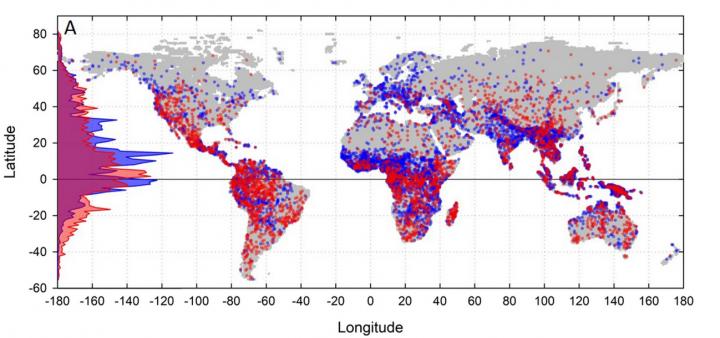
Credit: (Figure: Hamilton et al, Scientific Reports)
Most forms of life — species of mammals, birds, plants, reptiles, amphibians, etc. — are most diverse at Earth’s equator and least diverse at the poles. This distribution is called the latitudinal gradient of biodiversity.
A group of Santa Fe Institute collaborators was intrigued by the fact that human cultural diversity shows exactly the same distribution with latitude: human cultures are more diverse near the equator and least at the poles. Their big question was: why? Life is more diverse within richer environments, but it’s not clear why human cultural diversity would show this pattern too.
To find answers, the group conducted a biogeographic and macroecological study of the distribution of mammal species diversity and human ethnolinguistic diversity around the world.
In Scientific Reports, they share their study and a novel sampling method developed to explore biodiversity.
One of the authors, Marcus Hamilton, an associate professor of data analytics in the Department of Anthropology at the University of Texas at San Antonio and a former SFI postdoc, is interested in human cultural diversity and its distribution around the planet. He’s particularly curious about the ways humans and their cultures are both similar and different to other forms of biodiversity.
“Some aspects of human systems are very predictable for a mammal and others are seemingly novel,” Hamilton says.
So the group decided to explore the link between mammals and languages. “The most interesting finding here is that both mammal diversity and human linguistic diversity increase faster than you would expect with environmental richness in exactly the same way,” says Hamilton.
In other words, parts of the planet that are diverse biologically and culturally are even more diverse than you’d expect. This led to the title of their article: “Diversity begets diversity.”
The group developed a theory to show that this is because not only can richer environments hold more species but richer environments are also more interactive, so there are more niches available, more competition, cooperation, mutualisms, etc. Because richer environments are also more complex environments, you tend to find more species and languages.
“One of the things I find most interesting in our study is that diversity cannot simply be explained from the total amount of living matter that an ecosystem supports,” says SFI Professor Chris Kempes, a co-author of the article. “When we control for the amount of biomass within an environment we still see that diversity depends on ‘kinetics,’ the rate of interaction. This tells us that part of the diversity story emerges from the interaction amongst things and how often they interact, and generalizes distinct examples of species diversity and human cultures.”
It also provides insight into the relationship between complexity and diversity, which is central to complex systems.
“Our study is important to understanding why some parts of the planet are more culturally diverse than others,” says Hamilton. “It could also be very important for understanding links between the rapid loss of biodiversity and cultural diversity.”
Both biological species and human languages are going extinct at an alarming rate, and this study suggests there’s a fundamental link between the two.
###
Media Contact
J Marshall
[email protected]
Original Source
https:/
Related Journal Article
http://dx.



