A new way to reduce progression of diabetic kidney disease, affecting 40% of people with diabetes, has been discovered by scientists. The University of Bristol-led study published today [7 February] in JCI Insight, could help the 4.8 million people in the UK with diabetes who are four times more likely to need either dialysis or a kidney transplant.
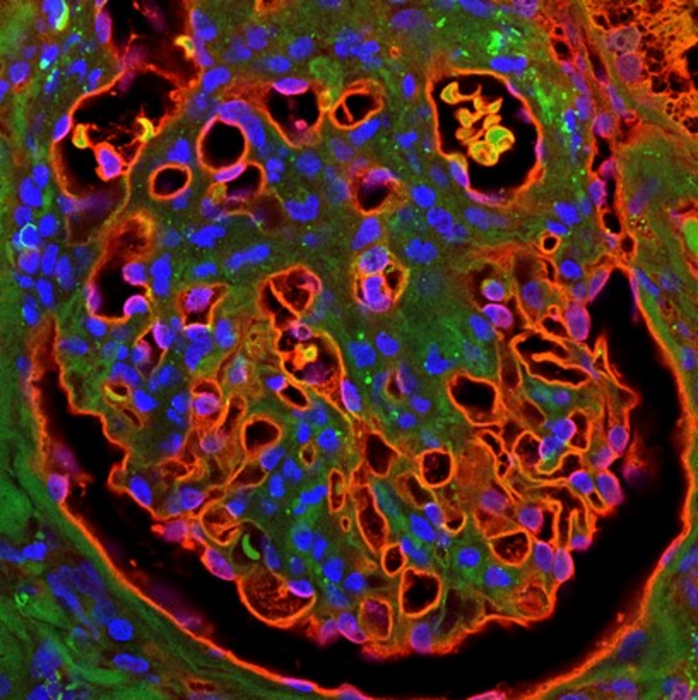
Credit: University of Bristol
A new way to reduce progression of diabetic kidney disease, affecting 40% of people with diabetes, has been discovered by scientists. The University of Bristol-led study published today [7 February] in JCI Insight, could help the 4.8 million people in the UK with diabetes who are four times more likely to need either dialysis or a kidney transplant.
Recent clinical trials show a commonly used blood pressure medicine, known as spironolactone, is an effective treatment by reducing protein leak into the urine. However, despite its positive effect, the drug can have adverse side effects, causing problems including high blood potassium levels (hyperkalaemia) in patients, making clinicians reluctant to use it.
Researchers from Bristol Medical School, in collaboration with international colleagues, aimed to understand how spironolactone prevents damage to the kidneys.
They found that the drug has a protective effect by helping preserve the gel-like glycocalyx layer on the surface of blood vessels within the kidney. Using novel alternative therapeutics to slow down glycocalyx layer degradation in diabetes directly could now help them recreate the same effect but without adverse side effects.
To conduct this study, the team used patient kidney biopsy specimens to develop a novel method to measure glycocalyx depth changes to confirm that diabetes damages the endothelial glycocalyx layer, and spironolactone prevents this damage.
Their results showed spironolactone reduces the activity of a group of enzymes, called matrix metalloproteases, helping to preserve the gel-like glycocalyx layer on the surface of the blood vessels in the kidney, preventing disease progression.
Dr Matthew Butler, the study’s joint senior author, Consultant Senior Lecturer and MRC Clinician Scientist at the University of Bristol and Honorary Nephrology Consultant at North Bristol NHS Trust (NBT), said: “This study is really exciting for us because it confirms that blocking mineralocorticoid receptors using spironolactone preserves kidney function by acting on the glycocalyx.
“Our next steps will be to look at repurposing drugs that target matrix metalloproteases enzymes [MMPs] to see if they could be of benefit in patients with kidney disease and avoid the troublesome side effects associated with mineralocorticoid receptor blockers. If we see that same level of protection using these more specific drugs, then patients will see significant benefits whilst avoiding the risks associated with high blood potassium levels.”
Dr Aisling McMahon, executive director of research and policy, Kidney Research UK, added: “Improving outcomes for patients is a key priority at Kidney Research UK. This work is an important step that will allow new treatments for diabetic kidney disease to be identified faster. We congratulate Simon and Matt on this innovative approach and look forward to seeing further developments from their team.”
The work was carried out in collaboration with colleagues at the University of Bari Aldo Moro, Italy; University of Groningen, Netherlands and the University of Texas Southwestern Medical Center, USA.
The study was funded by Kidney Research UK, Diabetes UK, British Heart Foundation, and the Medical Research Council (MRC) with support from the University’s Wolfson Bioimaging Facility.
Journal
JCI Insight
Method of Research
Experimental study
Subject of Research
Cells
Article Title
Mineralocorticoid receptor antagonism in diabetes reduces albuminuria by preserving the glomerular endothelial glycocalyx
Article Publication Date
7-Feb-2023