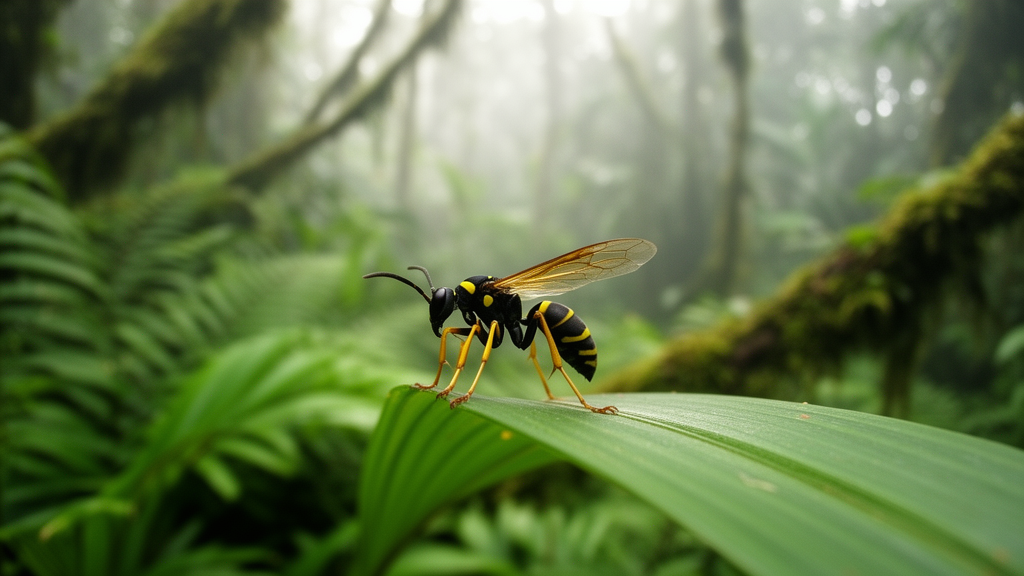
Deep in the collections of the Museo de Invertebrados de la Universidad de Panamá, a single female wasp sat for decades waiting to be recognized as something entirely new. Now, researchers examining the scoliid wasps of Mexico and Central America have formally described that specimen as Lissocampsomeris bribri, a new species of solitary wasp from Panama. The discovery, published in the journal Neotropical Biology and Conservation, raises the number of known Lissocampsomeris species in the Americas to seven and pushes the continental tally of Scoliidae wasps to 72 species.
The new species belongs to the family Scoliidae, a group of large, often strikingly colored solitary wasps whose larvae parasitize beetle grubs, including pest species. The genus Lissocampsomeris, established by Bradley in 1957, was previously known from six valid species confined to the Neotropical region. Until now, only two of those species, Lissocampsomeris columba and Lissocampsomeris wesmaeli, were thought to reach Central America, while the remaining four were typically associated with eastern South America in countries such as Brazil, French Guiana, Guyana, Paraguay, and Uruguay.
The path to the discovery began with an exhaustive review of approximately 2,600 specimens of Scoliidae from Mexico and Central America. Within that material, the researchers examined 769 specimens of Lissocampsomeris, including nine individuals of L. columba columba, 642 of L. columba albofimbriata, and 118 of L. wesmaeli. One female specimen, collected at Jardín Summit in Panama on 29 November 1994 by N. Cigarruista and housed at the Universidad de Panamá, stood out. Its morphology did not match L. columba or L. wesmaeli, nor did it fit any of the published descriptions of the South American species.
Under the microscope, the differences became unmistakable. Lissocampsomeris bribri can be distinguished by a specific combination of features in the female: the dorsal area of the propodeum, the rear segment of the thorax, bears sparse punctures and lacks the median projection on the posterior margin seen in relatives, while the posterior face of the propodeum is smooth, carrying only a few punctures restricted to the lateral margins. The species measures about 20 millimeters long, with a black-brownish integument broken only by a faint yellow band on the metanotum, white vestiture on the pectus, black setae on the pronotum, mesoscutum, and rear abdominal segments, and hyaline yellowish wings.
The researchers placed the new species in Lissocampsomeris based on the diagnostic traits proposed for the genus: posterior tibial spurs that are black and spatulate, a posterior face of the propodeum that is not coarsely and rugosely punctate, a weak mesopleural ridge, and a lower plate of the mesopleura that is polished and nearly or entirely free of punctures. The species name bribri honors the Bribri, one of the seven native peoples of Panama, who live in northwestern Panama in Bocas del Toro and in southeastern Costa Rica in the provinces of Puntarenas and Limón.
Beyond the new species itself, the study delivers the first published images of L. columba and L. wesmaeli, two species whose appearance had never been documented photographically. It also adds significant new distribution records: L. columba columba is recorded for the first time in Mexico and Guatemala, L. columba albofimbriata is now documented in all provinces of Costa Rica and for the first time in Bocas del Toro, Panama, and L. wesmaeli is recorded for the first time in Guatemala, with new records added for the Mexican states of Oaxaca and Veracruz. With these additions, the list of Scoliidae known from Panama grows to 13 species.
A major contribution of the work is the first complete taxonomic key to the females of all Lissocampsomeris species. Previous keys, including those by Bradley in 1945 and Fernandez and Cubillos in 1999, never covered every female species in the genus. The new key separates species using characters such as whether the scutellum is smooth or punctuated, wing coloration, the punctation of the occipital surface of the vertex, and the pattern of punctures and projections on the propodeum. The authors caution that the key should be used carefully, since for L. argentea, L. aureohirta, L. hoffmanseggii, and L. idonea only the original descriptions were reviewed, and those accounts are limited. The picture may change once the South American species receive fuller treatment.
The review also corrected a case of mistaken identity in the recent literature. The single male specimen identified as Pygodasis hyalina in a 2022 study is actually Lissocampsomeris columba columba, and a male specimen cited in a 2024 paper on Panamanian Scoliidae is L. columba albofimbriata. The errors came to light after the researchers examined male and female specimens of L. columba from the same localities. Pygodasis hyalina itself is restricted to Argentina, Brazil, and Colombia, and although Pygodasis is one of the more diverse scoliid genera with 14 species, images exist for only two of them and no taxonomic keys are available, making a full taxonomic review overdue.
Describing a new species from a single female specimen presents real limitations. The authors acknowledge that little can yet be said about the distribution, morphological variability, or sexual dimorphism of L. bribri, since the male remains unknown. Still, they note that some taxa are represented by very few collected specimens, and rare species are not unusual in tropical insect faunas. The holotype is deposited at the Colección Entomológica of El Colegio de la Frontera Sur in San Cristóbal, ensuring the specimen remains available for future study.
The family Scoliidae as a whole requires thorough revision, especially in South and Central America, the researchers argue. Recent taxonomic efforts in Mexico, Brazil, and Panama are steadily improving understanding of the group through new records, distribution updates, taxonomic keys, and species descriptions. The last previously described Lissocampsomeris species dates to 1945, so the addition of L. bribri after eight decades underscores how much remains to be discovered. The authors call for further fieldwork to collect the male of the new species and to map its true distribution, work that could reveal whether this Panamanian endemic is a rare relict or simply an overlooked resident of the region’s forests.
Subject of Research: Taxonomy and biodiversity of Neotropical scoliid wasps
Article Title: Lissocampsomeris bribri ( Scoliidae , Scoliinae , Campsomerini ), a new species from Panama
Article References: Ramírez-Guillén, L. D., León-Cortés, J. L., & Falcon-Brindis, A. (2026). Lissocampsomeris bribri (Scoliidae, Scoliinae, Campsomerini), a new species from Panama. Neotropical Biology and Conservation, 21(2), 111-122. https://doi.org/10.3897/neotropical.21.e190757
Image Credits: AI Generated
DOI: 10.3897/neotropical.21.e190757
Keywords: Lissocampsomeris bribri, Scoliidae, Panama, new species, taxonomy, Neotropical wasps, Bribri, Campsomerini, distribution records, taxonomic key, Lissocampsomeris, Scoliinae
News Source: Gavin Prescott. (October 16, 2026). New wasp species from Panama honors Indigenous Bribri people. Scienmag.