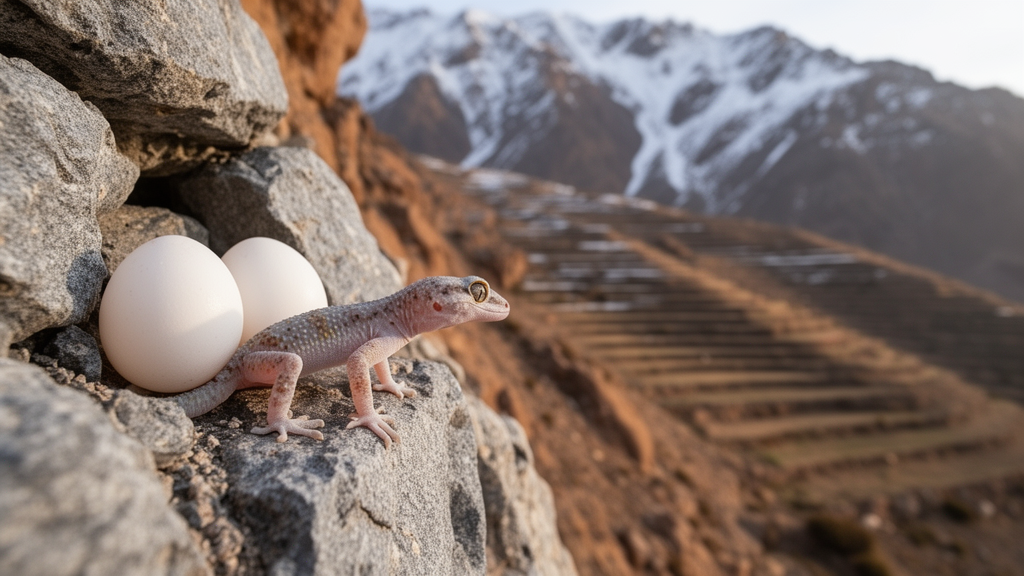
Deep in Morocco’s High Atlas Mountains, a small diurnal gecko is quietly rewriting what scientists know about how cold environments shape reproduction. A new study of the Atlas Day Gecko, Quedenfeldtia trachyblepharus, published in the journal Herpetozoa, reports that females living at higher elevations lay larger eggs than expected for their body size, a pattern consistent with increased per-offspring investment in one of the harshest habitats this cold-adapted reptile can occupy. The finding offers a rare quantitative look at how maternal provisioning varies along an elevational gradient in an oviparous gecko with invariant clutch size.
The Atlas Day Gecko is endemic to the High Atlas Mountains, where it occurs from roughly 1,400 meters to above 4,000 meters. Unlike most geckos, it is active during the day, and its reproduction is tightly constrained by seasonal thermal conditions. Field studies have shown that early in the activity season, body temperatures typically fall below the species’ preferred range of approximately 29.5 to 31.5 degrees Celsius, and individuals reach those temperatures mainly in late spring. This thermal limitation makes the species an ideal candidate for studying how cold, short-season environments influence reproductive strategies.
To investigate elevational variation in reproductive traits, researchers captured 51 gravid females at five sites located at approximately 1,900, 2,100, 2,600, 2,750, and 3,000 meters above sea level in the vicinity of Oukaimeden between April and June 2014. The High Atlas climate is cold temperate, with annual precipitation of roughly 500 to 600 millimeters, mean monthly temperatures ranging from about 22 degrees Celsius in the warmest month to about minus 5 degrees Celsius in the coldest month, and snowfall concentrated between November and March. Females were captured by hand or with a noose while basking, then housed individually in plastic terraria with a sand substrate and shelters.
In the laboratory, the room was maintained at 22 plus or minus 2 degrees Celsius, and basking heat was provided by a 60-watt spotlight at one end of each enclosure, creating a thermal gradient of approximately 22 to 40 degrees Celsius. Photoperiod was set to 14 hours of light and 10 hours of dark, water was provided ad libitum, and females were fed mealworms every two days until oviposition. Post-oviposition mass was recorded within 24 hours of laying, and all females were released at their exact capture sites within a few days after oviposition.
Each egg was measured for length and width to the nearest 0.01 millimeter and weighed to an accuracy of 0.001 gram. Egg volume was calculated using the formula V = (π/6) × L × W², where L is egg length and W is egg width. Because females laid a single egg, clutch mass was equivalent to egg mass. Relative clutch mass, expressed as a percentage, was computed as egg mass divided by post-oviposition mass multiplied by 100. Eggs were incubated in moist vermiculite within a temperature-controlled climatic chamber at 29 degrees Celsius, the only temperature at which any eggs hatched, since no eggs hatched at 24 degrees Celsius. Hatching success at 29 degrees Celsius was 91 percent, and incubation lasted 42 to 51 days with a mean of 45.4 days.
The results revealed striking elevational patterns. Female snout-vent length increased with elevation, with a correlation coefficient of 0.48 and a p-value below 0.001, indicating that females were generally larger at higher sites. Maternal body mass also increased with elevation, and this pattern persisted after controlling for maternal size. The smallest gravid female measured 35.7 millimeters in snout-vent length. All ovipositing females produced a single egg, confirming the invariant clutch size characteristic of geckos.
Egg mass and egg volume were significantly affected by maternal snout-vent length, with larger females having heavier and larger eggs. However, the elevational difference in egg traits did not disappear even after the effect of maternal size had been removed statistically. Residual egg mass and residual egg volume, calculated from regressions against maternal snout-vent length, correlated positively with the elevational gradient, with correlation coefficients of 0.29 and 0.32 respectively. This means that high-elevation females produced larger eggs than expected for their body size, independent of the allometric relationship between maternal size and egg provisioning.
Relative clutch mass declined with female snout-vent length, indicating negative allometry in reproductive allocation, and varied among elevations. However, residual relative clutch mass did not correlate with the elevational gradient itself, suggesting that the elevational pattern in egg size operates through absolute per-offspring provisioning rather than through the proportion of maternal mass allocated to reproduction. Hatchling snout-vent length increased with egg mass and egg volume, and hatchling body condition also increased with egg mass and, more strongly, with egg volume. When maternal size and egg traits were included in the same model, the effect of maternal size on hatchling size was only marginal, suggesting that the relationship between maternal size and hatchling phenotype was largely mediated through egg provisioning. Elevation did not explain additional variation in hatchling traits once egg traits were considered.
These findings are consistent with the idea that environmental constraints in the Atlas Mountains, such as low temperatures and short activity seasons, shift female reproductive allocation from offspring quantity toward offspring quality. In taxa with invariant clutch size, the classical offspring size-number trade-off is expressed primarily through egg size rather than clutch size, making egg provisioning the key pathway through which mothers modulate offspring traits. Larger eggs may provide hatchlings with greater energy reserves, potentially enhancing survival or performance advantages when time for growth is limited. Similar patterns have been observed in lizards with variable clutch size, where females produce smaller clutches of larger eggs at high elevations.
The study underscores how maternal size-dependent allocation and elevational context jointly shape reproductive output in a high-mountain gecko. Larger eggs at high elevation, independent of maternal size, highlight the potential importance of maternal provisioning as a mechanism linking environmental constraint to offspring traits. However, the authors note that understanding whether these elevational shifts are driven purely by environmental conditions or reflect genetically based local adaptation requires further investigation. Future work combining nest microclimate monitoring, maternal body condition, and incubation under fluctuating thermal regimes, followed by measurements of post-hatching growth and ecophysiological traits, would clarify the mechanisms and fitness consequences of increased egg size at high elevation.
Subject of Research: Elevational variation in egg size and maternal investment in the Atlas Day Gecko
Article Title: High-elevation females lay larger eggs in the Atlas Day Gecko, Quedenfeldtia trachyblepharus (Boettger, 1873)
Article References: Lansari, A., Blouin-Demers, G., Lourdais, O., El Mouden, E. H., & Bouazza, A. (2026). High-elevation females lay larger eggs in the Atlas Day Gecko, Quedenfeldtia trachyblepharus (Boettger, 1873). Herpetozoa, 39, 273-279. https://doi.org/10.3897/herpetozoa.39.e171364
Image Credits: AI Generated
DOI: 10.3897/herpetozoa.39.e171364
Keywords: Atlas Day Gecko, High Atlas Mountains, Morocco, reproductive investment, egg size, life-history evolution, elevational gradient, gekkota, herpetology, maternal effects, High-elevation, females
News Source: Gavin Prescott. (October 16, 2026). High-Atlas Geckos Lay Bigger Eggs as Elevations Rise, Study Finds. Scienmag.