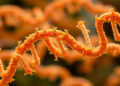
Muscle malfunctions may be as simple as a slight strain after exercise or as serious as heart failure and muscular dystrophy. A new technique developed at McGill now makes it possible to look much more closely at how sarcomeres, the basic building blocks within all skeletal and cardiac muscles, work together. It's a discovery that should advance research into a wide range of muscle malfunctions.
Talk about finicky work
Sarcomeres are the smallest unit within a muscle in which all the molecules responsible for making a muscle work can be found intact. These minuscule structures, about one hundred times smaller in diameter than an average human hair, work cooperatively to produce force during muscle contraction. Scientists have known for some time that when muscles are active many million sarcomeres work together, and that muscle malfunctions can be due, at least in part, to miscommunication between sarcomeres. But how exactly this communication takes place has been a mystery until now. Because no one before has been able to isolate a single sarcomere, watch it in action, and measure what's going on.
"It was very, very tricky and sometimes frustrating for the students working on this project over the last few years," says Dilson Rassier who teaches in the Department of Kinesiology at McGill and is the lead researcher on the study that was recently published in the prestigious journal Proceedings of the National Academy of Sciences of the United States of America. "We used micro-fabricated needles to measure force and high-tech microscopy to isolate the sarcomeres and then watch them contracting. One of our collaborators had to develop a mathematical model to analyze the data because the numbers involved were so minuscule and so precise."
Zooming in on microscopic mini-muscles in action
There are between 2,000 and 2,500 sarcomeres found together in linked coils in each 10 millimetres of muscle fibre. To watch the sarcomeres in action, the researchers first had to isolate a single myofibril (the basic rod-like units which make up muscle tissue) and then zoom in on an individual sarcomere. They then experimented with different concentrations of calcium (which is responsible for triggering muscle activation and relaxation) to cause the sarcomeres to contract and measure their force.
What they discovered was that, in a healthy myofibril, all the neighbouring sarcomeres adjust to the activation of one single sarcomere. This finding is new and provocative, showing a cooperative mechanism among sarcomeres in a myofibril that is linked to the specific properties of sarcomeric molecules. This inter-sarcomere dynamic is crucial for the understanding of the molecular mechanism of contraction.
Rassier sounds exultant about the findings: "My group had to work hard to conclude this study, but the results were worth it. The technique opens many possibilities in the muscle field. Since we published our findings a few weeks ago I've been hearing from biophysicists and physiologists from around the world who are excited about it. Our next step is to look into what happens in heart failure and other diseases of the muscular system when sarcomeres fail to cooperate."
###
Funding was provided by the Canadian Institutes for Health Research (CIHR), the Natural Science and Engineering Research Council of Canada (NSERC), the National Counsel of Technological and Scientific Development (CNPq, Brazil) and the Canada Research Chair Program.
To read "Microfluidic perfusion shows intersarcomere dynamics within single skeletal muscle myofibrils", by Felipe de Souza Leite et al, Proceedings of the National Academy of Sciences of the United States of America (PNAS) DOI: 10.1073/pnas.1700615114: http://www.pnas.org/content/114/33/8794.abstract
Contacts:
Prof. Dilson Rassier
Dept. of Kinesiology
McGill University
[email protected]
Katherine Gombay
Media and Public Relations
McGill University
[email protected]
514 398-2189
http://www.mcgill.ca/newsroom/
Media Contact
Katherine Gombay
[email protected]
514-398-2189
@McGillU
http://www.mcgill.ca
http://www.mcgill.ca/newsroom/channels/news/new-understanding-how-muscles-work-269759
Related Journal Article
http://dx.doi.org/10.1073/pnas.1700615114