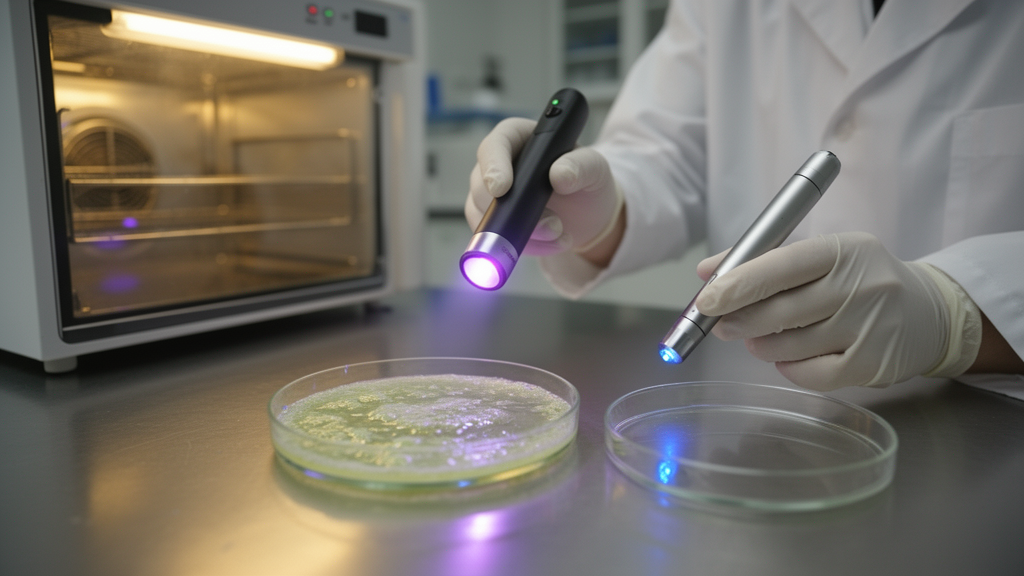
Every engineer who has fought mold on a hospital wall, bacteria on a food-processing line, or fungi on building materials knows the same frustrating truth: the same disinfection treatment that wipes out a young colony can leave a mature one largely intact. A new theoretical study published in Results in Engineering by Pavel Demo and Filip Přeučil of Czech technical institutions now offers a deceptively simple answer to the question that has long lurked behind this observation — not how strong a treatment must be, but how late it can be switched on and still guarantee that a growing surface colony is driven to extinction. The work converts a classic growth equation into an explicit deadline, a closed-form activation boundary that tells operators whether their intervention window has already closed.
The researchers frame the problem as a coupled design question. Any decontamination strategy must deliver sufficient microbial inactivation while limiting treatment time, energy use, material damage, and chemical burden. But for a colony that is actively expanding across a surface, there is a second, equally important variable: the state of the colony at the moment treatment begins. A sparse film of spores responds very differently to a fixed dose than a dense, three-dimensional mat with gradients of nutrients, oxygen, and moisture. Conventional inactivation models — Chick–Watson, Hom, Weibull, modified Gompertz, and Bigelow log-linear formulations — describe how survival declines during and after exposure. Demo and Přeučil deliberately ask a different, pre-treatment question: given the initial coverage and a calibrated balance between natural growth and killing, what is the latest activation time compatible with the extinction side of the underlying dynamical system?
The mathematical core of the paper is a reduced logistic balance. Surface coverage θ grows logistically toward a carrying capacity K with rate r, while an external inactivation source contributes an effective rate I during the treatment interval. The authors show that the maximum logistic production term is rK/4, which defines a critical inactivation intensity Ic = rK/4. If the treatment’s effective inactivation rate exceeds this critical value, the model predicts decline across the entire coverage range — no positive stationary point exists, and the colony is doomed regardless of its size. Below the critical intensity, however, two stationary points emerge, and the lower one acts as an unstable threshold. Colonies below it collapse toward zero; colonies above it survive and recover. This threshold structure yields the paper’s central result: an explicit formula for the latest activation time as a function of initial coverage, growth rate, and inactivation strength.
The sensitivity analysis of this boundary reveals intuitive but quantitatively sharp trends. Increasing the initial coverage always shortens the admissible waiting time, while increasing the inactivation strength relative to the critical value lengthens it. More strikingly, the sensitivity of the boundary to the inactivation strength diverges as the treatment approaches the critical intensity, meaning that small parameter errors can have enormous consequences near the transition. The authors are careful to stress that their framework is deterministic: they deliberately avoid language such as probability of eradication, because the model contains no stochastic component and the archived experiments provide no replicate-level frequencies from which probabilities could be estimated.
To illustrate the criterion, the authors re-analyzed previously obtained growth trajectories of Aspergillus brasiliensis, a mold strain maintained on malt extract agar in Petri dishes, whose surface coverage was quantified by pixel-based image analysis of high-resolution photographs processed in Fiji. Three treatment conditions were examined. Ultraviolet-C irradiation at 253.7 nanometers was applied 24 hours after inoculation using a germicidal lamp delivering approximately 450 microwatts per square centimeter at the sample. Cold atmospheric plasma was generated with a diffuse coplanar surface barrier discharge operated in ambient air at 300 watts, with the sample positioned 3 millimeters from the source, and applied either 72 or 117 hours after inoculation for 10 minutes per session.
The comparison between model classification and observed outcome is striking. In the UV-C case, coverage at activation had reached 1.28 percent, just 0.58 percentage points above the model’s unstable threshold of 0.70 percent — placing the treatment on the survival side, and indeed the colony subsequently grew. For plasma applied at 117 hours, coverage had climbed to 58.9 percent, far above the threshold of 39.5 percent, and the model correctly predicted survival, with the colony showing renewed macroscopic growth after a prolonged delay. Only the plasma treatment initiated at 72 hours landed on the extinction side: coverage was just 5.6 percent against a threshold near 50 percent, a margin of minus 44.4 percentage points, and no regrowth was observed. All three trajectories were consistent with the deterministic classification.
The authors are unusually candid about what these numbers do and do not mean. The optical coverage measure is an operational, macroscopic outcome, not a count of viable cells or spores — no colony-forming-unit assay, membrane-integrity test, or biochemical viability marker was performed. The effective inactivation rate I is a lumped parameter that absorbs the net outcome of a particular reactor, electrical setting, distance, humidity, substrate, colony morphology, and treatment duration; it is not a universal constant of a plasma source or lamp. The nominal electrical quantities reported for the plasma device — approximately 1.88 watts per square centimeter and 1.13 kilojoules per square centimeter — are hardware-level input parameters derived from the set point and source area, not plasma dose or absorbed biological dose, and the authors explicitly decline to convert between them.
This restraint reflects a genuine gap in the underlying data. The archived runs lack run-specific voltage and current, ambient relative humidity, sample temperature, optical emission spectra, reactive species concentrations, and electron temperature. None of the mechanisms widely discussed in the cold atmospheric plasma literature — oxidative and nitrosative stress, lipid and membrane damage, protein oxidation, nucleic-acid damage — was measured directly. The delayed regrowth observed after the 117-hour plasma treatment is an observed trajectory feature, and explanations such as sublethal injury followed by repair remain literature-supported possibilities rather than demonstrated findings. Similarly, the term biofilm is used operationally for a surface-associated colony; the model does not resolve the extracellular polymeric substance architecture, diffusion-limited regions, or protected subpopulations characteristic of real bacterial biofilms.
Despite these limitations, the engineering workflow the paper proposes is concrete and potentially transformative for preventive scheduling. First, surface monitoring or historical growth data provide estimates of initial coverage and growth rate. Second, a specific inactivation source is calibrated under fixed hardware, distance, humidity, substrate, and organism conditions to obtain an effective inactivation rate. Third, the critical intensity, unstable threshold, and activation boundary are calculated to determine the latest nominal intervention time. Fourth, the real schedule incorporates a safety margin based on measured uncertainty rather than operating directly on the boundary. Candidate application domains include periodically inspected hospital and medical-device surfaces, HVAC components, food-contact equipment, and moisture-sensitive building materials — though the authors emphasize these are prospective domains, not applications validated by the present dataset.
The study’s scope is deliberately narrow: one fungal species, one UV-C condition, two plasma activation times, and no replicate-level measurements. The three trajectories constitute an internal consistency check, not an independent validation, and no head-to-head comparison with conventional kinetic models is attempted because the dataset lacks multiple doses, replicates, and a validation set. Transfer to other organisms, materials, or plasma reactors requires separate calibration. Yet the conceptual contribution stands on its own: by converting a logistic growth–inactivation balance into an explicit activation deadline and a critical intensity, the paper reframes decontamination from a question of dose into a question of timing — and gives engineers, for the first time in closed form, a mathematical answer to how long they can afford to wait.
Subject of Research: A mathematical timing criterion for scheduling microbial biofilm inactivation by UV-C irradiation and cold atmospheric plasma
Article Title: An engineering timing criterion for microbial biofilm inactivation by UV-C irradiation and cold atmospheric plasma
Article References: Demo, P., & Přeučil, F. (2026). An engineering timing criterion for microbial biofilm inactivation by UV-C irradiation and cold atmospheric plasma. Results in Engineering, 32, Article 113299. https://doi.org/10.1016/j.rineng.2026.113299
Image Credits: AI Generated
DOI: Not provided
Keywords: biofilm, cold atmospheric plasma, UV-C irradiation, Aspergillus brasiliensis, logistic growth model, inactivation kinetics, surface decontamination, timing criterion, reactive oxygen and nitrogen species, DCSBD, predictive modeling, food safety
News Source: Denise Maddox. (October 15, 2026). New Timing Rule Tells Engineers Exactly When to Strike Growing Biofilms With UV Light or Plasma. Scienmag.