Credit: Purdue University/Chris Adam
WEST LAFAYETTE, Ind. – Something as simple as an electric field could soon make wartime missiles or drinking mugs easier to produce and more resilient for fracture.
Items such as drinking mugs, missile heads, thermal barrier coatings on engine blades, auto parts, electronic and optic components are commonly made with ceramics.
The ceramics are mechanically strong, but tend to fracture suddenly when just slightly strained under a load unless exposed to high temperatures.
Purdue University researchers have developed a new process to help overcome the brittle nature of ceramics and make it more ductile and durable. The Purdue team calls the process “flash sintering,” which adds an electric field to the conventional sintering process used to form bulk components from ceramics.
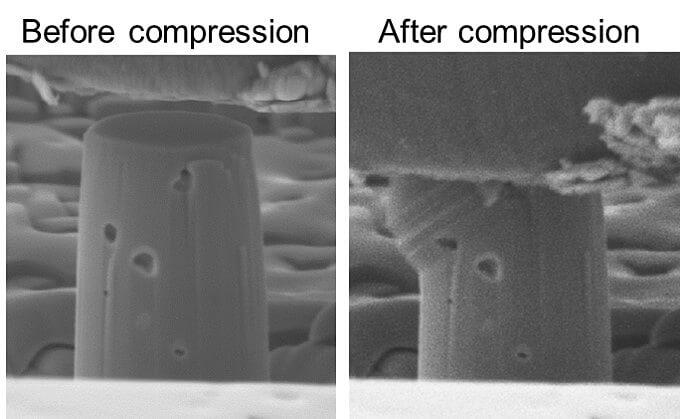
“We have been able to show that even at room temperatures, ceramics sintered with the electric field surprisingly deform plastically before fracture when compressed at high strain,” said Haiyan Wang, the Basil S. Turner Professor of Engineering in Purdue’s College of Engineering.
A study published in Science Advances demonstrates that applying an electric field to the formation of ceramics makes the material almost as easily reshaped as metal at room temperature. The Purdue team specifically applied its technique to titanium dioxide, a widely used white pigment.
“Nanotwins have been introduced in various metallic materials to improve strength and ductility. However, there are little prior studies that show nanotwins and stacking faults can significantly improve the plasticity of ceramics,” said Jin Li, a postdoctoral fellow and researcher on the research team.
The significantly enhanced room temperature ductility in titanium dioxide is attributed to the unusually high-density defects, such as stacking faults, twins and dislocations, formed through the flash sintering process.
“The existence of these defects remove the need for defect nucleation in ceramics, which typically requires a large nucleation stress, greater than the fracture stress of ceramics,” Wang said.
Li, the first author of the article from Purdue, said, “Our results are important because they open the door for using many different ceramics in new ways that can provide more flexibility and durability to sustain heavy loads and high temperatures without catastrophic brittle failure.”
Improved plasticity for ceramics means more mechanical durability during operation at relatively low temperatures. The sample also could withstand almost as much compression strain as some metals do before cracks started to appear.
“These ductile ceramics find many technologically important applications,” said Xinghang Zhang, professor of materials engineering and co-principle investigator on the research team. “It can be applied to defense operations, automobile manufacturing, nuclear reactor components and sustainable energy devices.”
###
This Purdue-led research is supported by the Office of Naval Research in collaboration with the University of California, Davis, Rutgers University and Naval Research Laboratory.
Their work aligns with Purdue’s Giant Leaps celebration of the global advancements in sustainability as part of Purdue’s 150th anniversary. Sustainability is one of the four themes of the yearlong celebration’s Ideas Festival, designed to showcase Purdue as an intellectual center solving real-world issues.
The research team is working with the Purdue Research Foundation Office of Technology Commercialization to patent their work. They are looking for partners for continued research. For more information on licensing and other opportunities, contact D.H.R. Sarma from OTC at [email protected].
About Purdue Research Foundation Office of Technology Commercialization
The Purdue Research Foundation Office of Technology Commercialization operates one of the most comprehensive technology transfer programs among leading research universities in the U.S. Services provided by this office support the economic development initiatives of Purdue University and benefit the university’s academic activities through commercializing, licensing and protecting Purdue intellectual property. For more information on licensing a Purdue innovation, contact the Office of Technology Commercialization at [email protected]. For more information about funding and investment opportunities in startups based on a Purdue innovation, contact the Purdue Foundry at [email protected] Purdue Research Foundation is a private, nonprofit foundation created to advance the mission of Purdue University.
Writer: Chris Adam, 765-588-3341, [email protected]
Sources: Haiyan Wang, [email protected]
Xinghang Zhang, [email protected]
Media Contact
Chris Adam
[email protected]
Related Journal Article
http://dx.