• HOME
  • NEWS
  • EXPLORE
    • CAREER
      • Companies
      • Jobs
    • EVENTS
    • iGEM
      • News
      • Team
    • PHOTOS
    • VIDEO
    • WIKI
  • BLOG
  • COMMUNITY
    • FACEBOOK
    • INSTAGRAM
    • TWITTER
Saturday, February 7, 2026
BIOENGINEER.ORG
No Result
View All Result
  • Login
  • HOME
  • NEWS
  • EXPLORE
    • CAREER
      • Companies
      • Jobs
        • Lecturer
        • PhD Studentship
        • Postdoc
        • Research Assistant
    • EVENTS
    • iGEM
      • News
      • Team
    • PHOTOS
    • VIDEO
    • WIKI
  • BLOG
  • COMMUNITY
    • FACEBOOK
    • INSTAGRAM
    • TWITTER
  • HOME
  • NEWS
  • EXPLORE
    • CAREER
      • Companies
      • Jobs
        • Lecturer
        • PhD Studentship
        • Postdoc
        • Research Assistant
    • EVENTS
    • iGEM
      • News
      • Team
    • PHOTOS
    • VIDEO
    • WIKI
  • BLOG
  • COMMUNITY
    • FACEBOOK
    • INSTAGRAM
    • TWITTER
No Result
View All Result
Bioengineer.org
No Result
View All Result
Home NEWS Science News Chemistry

New technique for engineering living materials and patterns

Bioengineer by Bioengineer
June 5, 2020
in Chemistry
Reading Time: 3 mins read
0
IMAGE
Share on FacebookShare on TwitterShare on LinkedinShare on RedditShare on Telegram

IMAGE

Credit: University of Warwick

Engineered living materials (ELMs) is a new class of materials that exploit the properties of living organisms

    · While various techniques such as 3D printers have been utilized for developing ELMs, these techniques are typically limited for static patterns and suffer for technical complications

    · Researchers at the Departments of Physics and the School of Life Sciences, University of Warwick used fluidic channels to make patterns using bacterial cells

    · The method, named MeniFluidics, opens the door for further innovations and creation of arts, from ELMs, fundamental research into cellular interactions, to bio-art and tissue engineering

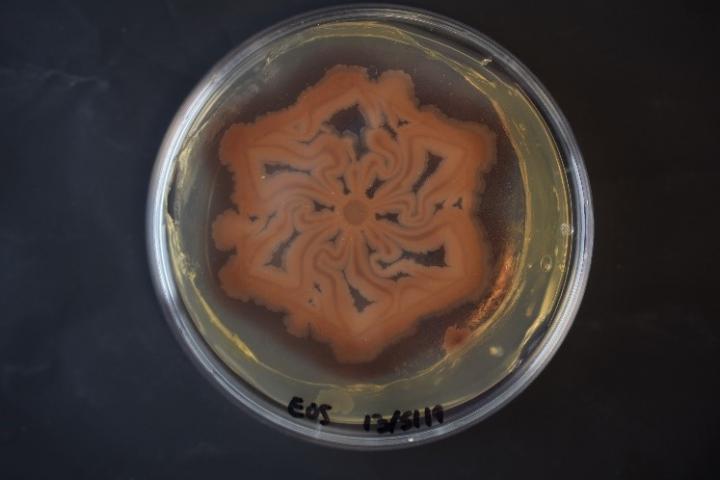
A new method for engineering living materials called ‘MeniFluidics’, made by researchers at the University of Warwick could see a transformation in tissue engineering and bio-art, as well as new ways to research cellular interactions.A bacterial biofilm patterned using MeniFluidics.

Living cells have many properties that non-living materials simply don’t. The ability of controlling the emergent behaviours of cells and organising them into arbitrary patterns is a key step forward towards utilizing living materials, for uses such as organs on a chip. This is why new technologies are being developed to obtain such an ability.

Physicists and biologists at the University of Warwick have teamed up to develop a new method for controlling cellular patterns, published in the journal ACS Synthetic Biology, titled ‘Pattern engineering of living bacterial colonies using meniscus-driven fluidic channels’, their new technique is called MeniFluidics.

Grounded on the physics of meniscus generation, the researchers implemented structures into gel surfaces. Evaporation of water from gel materials lead to formation of open channels which can be used for guiding the direction and speed of cellular expansion.

Dr Vasily Kantsler, from Department of Physics at the University of Warwick comments;

“I believe that our catchy named (Menifluidics) technique will enable new opportunities in biophysical and biomedical research and applications such as antibiotic resistance and biofouling”

Dr Munehiro Asally, from School of Life Science at the University of Warwick adds;

“We hope MeniFluidics will be used widely by biophysics, microbiologists, engineers and also artists! As it is a simple and versatile method.”

###

NOTES TO EDITORS

High-res images available credit to the University of Warwick at: https://warwick.ac.uk/services/communications/medialibrary/images/june2020/pic_for_release.jpgCaption: A bacterial biofilm patterned using MeniFluidics.

Paper available to view at: https://pubs.acs.org/doi/10.1021/acssynbio.0c00146

For further information please contact:

Alice Scott

Media Relations Manager – Science

University of Warwick

Tel: +44 (0) 7920 531 221

E-mail: [email protected]

Media Contact
Alice Scott
[email protected]

Original Source

https://warwick.ac.uk/newsandevents/pressreleases/new_technique_for

Related Journal Article

http://dx.doi.org/10.1021/acssynbio.0c00146

Tags: BiochemistryBiologyBiomedical/Environmental/Chemical EngineeringBiotechnology
Share12Tweet8Share2ShareShareShare2

Related Posts

blank

Breakthrough in Environmental Cleanup: Scientists Develop Solar-Activated Biochar for Faster Remediation

February 7, 2026
blank

Cutting Costs: Making Hydrogen Fuel Cells More Affordable

February 6, 2026

Scientists Develop Hand-Held “Levitating” Time Crystals

February 6, 2026

Observing a Key Green-Energy Catalyst Dissolve Atom by Atom

February 6, 2026
Please login to join discussion

POPULAR NEWS

  • Robotic Ureteral Reconstruction: A Novel Approach

    Robotic Ureteral Reconstruction: A Novel Approach

    82 shares
    Share 33 Tweet 21
  • Digital Privacy: Health Data Control in Incarceration

    63 shares
    Share 25 Tweet 16
  • Study Reveals Lipid Accumulation in ME/CFS Cells

    57 shares
    Share 23 Tweet 14
  • Breakthrough in RNA Research Accelerates Medical Innovations Timeline

    53 shares
    Share 21 Tweet 13

About

We bring you the latest biotechnology news from best research centers and universities around the world. Check our website.

Follow us

Recent News

Oxygen-Enhanced Dual-Section Microneedle Patch Improves Drug Delivery and Boosts Photodynamic and Anti-Inflammatory Treatment for Psoriasis

Scientists Identify SARS-CoV-2 PLpro and RIPK1 Inhibitors Showing Potent Synergistic Antiviral Effects in Mouse COVID-19 Model

Neg-Entropy: The Key Therapeutic Target for Chronic Diseases

Subscribe to Blog via Email

Enter your email address to subscribe to this blog and receive notifications of new posts by email.

Join 73 other subscribers
  • Contact Us

Bioengineer.org © Copyright 2023 All Rights Reserved.

Welcome Back!

Login to your account below

Forgotten Password?

Retrieve your password

Please enter your username or email address to reset your password.

Log In
No Result
View All Result
  • Homepages
    • Home Page 1
    • Home Page 2
  • News
  • National
  • Business
  • Health
  • Lifestyle
  • Science

Bioengineer.org © Copyright 2023 All Rights Reserved.