• HOME
  • NEWS
  • EXPLORE
    • CAREER
      • Companies
      • Jobs
    • EVENTS
    • iGEM
      • News
      • Team
    • PHOTOS
    • VIDEO
    • WIKI
  • BLOG
  • COMMUNITY
    • FACEBOOK
    • INSTAGRAM
    • TWITTER
Sunday, May 10, 2026
BIOENGINEER.ORG
No Result
View All Result
  • Login
  • HOME
  • NEWS
  • EXPLORE
    • CAREER
      • Companies
      • Jobs
        • Lecturer
        • PhD Studentship
        • Postdoc
        • Research Assistant
    • EVENTS
    • iGEM
      • News
      • Team
    • PHOTOS
    • VIDEO
    • WIKI
  • BLOG
  • COMMUNITY
    • FACEBOOK
    • INSTAGRAM
    • TWITTER
  • HOME
  • NEWS
  • EXPLORE
    • CAREER
      • Companies
      • Jobs
        • Lecturer
        • PhD Studentship
        • Postdoc
        • Research Assistant
    • EVENTS
    • iGEM
      • News
      • Team
    • PHOTOS
    • VIDEO
    • WIKI
  • BLOG
  • COMMUNITY
    • FACEBOOK
    • INSTAGRAM
    • TWITTER
No Result
View All Result
Bioengineer.org
No Result
View All Result
Home NEWS Science News Chemistry

New study suggests ‘Pac-Man-like’ mergers could explain massive, spinning black holes

Bioengineer by Bioengineer
November 8, 2019
in Chemistry
Reading Time: 2 mins read
0
IMAGE
Share on FacebookShare on TwitterShare on LinkedinShare on RedditShare on Telegram

RIT Associate Professor Richard O’Shaughnessy contributes to study in Physical Review Letters
IMAGE

Credit: Scott C. Noble


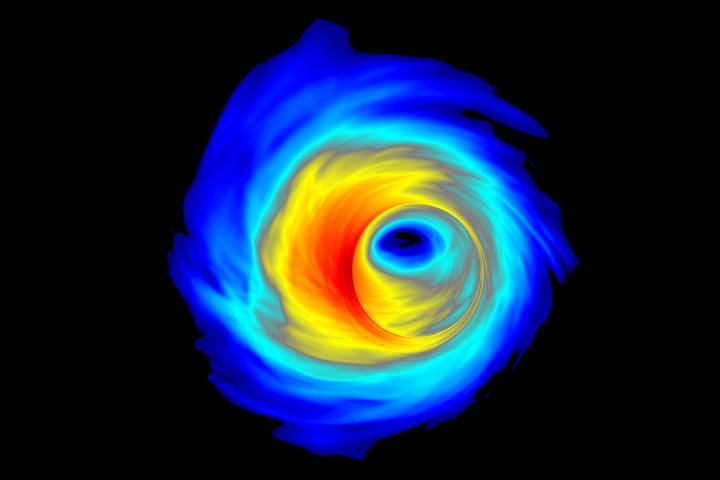
Scientists have reported detecting gravitational waves from 10 black hole mergers to date, but they are still trying to explain the origins of those mergers. The largest merger detected so far seems to have defied previous models because it has a higher spin and mass than the range thought possible. A group of researchers, including Rochester Institute of Technology Assistant Professor Richard O’Shaughnessy, has created simulations that could explain how the merger happened.

In a new paper published in Physical Review Letters, the researchers suggest that such large mergers could happen just outside supermassive black holes at the center of active galactic nuclei. Gas, stars, dust and black holes become caught in a region surrounding supermassive black holes known as the accretion disk. The researchers suggest that as black holes circle around in the accretion disk, they eventually collide and merge to form a bigger black hole, which continues to devour smaller black holes, becoming increasingly large in what O’Shaughnessy calls “Pac-Man-like” behavior.

“This is a very tantalizing prospect for those of us who work in this field,” said O’Shaughnessy, a member of RIT’s Center for Computational Relativity and Gravitation (CCRG). “It offers a natural way to explain high mass, high spin binary black hole mergers and to produce binaries in parts of parameter space that the other models cannot populate. There is no way to get certain types of black holes out of these other formation channels.”

As the LIGO and Virgo collaboration continue to hunt for gravitational waves, O’Shaughnessy and his fellow researchers hope to find signatures of large, spinning black holes that could help confirm their models. If their assumptions are correct, it could help us better understand how the cosmic web of galaxies assembles.

“This could be a unique way of probing the physics around these supermassive black holes in a way that could not be probed in any other way,” said O’Shaughnessy. “It offers unique insight into how the centers of galaxies grow, which is of course essential to understanding how galaxies as a whole grow, which explains most of the structure in the universe.”

###

RIT’s CCRG has a large and active group of 18 faculty, students and postdoctoral researchers involved in the LIGO Scientific Collaboration. For more information, visit the CCRG website: https://ccrg.rit.edu/

For more information, contact Luke Auburn at 585-475-4335, [email protected], or on Twitter: @lukeauburn.

Media Contact
Luke Auburn
[email protected]
585-475-4335

Original Source

https://www.rit.edu/news/new-study-suggests-pac-man-mergers-could-explain-massive-spinning-black-holes

Tags: Algorithms/ModelsAstronomyAstrophysicsCalculations/Problem-SolvingSpace/Planetary Science
Share19Tweet12Share3ShareShareShare2

Related Posts

Miniature Sensor Uses Light to Detect Touch — Chemistry

Miniature Sensor Uses Light to Detect Touch

May 8, 2026
Iron Minerals Determine Whether Dissolved Organic Matter Fuels Microbes or Becomes Long-Term Carbon Storage — Chemistry

Iron Minerals Determine Whether Dissolved Organic Matter Fuels Microbes or Becomes Long-Term Carbon Storage

May 8, 2026

Kate Evans Appointed Associate Lab Director for Biological and Environmental Systems Science at ORNL

May 8, 2026

Advancing Multiscale Modeling and Overcoming Operational Challenges in Autothermal COâ‚‚-to-Methanol Reactors

May 8, 2026
Please login to join discussion

POPULAR NEWS

  • Research Indicates Potential Connection Between Prenatal Medication Exposure and Elevated Autism Risk

    840 shares
    Share 336 Tweet 210
  • New Study Reveals Plants Can Detect the Sound of Rain

    727 shares
    Share 290 Tweet 181
  • Scientists Investigate Possible Connection Between COVID-19 and Increased Lung Cancer Risk

    68 shares
    Share 27 Tweet 17
  • Salmonella Haem Blocks Macrophages, Boosts Infection

    61 shares
    Share 24 Tweet 15

About

We bring you the latest biotechnology news from best research centers and universities around the world. Check our website.

Follow us

Recent News

Evaluating Digoxin Use in Patients with Symptomatic Rheumatic Heart Disease

Evaluating the Effectiveness and Safety of Digitalis Glycosides in Treating Heart Failure

Urdu Fall Risk Questionnaire Adapted for Elderly

Subscribe to Blog via Email

Success! An email was just sent to confirm your subscription. Please find the email now and click 'Confirm' to start subscribing.

Join 82 other subscribers
  • Contact Us

Bioengineer.org © Copyright 2023 All Rights Reserved.

Welcome Back!

Login to your account below

Forgotten Password?

Retrieve your password

Please enter your username or email address to reset your password.

Log In
No Result
View All Result
  • Homepages
    • Home Page 1
    • Home Page 2
  • News
  • National
  • Business
  • Health
  • Lifestyle
  • Science

Bioengineer.org © Copyright 2023 All Rights Reserved.