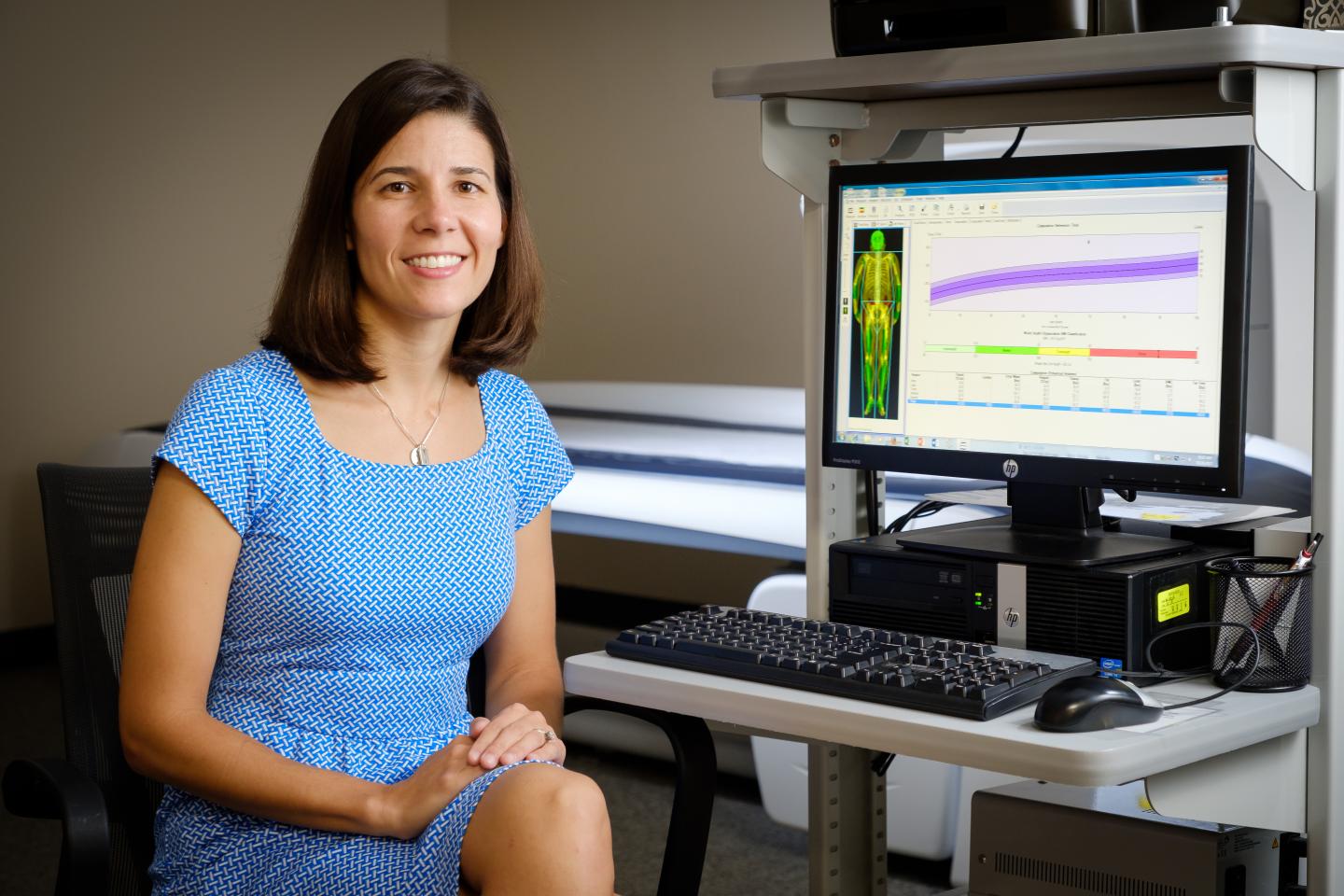
Credit: WFU / Ken Bennett
A high-protein, low-calorie diet helps older adults with obesity lose more weight, maintain more muscle mass, improve bone quality and lose “bad” fat, according to results from a new randomized controlled trial led by Wake Forest University researcher Kristen Beavers.
Four research papers based on the study results have been accepted for publication in peer-reviewed journals including the Journals of Gerontology: Medical Sciences and the American Journal of Clinical Nutrition. The latest was published this week in the Annals of Nutrition and Metabolism.
Geriatricians have long struggled with how to recommend safe weight loss for seniors, because dropping pounds can lead to muscle and bone loss.
“Doctors hesitate to recommend weight loss for fear that losing muscle and bone could cause mobility issues or increase the risk of injury,” said Beavers, assistant professor of health and exercise science at Wake Forest and principal investigator of this study. “This study suggests that a diet high in protein and low in calories can give seniors the health benefits of weight loss while keeping the muscle and bone they need for better quality of life as they age.”
This study aimed to quantify the risk of doing nothing by comparing results from a weight loss group vs. a weight stability group. For the study, 96 older adults over age 65 were randomly assigned to one of two groups: a six-month low-calorie meal plan that included more than 1 gram of protein per kilogram of body weight, plus adequate calcium and vitamin D; or a weight stability group targeting .8 grams of protein per kilogram of body weight, which is the current, government-recommended dietary allowance. The researchers decided not to include exercise, because many older adults are unlikely to perform the volume and intensity of exercise needed to preserve muscle and bone.
Here’s what the researchers found:
- – Participants lost about 18 pounds, most of it fat (87 percent), and preserved muscle mass. The control group lost about half a pound.
– Even when participants lost weight, they maintained bone mass. In fact, trabecular bone score, a measure of bone quality that predicts fracture risk, seemed to improve.
– Fat was lost in the stomach, hips, thighs and rear, which is important for preventing or controlling cardiometabolic diseases such as diabetes and stroke.
– Participants’ score on the Healthy Aging Index, which measures biomarkers that predict mortality and longevity, improved by 0.75 points.
Previously, Beavers has conducted smaller studies for which she oversaw the planning and preparation of healthy high-protein, low-calorie meals for weight-loss study participants. However, the size of the recent trial sent her in search of a simpler, cost-effective solution.
In this case, the researchers had the weight-loss group follow a high-protein, nutritionally complete, reduced-calorie meal plan that included the use of four meal replacements, two meals of lean protein and vegetables prepared by the participants, and one healthy snack; however, Beavers said any high-protein, nutritious low-calorie meal plan would likely work.
The weight-stability group attended health education classes and were encouraged to maintain their baseline diet and normal activity. Beavers said participants complied with their assigned intervention.
Jason Pharmaceuticals Inc., a wholly owned subsidiary of Medifast Inc., provided a grant and an in-kind donation of the products given to the research participants. Additional funding was provided by the Wake Forest Claude D. Pepper Center Older Americans Independence Center and a National Institute on Aging career development award to Beavers (K01 AG047921).
The research team included Amy Collins, Sherri Ford, Beverly Nesbit, Lauren Shaver and Jessica Sheedy of Wake Forest’s Department of Health and Exercise Science; Arlynn Baker, Daniel Beavers, Rebecca Henderson, Denise Houston, Mary Lyles, Stephen Kritchevsky, and Ashley Weaver of the Wake Forest School of Medicine; Monica Serra and Jessica Kelleher of Emory University School of Medicine; Sue Shapses of Rutgers University; and Linda Arterburn, Christopher Coleman and Jessica Kiel of Medifast.
###
The studies:
– “Effect of an Energy-Restricted, Nutritionally Complete, Higher Protein Meal Plan on Body Composition and Mobility in Older Adults with Obesity,” Journals of Gerontology: Medical Sciences, published online in advance of print June 21, 2018
– “Effect of a Hypocaloric, Nutritionally Complete, Higher-Protein Meal Plan on Bone Density and Quality in Older Adults With Obesity,” American Journal of Clinical Nutrition, published online in advance of print Jan. 9, 2019
–
“Effect of Intentional Weight Loss on Mortality Biomarkers in Older Adults With Obesity,” Journals of Gerontology: Medical Sciences, published online in advance of print Aug. 20, 2018
– “Effects of a Hypocaloric, Nutritionally Complete, Higher Protein Meal Plan on Regional Body Fat and Cardiometabolic Biomarkers in Older Adults with Obesity,” Annals of Nutrition and Metabolism, published online in advance of print Feb. 12, 2019
Media Contact
Katie Neal
[email protected]
336-758-6141
Original Source
https:/
Related Journal Article
http://dx.