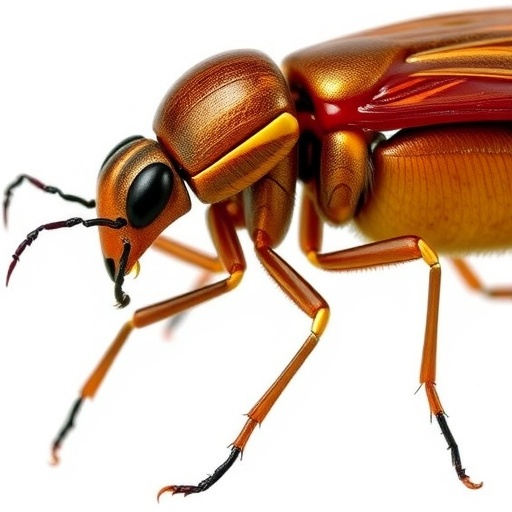
In recent decades, the escalating crises wrought by population expansion and climate change have intensified global efforts to identify sustainable alternative food sources. Among these, insect consumption—or entomophagy—has garnered increasing attention, supported by the Food and Agriculture Organization of the United Nations, which catalogs over 1,600 edible insect species worldwide. Despite this, Western societies remain largely resistant to embracing entomophagy, a cultural aversion whose origins have been elusive. New genomic research published in Science Advances provides illuminating insights into the evolutionary and ecological factors that underpin this reluctance and traces the complex history of insect consumption in Eurasian populations.
The multidisciplinary team at the Institute of Evolutionary Biology (IBE), a collaborative institute of the Spanish National Research Council (CSIC) and Pompeu Fabra University (UPF), performed extensive genomic analyses on ancient dental calculus samples from anatomically modern humans spanning back 33,000 years. Dental tartar serves as a repository of dietary DNA, allowing researchers to reconstruct diets with remarkable precision. Their findings reveal that deliberate insect consumption was sporadic and largely incidental in northern Eurasian populations, contrasting sharply with the pattern of frequent entomophagy seen in tropical regions. This suggests a geographic and evolutionary basis for the varied human relationship with insects as food.
Central to the study was the investigation of chitinase genes—those responsible for producing enzymes capable of degrading chitin, the primary structural polysaccharide in insect exoskeletons. Analysis revealed that northern Eurasian populations carry mutations that impair chitin digestion, a genomic signature that has persisted for approximately 9,000 years since the dawn of agriculture. This enduring modification indicates a long-standing reduction in insect consumption in these populations, implying that the cultural rejection often attributed to recent factors may instead be deeply embedded in human ecological and evolutionary history.
The research also sheds light on the dietary habits of our closest relatives, the Neanderthals. Contrary to anatomically modern humans who inhabited similar environments, Neanderthals exhibited significantly higher levels of insect DNA in their dental calculus, analogous to the entomophagy-dependent diet of western chimpanzees living in savannah habitats. This parallels the hypothesis that Neanderthals regularly incorporated fly larvae and mosquitoes into their diet, possibly by scavenging animal carcasses infested by these insects, which are especially prevalent in wetland areas.
Genetic analyses further indicate that Neanderthals and even the Denisovan specimen examined possessed chitinase genes optimized for digesting insects. The functional adaptations in these archaic hominins suggest that insect consumption was more integral to their dietary ecology compared to modern humans in higher latitudes. This genomic evidence supports a model in which insect-based nutrition was a sustained and significant component of hominin survival strategies in diverse Pleistocene environments.
The study extends its genomic focus to modern and ancient populations residing near tropical latitudes, where insect diversity and biomass are significantly greater. Here, genetic variants linked to heightened expression of chitinase acid (CHIA) and chitobiase (CTBS) enzymes are prevalent, aligning with ethnographic records of persistent entomophagy. In these regions, the abundance of social insects such as termites and locusts not only provides a consistent and nutritionally rich food source but may also contribute to ecological pest control, highlighting a symbiotic relationship between humans and insect populations.
A compelling finding is the latitudinal gradient in the expression of insect-digesting enzymes, which decreases progressively with increasing distance from the tropics. This genetic cline reflects an evolutionary relaxation of selective pressures favoring insect digestion as populations migrated into temperate and boreal zones with limited insect availability. Thus, the abandonment of entomophagy in Europe and parts of northern Asia is not solely attributable to cultural prejudice but is also echoed in the genome over millennia.
The implications of this research reverberate beyond academic interest. It provides a nuanced understanding that dietary preferences and tolerances are interwoven with long-term ecological availability and evolutionary adaptation. Such insights can recalibrate how we approach modern dietary interventions and sustainability initiatives that promote insects as future food. Although the digestion of insect exoskeletons remains limited in many human populations, modern food processing technologies can exploit insects’ nutritional advantages without requiring enzymatic breakdown of chitin, facilitating broader acceptance.
Furthermore, the group led by Pablo Librado at the IBE is pioneering genomic studies on insect domestication processes, leveraging historical entomological collections to trace the evolutionary trajectories of edible insect species. These efforts aim to optimize insect farming practices for human consumption and animal feed, potentially revolutionizing the sustainability of animal protein sources and contributing to food security in a changing world.
The research underscores how ancient human behaviors are indelibly recorded both in the fossilized plaque of our ancestors and our contemporary genomes, illustrating a complex interplay of biology, environment, and culture. As humanity confronts unprecedented environmental challenges, revisiting and reevaluating entomophagy through this genomic lens offers a promising avenue for integrating evolutionary wisdom with future innovation.
Subject of Research: People
Article Title: Genomic evidence for limited entomophagy in ancient Europeans
News Publication Date: 5-Jun-2026
Web References: http://dx.doi.org/10.1126/sciadv.aec6939
Image Credits: Juan Manuel Calvo Martin
Keywords: Arthropods, Entomophagy, Chitinase genes, Neanderthals, Genomics, Evolution, Sustainable food, Insect consumption
Tags: climate change and alternative proteinscultural aversion to entomophagydietary DNA analysis from dental calculusedible insect species worldwideevolutionary genomics of entomophagygenomic research on ancient humanshistory of human insect eatinginsect consumption in ancient dietsmultidisciplinary evolutionary biology studypopulation expansion and food securityregional differences in entomophagysustainable alternative food sources