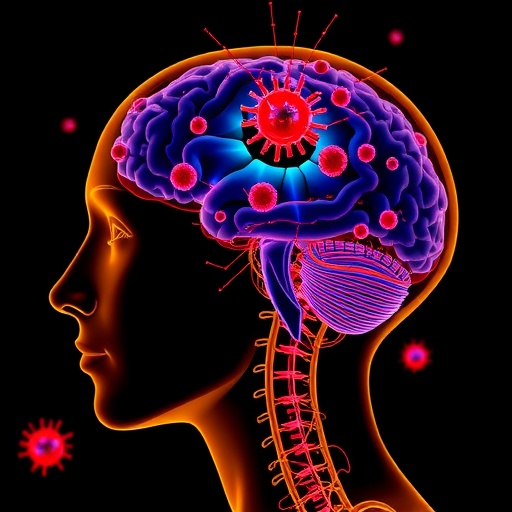
Ebola Virus Finds Sanctuary in the Brain: Breaking Ground with Human Cerebral Organoids
In a landmark study published in Nature Microbiology, researchers from the Icahn School of Medicine at Mount Sinai and the Bernhard Nocht Institute for Tropical Medicine (BNITM) have uncovered how the deadly Ebola virus can persist and replicate stealthily within the human central nervous system. By leveraging cutting-edge cerebral organoid models—three-dimensional brain-like structures derived from human pluripotent stem cells—the team has shed light on the viral mechanisms that allow long-term survival, raising critical implications for treatment and prevention strategies of Ebola virus disease (EVD).
It has long been a harrowing clinical observation that survivors of acute Ebola infections sometimes suffer relapses or develop inflammatory syndromes months or even years after recovery. This enduring threat is attributed to the virus’s ability to hide out in “immune-privileged” regions of the body—such as the central nervous system (CNS)—where the immune surveillance is deliberately restrained to protect vulnerable tissue from damaging inflammation. This latest research elucidates the ways Ebola virus exploits this sanctuary and endures prison-like conditions inside cerebral tissue without fully succumbing to immune clearance.
The team engineered cerebral organoids by coaxing human induced pluripotent stem cells (iPSCs) into forming spherical, differentiated structures composed of multiple neural cell types: neurons, astrocytes, and microglia alike. These organoids mimic the cellular environment of the human brain closely enough to serve as a viable model to explore viral persistence with unprecedented resolution and relevance. Unlike traditional animal models, these human-derived organoids enable direct examination of host-virus interactions in a context that recapitulates human neuroanatomy and immunology.
Longitudinal infection experiments revealed that Ebola virus and related filoviruses—including Sudan, Reston, and Marburg viruses—could sustain active replication within these cerebral organoids for up to 120 days. More intriguingly, Ebola virus infected not just neurons but also astrocytes and microglia, the brain’s resident immune cells. The virus exhibited two spreading modalities: direct cell-to-cell contact transmission as well as classical budding from host cells. This productive persistence clearly places the virus in an infectious, replicative state rather than a latent or inactive one.
Despite the robust production of pro-inflammatory cytokines by infected organoids, the innate immune responses orchestrated within this model failed to clear the infection entirely. The study observed an upregulation of immune and inflammatory markers at later stages, mirroring clinical presentations seen in Ebola virus disease survivors who develop delayed meningoencephalitis and other inflammatory sequelae. The data affirm that persistent filovirus infection in immune-privileged tissues contributes to localized inflammation, fostering neurological disease conditions even after primary viremia subsides.
At the molecular level, whole-genome sequencing of viral populations recovered from persistently infected organoids uncovered the presence of defective viral genomes (DVGs) and a spectrum of mutations emerging during chronic replication. DVGs are truncated or mutated forms of viral genomes known to modulate replication dynamics and immune evasion in other viral families. These defective genomes may allow the Ebola virus to dampen replication while maintaining a foothold inside host tissue, facilitating long-term survival without triggering overwhelming immune destruction.
Several mutations identified in the viral sequences corresponded to variants previously reported to attenuate replication in natural infections, while others were novel and uncharacterized. This emerging mutational landscape hints at an ongoing evolutionary arms race as the virus adapts to the CNS environment and immune pressures. Such adaptations could be critical determinants in the capacity of Ebola virus to establish persistent reservoirs and cause relapses.
This cerebral organoid model’s faithful recapitulation of human Ebola virus infection patterns underscores its utility as a powerful platform for mechanistic studies of viral persistence. Unlike animal models, which often fail to mimic intricate human neural immunology adequately, organoids offer a nearer-to-human experimental system. This breakthrough has potential ramifications for testing and optimizing targeted antiviral therapies aimed specifically at reservoirs residing in immune-privileged compartments.
Moreover, cerebral organoids provide an ethically favorable and scalable alternative to animal experiments, fostering more humane and potentially faster progress in infectious disease research. This innovation aligns with global efforts to reduce animal use in biomedical studies and to increase translational fidelity to human conditions.
Looking ahead, the research team emphasizes expanding their investigations to include other lesser-studied filoviruses such as Taï Forest, Bombali, and Bundibugyo viruses. Comprehensive deciphering of host–virus dynamics in such a model may unravel universal persistence mechanisms across filovirus species, informing cross-cutting therapeutic strategies. Crucially, this work also lays groundwork for exploring how viral persistence in the CNS intersects with immune modulation, neuroinflammation, and long-term neurological sequelae in EVD survivors.
Persistent Ebola infection in the brain highlights a formidable challenge for public health, given the potential for virus reactivation or even transmission from immune-privileged sanctuaries. This study delivers a compelling window into that hidden battleground, leveraging state-of-the-art human cellular models to confront a deadly pathogen’s stealth strategies. Unlocking the biology of Ebola’s cerebral persistence may ultimately pave the way for interventions that not only save lives during acute infection but also circumvent post-recovery complications and community outbreaks.
As our understanding deepens, harnessing cerebral organoids as investigative tools promises to revolutionize the study of neurotropic viral infections. The Mount Sinai and BNITM collaboration exemplifies how multidisciplinary, translational research can illuminate the dark corners of viral pathogenesis and guide clinical innovation for diseases once deemed intractable.
Subject of Research: Animals (via human-derived cerebral organoids)
Article Title: Host–virus determinants of Ebola virus persistence in a human cerebral organoid model
News Publication Date: 12-Jun-2026
Web References:
https://www.nature.com/articles/s41564-026-02388-2
http://dx.doi.org/10.1038/s41564-026-02388-2
Keywords: Ebola virus, cerebral organoids, central nervous system, viral persistence, filoviruses, neuroinflammation, antiviral therapy, immune evasion, defective viral genomes, virus-host interaction
Tags: advances in Ebola treatment and prevention strategiescerebral organoids in viral researchEbola virus persistence in central nervous systemEbola virus relapse and inflammatory syndromesEbola virus replication in brain tissuehuman induced pluripotent stem cells for brain modelingimmune-privileged sites and viral survivallong-term Ebola virus infection mechanismsMount Sinai microbiology Ebola studyneuroinflammation in Ebola virus diseasestem cell models for infectious diseasesviral immune evasion in CNS