• HOME
  • NEWS
  • EXPLORE
    • CAREER
      • Companies
      • Jobs
    • EVENTS
    • iGEM
      • News
      • Team
    • PHOTOS
    • VIDEO
    • WIKI
  • BLOG
  • COMMUNITY
    • FACEBOOK
    • INSTAGRAM
    • TWITTER
Saturday, June 20, 2026
BIOENGINEER.ORG
No Result
View All Result
  • Login
  • HOME
  • NEWS
  • EXPLORE
    • CAREER
      • Companies
      • Jobs
        • Lecturer
        • PhD Studentship
        • Postdoc
        • Research Assistant
    • EVENTS
    • iGEM
      • News
      • Team
    • PHOTOS
    • VIDEO
    • WIKI
  • BLOG
  • COMMUNITY
    • FACEBOOK
    • INSTAGRAM
    • TWITTER
  • HOME
  • NEWS
  • EXPLORE
    • CAREER
      • Companies
      • Jobs
        • Lecturer
        • PhD Studentship
        • Postdoc
        • Research Assistant
    • EVENTS
    • iGEM
      • News
      • Team
    • PHOTOS
    • VIDEO
    • WIKI
  • BLOG
  • COMMUNITY
    • FACEBOOK
    • INSTAGRAM
    • TWITTER
No Result
View All Result
Bioengineer.org
No Result
View All Result
Home NEWS Science News

New study resolves the structure of the human protein that causes cystic fibrosis

Bioengineer by Bioengineer
March 23, 2017
in Science News
Reading Time: 2 mins read
0
Share on FacebookShare on TwitterShare on LinkedinShare on RedditShare on Telegram
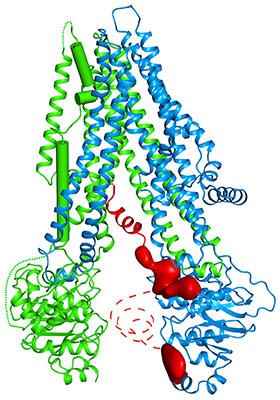
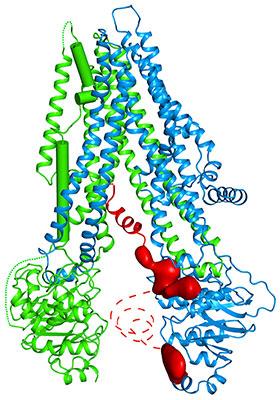
IMAGE

Credit: Laboratory of Membrane Biology and Biophysics at The Rockefeller University/Cell

Scientists at The Rockefeller University have mapped the three-dimensional structure for one of the more notorious disease-causing molecules in the human body: the protein responsible for the genetic disorder cystic fibrosis. And it looks fishy.

In research described in Cell on March 23, the researchers report that the human structure is almost identical to one they have determined previously for the zebrafish version of the protein.

"With these detailed new reconstructions, we can begin to understand how this protein functions normally, and how errors within it cause cystic fibrosis," says Jue Chen, William E. Ford Professor. "We now know that the conclusions we drew from our previous work in zebrafish also apply to us."

Cystic fibrosis arises from mutations in a single gene, which encodes a protein that forms a channel through which chloride ions pass in and out of cells. Errors in this protein, called the cystic fibrosis transmembrane conductance regulator (CFTR), can lead to the accumulation of thick, sticky mucus. The buildup of mucus has the most deadly effects in the lungs, where it can cause potentially fatal breathing problems or respiratory infections.

Although cystic fibrosis is a human disorder, many animals also express CFTR. When the human protein proved difficult to work with in the lab, Chen and her colleagues instead turned to the more-cooperative zebrafish version. Among other things, they used it to map the location of disease-causing mutations–findings that can now be applied to studying how the faulty human protein can spark disease.

Two researchers from Chen's lab, Fangyu Liu, a graduate student, and Zhe Zhang, a postdoc, led the effort to resolve the configuration of the human CFTR using an imaging technique known as cryo-electron microscopy, which has allowed researchers to take pictures, down to the level of atoms, of many previously intractable molecules. The structure of the human protein, like that of the zebrafish version, was determined using equipment at the Evelyn Gruss Lipper Cryo-Electron Microscopy Resource Center.

With new clues from the human structure, the researchers went on to explore the mechanism by which the channel becomes activated and the events that lead it to open and close, with help from David C. Gadsby, Patrick A. Gerschel Family Professor at Rockefeller and László Csanády of Hungary's Semmelweis University, a former graduate student in Gadsby's lab.

Chen is the head of Rockefeller's Laboratory of Membrane Biology and Biophysics and a Howard Hughes Medical Institute investigator.

###

Media Contact

Katherine Fenz
[email protected]
212-327-7913
@rockefelleruniv

http://www.rockefeller.edu

############

Story Source: Materials provided by Scienmag

Share12Tweet8Share2ShareShareShare2

Related Posts

Animal Models Advance Neuro-Urology in Spinal Injury

June 20, 2026
Tiny Genetic Fragments Crucial for Signaling Brain Rest Identified — Biology

Tiny Genetic Fragments Crucial for Signaling Brain Rest Identified

June 19, 2026

How H5N1 Bird Flu Went Undetected for Weeks in Dairy Cattle

June 19, 2026

Turning Quantum Potential into Reality

June 19, 2026
Please login to join discussion

POPULAR NEWS

  • Saying Goodbye to PGY-6: Pediatric Fellowship Realities

    103 shares
    Share 41 Tweet 26
  • Multi-Hospital Study Reveals Long Covid Burden Is Twice as High as Current Estimates

    92 shares
    Share 36 Tweet 23
  • Detection of EDCs in Breast Milk and Infant Urine Up to Six Months Highlights Early Exposure Risks

    77 shares
    Share 31 Tweet 19
  • New Drug Candidate Developed at McMaster Shows Potential for Treating Brain Cancer

    58 shares
    Share 23 Tweet 15

About

We bring you the latest biotechnology news from best research centers and universities around the world. Check our website.

Follow us

Recent News

Animal Models Advance Neuro-Urology in Spinal Injury

Tiny Genetic Fragments Crucial for Signaling Brain Rest Identified

How H5N1 Bird Flu Went Undetected for Weeks in Dairy Cattle

Subscribe to Blog via Email

Enter your email address to subscribe to this blog and receive notifications of new posts by email.

Join 82 other subscribers
  • Contact Us

Bioengineer.org © Copyright 2023 All Rights Reserved.

Welcome Back!

Login to your account below

Forgotten Password?

Retrieve your password

Please enter your username or email address to reset your password.

Log In
No Result
View All Result
  • Homepages
    • Home Page 1
    • Home Page 2
  • News
  • National
  • Business
  • Health
  • Lifestyle
  • Science

Bioengineer.org © Copyright 2023 All Rights Reserved.