• HOME
  • NEWS
  • EXPLORE
    • CAREER
      • Companies
      • Jobs
    • EVENTS
    • iGEM
      • News
      • Team
    • PHOTOS
    • VIDEO
    • WIKI
  • BLOG
  • COMMUNITY
    • FACEBOOK
    • INSTAGRAM
    • TWITTER
Friday, June 26, 2026
BIOENGINEER.ORG
No Result
View All Result
  • Login
  • HOME
  • NEWS
  • EXPLORE
    • CAREER
      • Companies
      • Jobs
        • Lecturer
        • PhD Studentship
        • Postdoc
        • Research Assistant
    • EVENTS
    • iGEM
      • News
      • Team
    • PHOTOS
    • VIDEO
    • WIKI
  • BLOG
  • COMMUNITY
    • FACEBOOK
    • INSTAGRAM
    • TWITTER
  • HOME
  • NEWS
  • EXPLORE
    • CAREER
      • Companies
      • Jobs
        • Lecturer
        • PhD Studentship
        • Postdoc
        • Research Assistant
    • EVENTS
    • iGEM
      • News
      • Team
    • PHOTOS
    • VIDEO
    • WIKI
  • BLOG
  • COMMUNITY
    • FACEBOOK
    • INSTAGRAM
    • TWITTER
No Result
View All Result
Bioengineer.org
No Result
View All Result
Home NEWS Science News Biology

New study identifies potential path forward for brachial plexus injury recovery

Bioengineer by Bioengineer
January 16, 2020
in Biology
Reading Time: 2 mins read
0
IMAGE
Share on FacebookShare on TwitterShare on LinkedinShare on RedditShare on Telegram

IMAGE

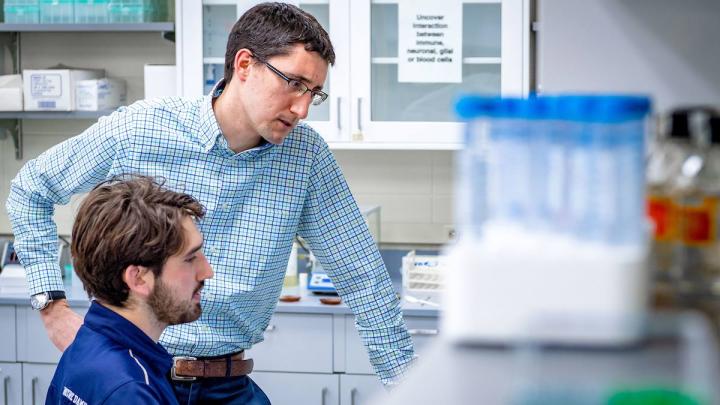
Credit: Photo by Matt Cashore/University of Notre Dame

On average, an estimated three out of every 1,000 newborns will suffer a brachial plexus injury during birth, damaging the bundle of nerves that connect the brain and spinal cord to the shoulders, arms and hands. In the most traumatic cases, even with surgery and physical therapy as an infant, there is no treatment that can guarantee a full recovery.

However, a new study from the University of Notre Dame has identified a strategy that may support the regeneration of nerves affected by a brachial plexus injury. The findings show that there could be a new path forward for a full behavioral recovery.

“Early on, our model showed that the nerve regeneration process after a brachial plexus injury differed from how these nerves connect the peripheral and central nervous systems during early development,” said Cody Smith, the Elizabeth and Michael Gallagher Assistant Professor of Biological Sciences and co-author of the study. “My lab worked to recreate that development-like process by using a chemotherapy treatment, paclitaxel, which helped stabilize axon invasion for spinal cord re-entry.”

During early development, nerves known as dorsal root ganglia (DRG) sensory axons enter the spinal cord to then connect with specific neurons, which provide motor and sensory function for hands, arms and shoulders. However, after a brachial plexus injury, these DRG sensory axons are unable to penetrate the spinal cord barrier when attempting to regenerate. For the study, which was published in Cell Reports, the Notre Dame researchers aimed to identify a process that would allow severed DRG sensory axons to enter the spinal cord when regenerating after an injury within their model.

Once the DRG sensory axons penetrated the spinal cord, the researchers were able to establish connection between the nerves and with neuronal “partners,” allowing for full functional recovery in the model after 48 hours. Although the study was intended to mimic regeneration after obstetrical brachial plexus injuries, there is potential for it to benefit those who suffer a brachial plexus injury later in life as a result of an accident or other trauma.

“Moving forward, our goal is to use our studies during development to identify more specific strategies for regeneration,” said Smith. “It is exciting that we have a path forward to identify new regeneration molecules.”

###

The lead author of the study is Evan Nichols, a graduate of the University of Notre Dame and a current graduate student at Stanford University. Smith is an affiliated member of the Center for Stem Cells and Regenerative Medicine at Notre Dame. The study was completed with the support of the Freimann Life Science Center and was funded by the Alfred P. Sloan Foundation, the National Institutes of Health and the Spinal Cord and Brain Injury Fund Research Grant from the Indiana State Department of Health.

Media Contact
Jessica Sieff
[email protected]
574-631-3933

Original Source

https://news.nd.edu/news/new-study-identifies-potential-path-forward-for-brachial-plexus-injury-recovery/

Related Journal Article

http://dx.doi.org/10.1016/j.celrep.2019.12.008

Tags: Biology
Share12Tweet8Share2ShareShareShare2

Related Posts

Natural Hallucinogens: Evolution’s Ecological Tools, Not Mere Chemical Byproducts

June 25, 2026

This Famous Butterfly Revealed: Three Distinct Species Hidden in One

June 25, 2026

Scientists Attack Soybean Cyst Nematode by Starving Its Food Source

June 25, 2026

Decoding the Secret Code of a Crucial Immune Sensor

June 24, 2026
Please login to join discussion

POPULAR NEWS

  • Saying Goodbye to PGY-6: Pediatric Fellowship Realities

    103 shares
    Share 41 Tweet 26
  • Multi-Hospital Study Reveals Long Covid Burden Is Twice as High as Current Estimates

    92 shares
    Share 36 Tweet 23
  • Detection of EDCs in Breast Milk and Infant Urine Up to Six Months Highlights Early Exposure Risks

    77 shares
    Share 31 Tweet 19
  • New Drug Candidate Developed at McMaster Shows Potential for Treating Brain Cancer

    58 shares
    Share 23 Tweet 15

About

We bring you the latest biotechnology news from best research centers and universities around the world. Check our website.

Follow us

Recent News

Tracking Lanthanide-Labeled Microplastics in Plants

POSTECH Researchers Slash Cost of Reconstituted Cell-Free Systems by 95%

AI and Physics Collaborate to Design Advanced Hydrogen Storage Materials

Subscribe to Blog via Email

Success! An email was just sent to confirm your subscription. Please find the email now and click 'Confirm' to start subscribing.

Join 82 other subscribers
  • Contact Us

Bioengineer.org © Copyright 2023 All Rights Reserved.

Welcome Back!

Login to your account below

Forgotten Password?

Retrieve your password

Please enter your username or email address to reset your password.

Log In
No Result
View All Result
  • Homepages
    • Home Page 1
    • Home Page 2
  • News
  • National
  • Business
  • Health
  • Lifestyle
  • Science

Bioengineer.org © Copyright 2023 All Rights Reserved.