• HOME
  • NEWS
  • EXPLORE
    • CAREER
      • Companies
      • Jobs
    • EVENTS
    • iGEM
      • News
      • Team
    • PHOTOS
    • VIDEO
    • WIKI
  • BLOG
  • COMMUNITY
    • FACEBOOK
    • INSTAGRAM
    • TWITTER
Friday, July 3, 2026
BIOENGINEER.ORG
No Result
View All Result
  • Login
  • HOME
  • NEWS
  • EXPLORE
    • CAREER
      • Companies
      • Jobs
        • Lecturer
        • PhD Studentship
        • Postdoc
        • Research Assistant
    • EVENTS
    • iGEM
      • News
      • Team
    • PHOTOS
    • VIDEO
    • WIKI
  • BLOG
  • COMMUNITY
    • FACEBOOK
    • INSTAGRAM
    • TWITTER
  • HOME
  • NEWS
  • EXPLORE
    • CAREER
      • Companies
      • Jobs
        • Lecturer
        • PhD Studentship
        • Postdoc
        • Research Assistant
    • EVENTS
    • iGEM
      • News
      • Team
    • PHOTOS
    • VIDEO
    • WIKI
  • BLOG
  • COMMUNITY
    • FACEBOOK
    • INSTAGRAM
    • TWITTER
No Result
View All Result
Bioengineer.org
No Result
View All Result
Home NEWS Science News Chemistry

New study finds novel functions of the pyruvate-sensing protein PdhR in E. Coli

Bioengineer by Bioengineer
September 28, 2020
in Chemistry
Reading Time: 2 mins read
0
IMAGE
Share on FacebookShare on TwitterShare on LinkedinShare on RedditShare on Telegram

IMAGE

Credit: Microbial Genomics, Tokyo Tech

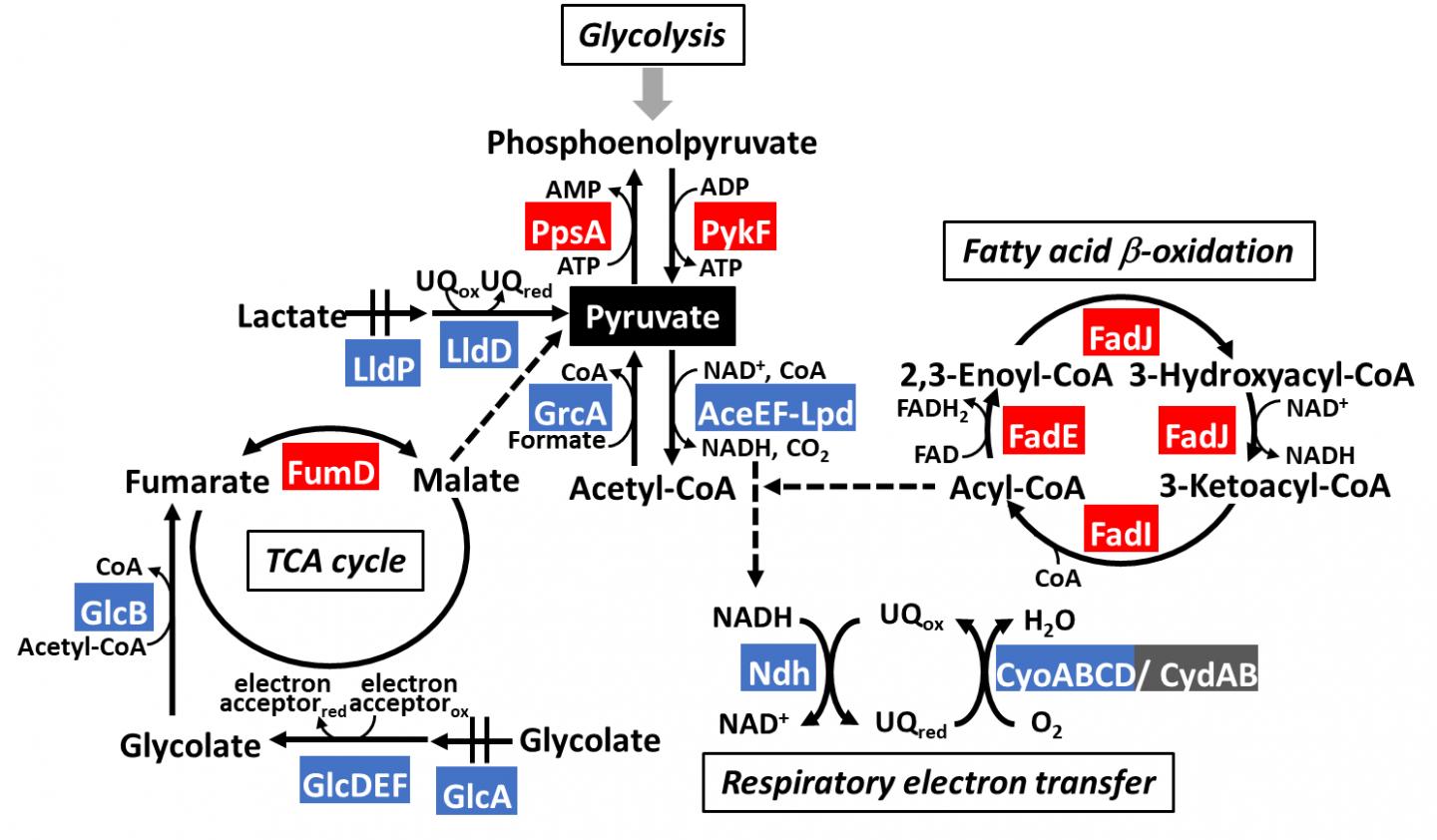
Organisms, ranging from bacteria to humans, run on an interconnected series of metabolic pathways–with glycolysis being the essential process that generates energy from sugars (glucose) in food. Pyruvate is the final product of glycolysis: it is an important molecule that acts as a node between different pathways (Figure 1). To better understand how these pathways work, a team of scientists, led by Dr Tomohiro Shimada from Meiji University and including Dr Akira Ishihama from Hosei University and Dr Sousuke Imamura from Tokyo Institute of Technology (Tokyo Tech), decided to investigate a protein called “PdhR,” the master regulator of pyruvate catabolism (or breakdown) in Escherichia coli (a common model organism). They knew from previous research that PdhR regulates the expression of at least nine proteins involved in carbon metabolism pathways (breakdown of sugars into energy sources). But, given the many roles of pyruvate from scavenging free radicals to generating amino acids, it was logical to think PdhR had multiple targets.

Researchers used a process called gSELEX (Genomic SELEX) screening, in which PdhR is mixed with small pieces of E. coli genome. PdhR was tagged with a marker that allowed researchers to isolate the targets of PdhR. This led to the successful identification of multiple targets of PdhR. “We were able to find 16-27 possible targets of PdhR this way,” Dr Shimada explained. “And from these, we decided to analyze the ones that had never been identified before. The goal was to find new pathways involving PdhR.”

The team identified PdhR regulatory targets that were involved in bacterial movement, specifically acting as a repressor of genes affecting flagella (the appendage that many bacteria use to move). They also found that PdhR regulated breakdown of fatty acids (an important energy source in bacteria) by suppressing a protein that inhibits this process. In other words, active PdhR decreases bacterial mobility and increases fatty acid degradation–functions of PdhR that are completely novel. Moreover, the scientists also identified other carbon-metabolism genes regulated by PdhR, including enzymes that produces pyruvate during glycolysis, lactate metabolism, and TCA cycle.

The scientists are optimistic that these findings from E. coli can be applied to more complex, multicellular animals. They could also help us to better manipulate E. coli metabolism, which has important implications for bioengineering and molecular biology experiments.” Dr Shimada concludes, “Our work allowed us to expand the role of PdhR beyond what was already known. Because pyruvate concentrations influence PdhR activity, these results really helps us better understand the critical central role of pyruvate in E. coli metabolism. E. coli is an extremely common bacteria, and understanding it can lead to significant insights into the medical field.”

###

Media Contact
Kazuhide Hasegawa
[email protected]

Original Source

https://www.titech.ac.jp/english/news/2020/047983.html

Related Journal Article

http://dx.doi.org/10.1099/mgen.0.000442

Tags: BiochemistryBiologyGenesGenetics
Share12Tweet8Share2ShareShareShare2

Related Posts

Graz University of Technology Deciphers the Structural Secrets of MOF Thin Films — Chemistry

Graz University of Technology Deciphers the Structural Secrets of MOF Thin Films

July 2, 2026
Breaking Thermodynamic Limits: Wavelength-Driven Catalysis Advances Ammonia Synthesis — Chemistry

Breaking Thermodynamic Limits: Wavelength-Driven Catalysis Advances Ammonia Synthesis

July 2, 2026

From Quantum Mechanics to AI-Powered Materials Discovery: MARVEL Marks 12 Years of Transforming Computational Science

July 2, 2026

Djire Recognized with National Award for Outstanding Contributions in Research and Teaching

July 2, 2026
Please login to join discussion

POPULAR NEWS

  • Detection of EDCs in Breast Milk and Infant Urine Up to Six Months Highlights Early Exposure Risks

    77 shares
    Share 31 Tweet 19
  • Saying Goodbye to PGY-6: Pediatric Fellowship Realities

    103 shares
    Share 41 Tweet 26
  • New Drug Candidate Developed at McMaster Shows Potential for Treating Brain Cancer

    58 shares
    Share 23 Tweet 15
  • KTU Researchers Explore Ultrasound’s Role in Enhancing Blood Flow Beyond Diagnostics

    53 shares
    Share 21 Tweet 13

About

BIOENGINEER.ORG

We bring you the latest biotechnology news from best research centers and universities around the world. Check our website.

Follow us

Recent News

Steatosis Drives Liver Metastasis Diversity in CRC

Unlocking the Mysteries of Alzheimer’s Disease

Pensoft Introduces New Peer-Reviewed Journal of Regeneration to Advance Restorative Biology Across Species

Subscribe to Blog via Email

Enter your email address to subscribe to this blog and receive notifications of new posts by email.

Join 83 other subscribers
  • Contact Us

Bioengineer.org © Copyright 2023 All Rights Reserved.

Welcome Back!

Login to your account below

Forgotten Password?

Retrieve your password

Please enter your username or email address to reset your password.

Log In
No Result
View All Result
  • Homepages
    • Home Page 1
    • Home Page 2
  • News
  • National
  • Business
  • Health
  • Lifestyle
  • Science

Bioengineer.org © Copyright 2023 All Rights Reserved.