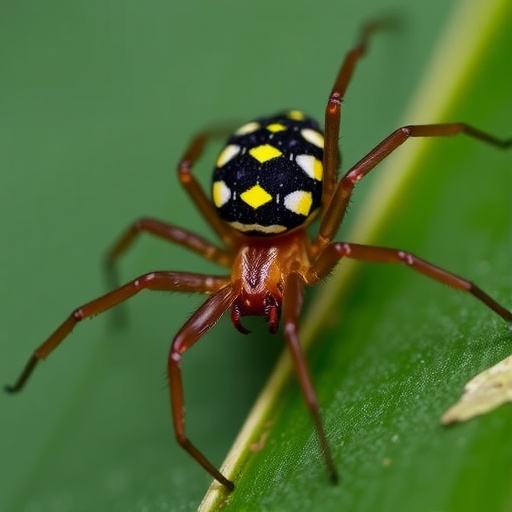
A Rock-and-Roll Discovery in Urban Arthropod Ecology: Unveiling Pikelinia floydmuraria
In a remarkable advancement for arachnological science and urban ecology, a multinational research team spanning South America has revealed a new species of crevice weaver spider within the genus Pikelinia. The spider, scientifically designated Pikelinia floydmuraria, not only enriches taxonomic understanding but also embodies a creative homage to one of rock music’s most seminal bands, Pink Floyd. This innovative nomenclature merges cultural symbolism with biological specificity—the species epithet “muraria,” from Latin, reflects the species’ affinity for man-made walls as habitat, while simultaneously nodding to the iconic Pink Floyd album, The Wall. This pivotal research is documented in the open-access journal Zoosystematics and Evolution, elucidating novel aspects of spider biodiversity in urban environments.
The genus Pikelinia has traditionally been understudied, particularly in the neotropical regions. This new species discovery from Colombia deepens the baseline knowledge of Filistatidae spiders, renowned for their cribellate silk weaving and specialized predatory tactics. P. floydmuraria occupies a niche that intersects urban infrastructure and ecological function, representing a rare instance where taxonomic expansion intersects directly with potential applications in pest control. Its discovery marks only the second instance of Pikelinia documented within Colombian territory, signalling untapped diversity yet to be fully explored in synanthropic webs.
A focal point of this study lies in the spider’s intriguing foraging behavior and diet composition. Despite a diminutive size ranging between 3 to 4 millimeters in body length, P. floydmuraria demonstrates remarkable predatory efficiency. Dietary analyses conducted by the researchers revealed a heavy predilection for Hymenoptera (particularly ants), Diptera (including flies and mosquitoes), and Coleoptera (beetles). The spiders’ ability to subdue prey significantly larger than themselves—ants up to six times the spider’s prosoma size—suggests evolved hunting mechanisms facilitating a niche as urban pest suppressors.
Moreover, the research elucidates an adaptive ecological strategy whereby Pikelinia spiders position their silk retreats near artificial light sources. This behavior exploits phototaxis phenomena—as many flying insects including pestiferous mosquitoes and houseflies are attracted to light, the spider’s webs become strategic traps. This adaptation highlights a complex ecological interaction and underscores the potential of P. floydmuraria to contribute to urban pest regulation in a naturalistic, chemical-free manner. Such findings prompt a reevaluation of spiders as integral components within anthropogenic ecosystems, particularly in densely populated urban settings.
Beyond the Colombian discovery, the study offers groundbreaking morphological insights into a related species, Pikelinia fasciata, endemic to the Galapagos Islands. For the first time, the female internal genitalia of P. fasciata have been comprehensively described and illustrated, filling a significant gap in the anatomical and taxonomic literature. Notably, the male palpal structures of P. fasciata exhibit striking similarity to those of P. floydmuraria, despite the vast Pacific Ocean separating their habitats. This raises compelling questions about their evolutionary trajectories—whether these morphological congruences are attributable to a shared ancestor or represent convergent evolution driven by similar ecological pressures.
The biogeographic puzzle presented by Pikelinia species scattered across distant ecological locales prompts broader reflections on arachnid dispersal mechanisms and speciation events in island and continental contexts. Understanding whether transoceanic distribution stems from vicariance or long-distance dispersal can illuminate patterns relevant not only for spider evolution but also for other terrestrial arthropods inhabiting fragmented or isolated habitats.
With this foundational work accomplished, the authors stress the necessity for further research utilizing molecular and genetic methodologies. DNA-based dietary studies promise to refine our understanding of P. floydmuraria’s trophic ecology with enhanced resolution. Concurrently, molecular phylogenetics would elucidate lineage differentiation and pinpoint precise biogeographic origins, thus contextualizing the species within broader evolutionary frameworks.
Moreover, quantifying the spider’s potential role in urban pest mitigation could have significant practical implications. In an era of increasing urbanization and chemical pesticide resistance, natural predators like Pikelinia spiders may offer sustainable, biologically based alternatives for managing insect populations. Future interdisciplinary research integrating ecology, genetics, and urban planning stands to unlock these possibilities.
The narrative of Pikelinia floydmuraria exemplifies how creative scientific discovery can intertwine with cultural homage and environmental relevance. By celebrating both the rock legacy of Pink Floyd and the spider’s ecological niche on literal “walls,” the research fosters public engagement with taxonomy and biodiversity conservation, potentially inspiring urban dwellers to recognize the unseen ecosystems within their midst.
This study heralds a new chapter in understanding synanthropic arachnids, illustrating that even the smallest urban denizens hold profound stories of evolution, adaptation, and ecological intricacy. Heretofore overlooked spider species like P. floydmuraria may very well be the frontline defenders in the ongoing balance between human habitation and insect biodiversity.
In conclusion, the identification and description of Pikelinia floydmuraria not only enrich the systematics of Filistatidae but also open avenues for exploring how urban ecosystems can be leveraged for sustainable pest control. Through detailed anatomical, ecological, and behavioral research, this study expands the horizons of urban arthropod science, blending heritage, innovation, and environmental stewardship into a singular narrative worthy of continued exploration.
Subject of Research:
Discovery and ecological characterization of a new urban-dwelling species of Pikelinia spider in Colombia with a focus on its dietary habits, habitat use, and morphological comparison with the Galapagos endemic Pikelinia fasciata.
Article Title:
Another web in the wall: A new Pikelinia Mello-Leitão, 1946 (Araneae, Filistatidae) from Colombia, with notes on its diet and description of the female genitalia of P. fasciata (Banks, 1902)
News Publication Date:
18-February-2026
Web References:
https://doi.org/10.3897/zse.102.175423
https://zse.pensoft.net/
Image Credits:
Leonardo Delgado-Santa
Keywords:
Pikelinia floydmuraria, Filistatidae, urban ecology, synanthropic spiders, spider taxonomy, pest control, neotropical arachnology, evolutionary morphology, molecular phylogenetics, urban pests, dietary analysis, species discovery, biogeography
Tags: crevice weaver spiderscribellate silk weaving spidersneotropical spider biodiversitynew spider species Colombiaopen-access arachnology researchPikelinia floydmuraria discoveryPink Floyd inspired species namespider habitat man-made wallsspider species taxonomy South Americataxonomy of Filistatidae spidersurban arthropod ecologyurban pest control potential