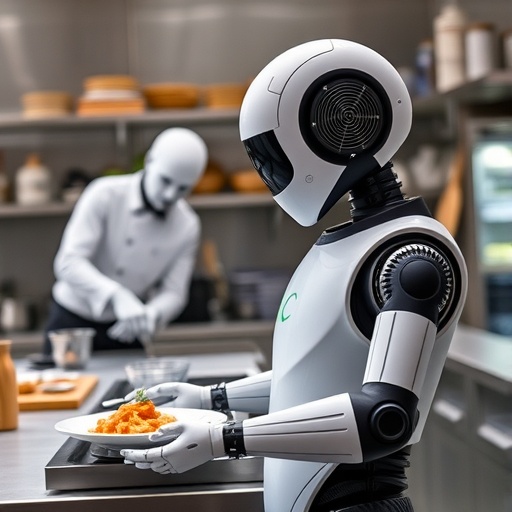
In the rapidly advancing domain of robotics, the challenge of optimizing the efficiency of robot collectives deployed in confined spaces has long intrigued scientists and engineers. Recent research emerging from the laboratories of Harvard University’s School of Engineering and Applied Sciences (SEAS) unveils a fundamentally counterintuitive yet elegantly mathematical insight into this problem: introducing a calculated degree of randomness into the trajectories of robots operating in crowded environments significantly enhances their collective operational efficiency.
As the proliferation of automated systems surges, envision a scenario wherein fleets of robots are dispatched on pressing missions such as environmental cleanup or intricate manufacturing tasks. Initially, the logic suggests augmenting the number of robots expedites work completion due to parallel task execution. However, the complexity escalates sharply when spatial constraints result in congestion, leading to diminishing returns as robots obstruct one another, akin to a dense commuter crowd during rush hour. At this critical juncture, a pivotal question arises—what is the ideal robot density, and how should their motions be regulated to maximize effectiveness?
The groundbreaking study spearheaded by Lucy Liu, a Ph.D. candidate in applied mathematics at Harvard SEAS, with oversight by Senior Research Fellow Justin Werfel, adopts a multifaceted approach combining rigorous mathematical analysis, comprehensive computer simulations, and meticulous robotic experiments. This strategy elucidates how noise, defined as a tunable quantity of stochastic perturbation in navigation paths, can mitigate bottlenecks and foster an emergent order that facilitates continual progress toward goals.
At the crux of their methodology is a departure from deterministic navigation paradigms, which, although straightforward, precipitate severe traffic jams as robots strictly adhere to shortest-path trajectories. Instead, theoretical frameworks model each robot as an autonomous agent endowed with a parameterizable ‘wiggle,’ introducing varied levels of directional noise. This stochastic element empowers the collective to escape local gridlocks, enabling robots to weave past one another in a fluidly orchestrated manner that preserves flow while avoiding chaotic dithering.
Detailed simulation environments emulate the operational conditions by initializing robots at random start points, each tasked with randomly assigned target destinations. The agents continuously cycle through these spatial assignments, mimicking ongoing, dynamic workflows where immediate redeployment follows task completion. Varying noise intensities reveal a non-linear relationship between randomness and throughput; minimal noise results in immobilizing jams, extreme noise induces aimless wandering, while an intermediate ‘Goldilocks zone’ facilitates optimal throughput by balancing collision avoidance and directional persistence.
Mathematicians from the team derived analytic expressions approximating the ‘goal attainment rate,’ a pivotal metric quantifying the frequency at which robots reach their assigned goals per unit time. These formulas integrate parameters such as crowd density and noise magnitude, offering prescriptive insights for optimizing swarm configurations in practical deployments. Beyond theoretical elegance, such models hold profound implications for designing autonomous fleets tasked with environmental remediation, factory automation, or warehouse logistics, where maximizing throughput amidst spatial restrictions is quintessential.
To transcend the realm of abstract theory, the collaboration with physicist Federico Toschi at Eindhoven University of Technology led to empirical validation using small wheeled robots equipped with QR-coded markers for precise tracking. The controlled laboratory setup replicated the idealized scenarios in physical hardware, uncovering that while real-world complexities introduced noise through mechanical and sensor imperfections, the core dynamics predicted by simulations — the emergence of transient congestion punctuated by fluid flow — persisted robustly.
Crucially, the investigation underscores the surprising sufficiency of decentralized control schemes predicated on simple local navigational rules rather than requiring superlative central coordination or highly sophisticated robotic intelligence. This phenomenon, known as self-organization, reveals how complex collective behavior materializes from local agent-level interactions, offering pathways to scalable, resilient robotic systems that adaptively optimize task execution in dense environments.
Beyond robotics, the study resonates profoundly with broader scientific inquiries into active matter — systems composed of self-propelled entities such as ant colonies, fish schools, or pedestrian crowds. Insights into how controlled stochasticity compensates for volume-induced constraints enrich understanding across ecological, evolutionary, and behavioral biological disciplines, illustrating universal principles governing collective dynamics.
Professor L. Mahadevan, a luminary in applied mathematics and biophysics, reflects on the interdisciplinary ramifications, proposing that mathematical frameworks unveiled here could guide future innovations extending well past robotics — from engineering safer human crowd movements in events or transit hubs to designing smart vehicular traffic controls blending autonomous and human drivers.
Anticipating the trajectory of this research, Liu aspires to harness these principles toward environments harmonizing human and machine coexistence, striving for safer, more predictable dynamics in heavily trafficked spaces where diverse agents share the same physical arena. The potential for computationally enabling such ‘predictive crowd tuning’ heralds a new epoch in both technology and urban planning.
Funded by the National Science Foundation Graduate Research Fellowship alongside notable support from the Simons Foundation and the Henri Seydoux Fund, this work exemplifies the synergetic power of theoretical prowess combined with experimental tenacity, carving new frontiers in robotics and active matter physics.
The full study, entitled “Noise-enabled goal attainment in crowded collectives,” is available in the distinguished journal Proceedings of the National Academy of Sciences, providing an indispensable resource for researchers and practitioners pushing the envelope of robotic swarm intelligence and crowd management.
Subject of Research: Not applicable
Article Title: Noise-enabled goal attainment in crowded collectives
News Publication Date: 13-Feb-2026
Web References: DOI: 10.1073/pnas.2519032123
Image Credits: Lucy Liu / Harvard SEAS
Keywords: Robotics, Artificial intelligence, Control systems, Robot control, Robot navigation, Robots, Autonomous robots, Ecology, Evolutionary biology, Organismal biology, Animal locomotion, Entomology
Tags: collective robot motion strategiesenvironmental cleanup robotsHarvard SEAS robotics researchimpact of automation on cookingmathematical modeling of robot movementoptimizing robot efficiency in confined spacesparallel task execution challengesrandomness in robot trajectoriesrobot congestion solutionsrobot density optimizationrobotic automation in kitchensrobotic fleets in manufacturing