Discovery will help researchers better understand a region of the world known for its evolutionary significance
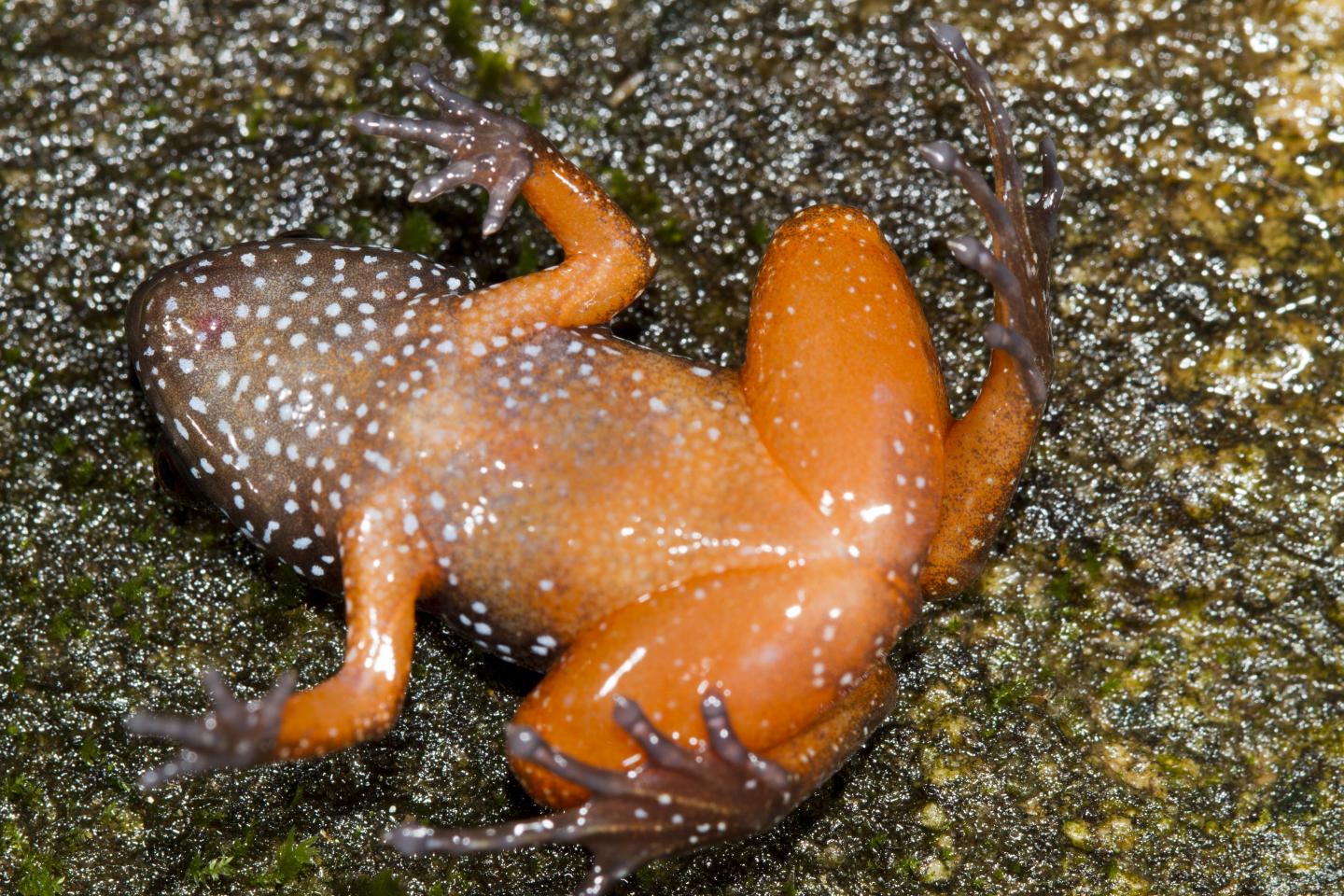
Credit: S.P.Vijayakumar
WASHINGTON (Mar. 12, 2019)–An expedition to an isolated hill range located in Southern India along one of the top biodiversity hotspots in the world led to the discovery of a new, ancient lineage of frog endemic to the area, according to a study published today in the journal PeerJ.
The Western Ghats is a mountain range on the western coast of peninsular India. It is known for being one of the top biodiversity hotspots in the world, with a significant level of plant and animal diversity found nowhere else in the world, including several hundred tree species and a wide variety of amphibians, reptiles and fishes. Despite this, parts of the mountain range remained relatively unexplored until recently.
A team of researchers, led by S.P. Vijayakumar, currently a postdoctoral scientist in biology at the George Washington University, and Kartik Shanker, an associate professor at the Indian Institute of Science, set out on expeditions to remote mountains across the Western Ghats to conduct a large-scale survey of amphibians and reptiles. During several nocturnal searches, they came across a type of frog on the forest floor and a single individual in the grasslands so small that it could perch on their thumbs. The unknown frog had bluish-white spots scattered more prominently along the lateral sides of the jaw and eyelids, deep orange coloration on the belly and brown dorsal coloration that helped camouflage the frog on the rainforest floor. The researchers collected samples of the unknown frog and used DNA sequencing technology to place the new species on the amphibian tree of life.
“The Western Ghats is a critical region that houses many ancient lineages and spectacular radiations. This new frog is a window into the deep history of the landscape. Persistence of such evolutionarily old frogs in the southern parts of this mountain range is a potential signature of a historical climatic refugium in this Gondwanan fragment,” Dr. Vijayakumar said.
The researchers determined that the unknown frog shared common ancestry with two existing subfamilies of frogs endemic to the region, Nyctibatrachinae and Lankanectinae. However, certain aspects of the unknown frog were highly divergent, both morphologically and genetically. This led the researchers to assign the unknown frog to a new subfamily, Astrobatrachinae, thus creating a new species, Astrobatrachus kurichiyana or more commonly, the Starry Dwarf Frog.
“We used molecular sequence data to estimate the historical relationships of this ancient lineage, along with 3-dimensional micro-CT scans of the skeleton,” R. Alexander Pyron, the Robert F. Griggs Associate Professor of Biology at GW, said. “This gives us crucial information about the historical evolutionary relationships of not only Western Ghats frogs, but also of the deeper structure of the Amphibian Tree of Life.”
The team, which also included researchers at the University of Florida and Zoological Survey of India, note that while they are not aware of imminent threats to the Starry Dwarf Frog, additional surveys will need to be done to determine if conservation measures are required. Additional surveys will also help the researchers better understand the Western Ghats, a region of the world known for its evolutionary significance, and one that is under great pressure from climate change and deforestation.
###
Media Contact
Timothy Pierce
[email protected]