A new leaf has turned in scientists’ hunt for developing cutting-edge materials used in organic light-emitting diode (OLED) TV’s, touchscreens, and more. The advance involves the polaron, a quasiparticle consisting of an electron and its surrounding distortions of atoms in a crystal lattice.
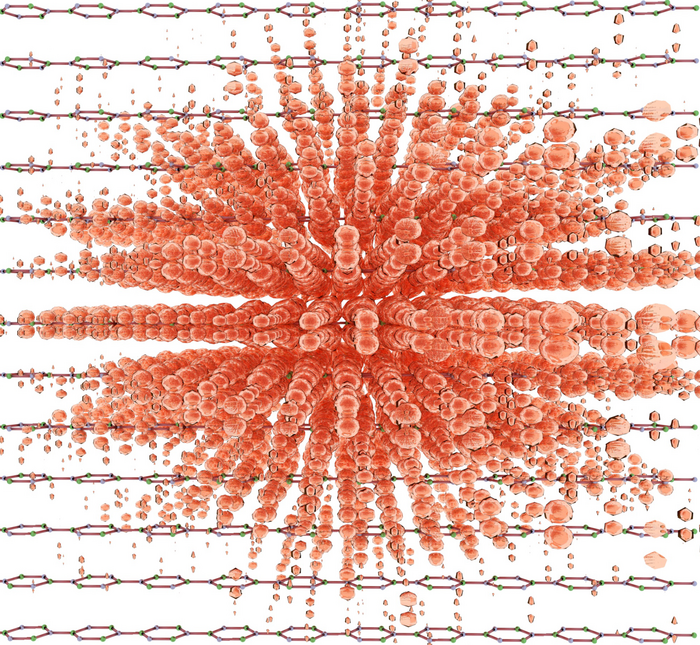
Credit: Feliciano Giustino, Oden Institute
A new leaf has turned in scientists’ hunt for developing cutting-edge materials used in organic light-emitting diode (OLED) TV’s, touchscreens, and more. The advance involves the polaron, a quasiparticle consisting of an electron and its surrounding distortions of atoms in a crystal lattice.
Simulations on the Texas Advanced Computing Center’s (TACC) Frontera supercomputer have helped scientists map for the first time the conditions that characterize polarons in 2D materials, the thinnest materials that have ever been made.
“We charted a map to indicate in which materials polarons should be found, under what conditions, and the characteristics of their properties,” said Feliciano Giustino, professor of Physics and the W. A. ‘Tex’ Moncrief, Jr. Chair of Quantum Materials Engineering at the Oden Institute for Computational Engineering and Sciences (Oden Institute) and the Department of Physics, College of Natural Sciences, The University of Texas at Austin.
Understanding polarons can help improve the performance and efficiency of devices such as touchscreens for phones and tablets, and the organic light-emitting diodes of OLED TVs, which rely on electric charge transport through polarons.
What’s more, generating hydrogen fuel from the splitting of water by sunlight is considered the ‘holy grail’ of energy science, a process which can be achieved through charge transport from polarons in key materials such as titanium dioxide.
Giustino is the lead author on work published February 2023 in Nature Physics. In it, he and study co-author Weng Hong Sio of the Oden Institute and the University of Macau determined the fundamental properties of polarons in 2D materials using quantum mechanical theory and computation.
Little has been known about polarons in 2D materials, until now. Polarons have been well-studied theoretically over the past 100 years, and characterized experimentally for three-dimensional bulk solids.
Giustino and Sio focused on atomically-thin crystal monolayers of hexagonal boron nitride (h-BN) on graphene as a case study, where polarons were computed and compared in the bulk crystal and in the monolayer. Next, they created a generalized model of polarons in 2D materials.
“Our aim was to understand where one can find polarons in two dimensions, and what are their properties. To do this, we used a new computational method that we developed,” Giustino said.
Giustino at the Oden Institute invented EPW, an open-source Fortran and message passing interface (MPI) code that calculates properties related to electron-phonon interaction using Density-Functional Perturbation Theory and Maximally Localized Wannier Functions. This code is currently developed by an international collaboration led by the Oden Institute.
“We used supercomputers to perform the calculations, primarily those of DOE (Argonne Leadership Computing Facility and National Energy Research Scientific Computing) as well as Frontera at TACC. EPW is something that we optimized very heavily on Frontera,” Giustino said.
During TACC’s Texascale Days, Giustino was awarded access to the full machine, allowing his group to perform full system runs on all 448,000 CPU cores of Frontera.
“Thanks to DOE support, we’ve been refactoring the EPW for exascale computing over the past 4 years,” Giustino said. “TACC’s Frontera supercomputer has helped us with this effort. We managed to refactor the EPW code to achieve 92% of ideal scaling. The ability to access the entire machine within Texascale Days has been absolutely critical to bring us to where we are now with the code.”
TACC’s Frontera supercomputer, funded by the National Science Foundation (NSF), is the most powerful academic system in the U.S. Frontera’s Characteristic Science Applications (CSA) program is part of the planning and early science program for the NSF’s Leadership-Class Computing Facility (LCCF), which will be 10 times as powerful as Frontera.
“TACC provided us with the opportunity to develop the codes on full scale systems that has not been possible anywhere else,” Giustino said.
His EPW code is one of 21 CSA projects selected by TACC to be benchmarked and optimized for the LCCF — these latest polaron simulations are linked with Giustino’s CSA project.
What’s more, Giustino continues his strong collaboration with TACC through a recent grant to develop software to design new materials, awarded from the NSF Office for Advanced Cyberinfrastructure through the Cyberinfrastructure for Sustained Scientific Innovation (CSSI) program. The grant will fund the development of software to design new materials.
The Department of Energy (DOE) funded Giustino’s latest work with polarons under the DOE Office of Science, Basic Energy Sciences, Computational Materials Sciences award no. DE-SC0020129.
“The National Energy Research Scientific Computing Center (NERSC) has provided the main resources that we use for this DOE project. We ran a significant fraction of our calculations on the Cori and Perlmuttersupercomputers at NERSC,” Giustino said.
The calculations pertain to the formation energies, wave functions, and atomic displacements of polarons, a quantum wave packet consisting of an electron “dressed” by a cloud of atomic vibrations.
Electrons alone behave like delocalized waves, and polarons behave differently in that the wave packet jumps from one lattice site to another. “This ‘hopping transport’ regime confers the material with novel properties and has implications on the design of materials for electronics,” Giustino said.
The packet extends over 10 nanometers, encompassing about 30,000 atoms of boron and nitrogen, considering all the interactions between atoms. This kind of calculation isn’t possible currently using standard density functional theory methods.
“We recast this problem into the solution of a very large nonlinear eigenvalue problem. Then we used supercomputers to solve this gigantic linear algebra problem,” Giustino said.
“We believe that with these new methods that we developed through the EPW code, we are now capitalizing on and supporting experimental data and see new directions in materials design,” he added.
Said Giustino: “The materials that we know today are just a tiny fraction of what is possible. Supercomputers are key to exploring this valuable and gigantic space without having to first invest billions into experimental synthesis and material characterization. Computation gives scientists a first pass to more easily see what is possible, something which I strongly advocate for and want the U.S. to maintain leadership in materials research through sustained support for high performance computing.”
Journal
Nature Physics
DOI
10.1038/s41567-023-01953-4
Method of Research
Computational simulation/modeling
Subject of Research
Not applicable
Article Title
Polarons in two-dimensional atomic crystals
Article Publication Date
13-Feb-2023