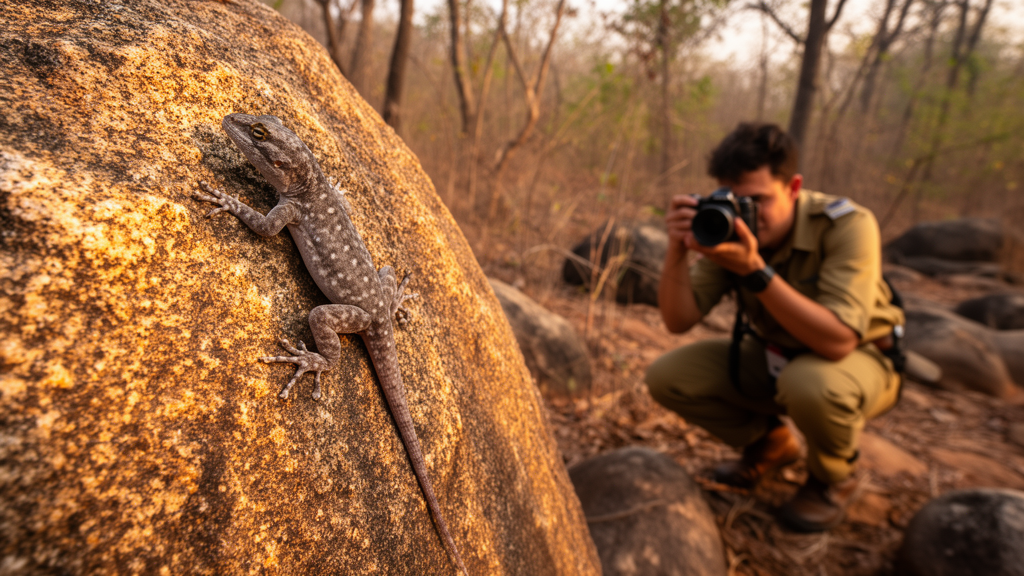
A large-bodied gecko that has been hiding in plain sight on the rock boulders of Odisha’s Eastern Ghats has finally been given a name. In a study published in the journal Herpetozoa, researchers describe Hemidactylus kalinga, a new species of rock-dwelling gecko from the northern Eastern Ghats of Odisha, India. The species, suggested common name Kalinga rock gecko, is genetically distinct from all of its closest relatives and can be told apart by a combination of subtle but consistent anatomical characters, from the rows of pointed tubercles on its back to the number of pores on the thighs of males.
The genus Hemidactylus, established in 1820, is one of the most species-rich groups among geckos, with 198 described species worldwide, 60 of which occur in India. These medium to large geckos occupy a remarkable range of habitats, from forest floors and tree trunks to caves and rock crevices, and some species live as human commensals on the walls of houses. Since 2008, intensive studies of the systematics and phylogeny of the genus have unravelled a great deal of cryptic diversity, leading to the description of 39 new species, and the pace of discovery suggests that many more await formal recognition.
Within the Indian radiation of the genus, the H. prashadi group is the most species-rich, currently comprising 23 described species. The group is divided into major clades, including a northern clade with species distributed mainly north of 14°N and a southern clade largely south of 13°N. The northern clade includes a northern Eastern Ghats group with two described species, H. kangerensis from Chhattisgarh and H. sushilduttai from northern Andhra Pradesh. Earlier work by Mohapatra and colleagues in 2023 had already flagged a distinct, undescribed large-bodied, tuberculate lineage from Kalinga Ghati in Odisha’s Kandhamal district, identified on the basis of the mitochondrial ND2 gene, and the new study formally describes that lineage as a novel species.
The researchers based the description on six specimens collected from outside protected areas in the Kandhamal, Khordha, Ganjam, and Angul districts of Odisha. The animals were collected by hand, euthanised with halothane following ethical guidelines, fixed in 8% formaldehyde, and stored in 70% ethanol. All specimens were deposited in the Reptilia section of the Zoological Survey of India in Kolkata. Morphological and meristic data were collected using a stereo dissecting microscope, with measurements taken using digital vernier callipers to the nearest 0.01 mm and converted to the nearest 0.1 mm. The characters recorded included snout-vent length, head dimensions, limb lengths, counts of lamellae beneath the digits, numbers of dorsal tubercle rows, supralabials and infralabials, and the number of femoral pores in males.
Molecular work was carried out on the mitochondrial ND2 gene, a protein-coding marker widely used in gecko phylogenetics. DNA was extracted using a commercial kit, and the complete ND2 gene was amplified with primers L4437 and H5540, generating sequences of up to 1041 nucleotides. Sequences for the new species were generated from two paratypes from Mandaragiri in Angul district, while the holotype sequence had already been published in earlier phylogenetic trees. The dataset included most named Indian species of the H. prashadi group and sister lineages from the Eastern Ghats, with H. hunae from Sri Lanka and H. vanam from Tamil Nadu used as outgroups. Sequence alignment was performed in MEGA v.12, and phylogenetic analysis was conducted under the GTR + G + I model with nodal support assessed via 1,000 bootstrap replicates.
The phylogenetic analyses recovered three well-supported subclades within the H. prashadi group in the northern Eastern Ghats: the H. sushilduttai, H. triedrus, and H. maculatus subclades, each with bootstrap support above 95. The newly identified lineage falls within the H. sushilduttai subclade and is a sister to a lineage that includes H. kangerensis. Genetic analysis based on uncorrected ND2 p-distances shows that the new species differs from its sister taxon H. sushilduttai by 13–16%, from H. kangerensis by 12.5–15%, and from all other members of the H. prashadi group by more than 18%. Given this substantial genetic divergence, the authors concluded that the lineage warrants recognition as a separate species.
Morphologically, Hemidactylus kalinga is a large, tuberculated gecko reaching a snout-vent length of up to 105.4 mm. Its dorsal scalation is heterogeneous, composed of small granular scales intermixed with large, pointed, strongly keeled, trihedral tubercles that form 15 to 19 fairly regularly arranged longitudinal rows at midbody. Males bear 22 to 26 femoral pores on each side, separated medially by five poreless scales, and there are 9 to 12 lamellae beneath the first digit and 12 to 14 beneath the fourth digit. The species has 11 to 13 supralabials and 9 to 11 infralabials. In life, the body is rusty-brown with four light transverse bands edged with black or dark brown between the occiput and sacrum, and the head is lighter than the body, with a narrow light collar edged by dark brown that is continuous with the post-ocular marking.
The new species can be readily diagnosed from its two closest relatives, H. sushilduttai and H. kangerensis, by a set of characters around the throat and cloaca. In H. kalinga, the second postmental is distinct and roughly 70% of the length of the first postmental, the first postmental touches infralabial I, the second postmental touches infralabials I and II, and there is a single post-cloacal spur on each side. By contrast, H. sushilduttai has two post-cloacal spurs on each side and a different pattern of postmental contacts with the infralabials, while H. kangerensis has three post-cloacal spurs on each side. The number of dorsal tubercle rows also differs among the three species, with 15 to 19 rows in H. kalinga, 16 to 17 in H. sushilduttai, and 18 to 20 in H. kangerensis.
The type series comprises an adult male holotype from Kalinga Ghati in Kandhamal district, collected in May 2016, and five paratypes, two males and three females, from Barbara Reserve Forest in Khordha district, Budhakhol in Ganjam district, and Mandaragiri in Angul district. The specific epithet is a toponym for Kalinga Ghati, the type locality, and also refers to the historical Kalinga Kingdom, which comprised present-day south Odisha, within which the species’ known distribution lies. The paratypes agree with the holotype in most characters, with some variation in the numbers of infralabials, scales across the midbody, dorsal tubercle rows, and femoral pores. One paratype from Budhakhol is lighter in colour without prominent body bands, and uncollected juveniles observed in the field showed darker colouration with more pronounced banding on the body and tail.
Hemidactylus kalinga is endemic to the Eastern Highlands biogeographic province of the Deccan Peninsula biogeographic zone and has been recorded from forest tracts in the northern Eastern Ghats range of Odisha, with its northernmost distribution north of the River Mahanadi. The species inhabits moist and dry deciduous forests with rocky outcrops at elevations of 156 to 746 m above sea level, preferring large boulders in cooler areas covered with large trees or situated in riparian zones. It is sympatric with several other geckos, including the golden gecko Calodactylodes aureus and the nebular bent-toed gecko Cyrtodactylus nebulosus, and occasionally enters human habitations. Field observations show that the species feeds on various arthropods and their larvae; one individual was observed preying on the mole cricket Gryllotalpa africana, apparently tracking the movement of the insect on the ground. The description of H. kalinga makes it the second endemic Hemidactylus from Odisha after H. paucifasciatus and the fourth endemic reptile from the state, underscoring that the Eastern Ghats hill ranges, already home to many endemic lizards, still hold a great deal of undiscovered diversity that will require more intensive taxonomic work to resolve.
Subject of Research: New gecko species Hemidactylus kalinga discovered in Odisha's Eastern Ghats
Article Title: A new species of Hemidactylus Goldfuss, 1820 ( Squamata , Gekkonidae ) from the Northern Eastern Ghats, Odisha, India
Article References: Mohapatra, P. P., Ray, S., Das, A. K., Bhupathi, B., Sarkar, V., Mohalik, R. K., Nair, M. V., & Dutta, S. K. (2025). A new species of Hemidactylus Goldfuss, 1820 (Squamata, Gekkonidae) from the Northern Eastern Ghats, Odisha, India. Herpetozoa, 38, 365-378. https://doi.org/10.3897/herpetozoa.38.e175753
Image Credits: AI Generated
DOI: 10.3897/herpetozoa.38.e175753
Keywords: Hemidactylus kalinga, gecko, Eastern Ghats, Odisha, India, new species, herpetology, taxonomy, ND2 gene, reptiles, species, Hemidactylus
News Source: Juliet Wilcox. (October 17, 2026). New rock-dwelling gecko species discovered in Odisha’s Eastern Ghats. Scienmag.