• HOME
  • NEWS
  • EXPLORE
    • CAREER
      • Companies
      • Jobs
    • EVENTS
    • iGEM
      • News
      • Team
    • PHOTOS
    • VIDEO
    • WIKI
  • BLOG
  • COMMUNITY
    • FACEBOOK
    • INSTAGRAM
    • TWITTER
Friday, August 14, 2026
BIOENGINEER.ORG
No Result
View All Result
  • Login
  • HOME
  • NEWS
  • EXPLORE
    • CAREER
      • Companies
      • Jobs
        • Lecturer
        • PhD Studentship
        • Postdoc
        • Research Assistant
    • EVENTS
    • iGEM
      • News
      • Team
    • PHOTOS
    • VIDEO
    • WIKI
  • BLOG
  • COMMUNITY
    • FACEBOOK
    • INSTAGRAM
    • TWITTER
  • HOME
  • NEWS
  • EXPLORE
    • CAREER
      • Companies
      • Jobs
        • Lecturer
        • PhD Studentship
        • Postdoc
        • Research Assistant
    • EVENTS
    • iGEM
      • News
      • Team
    • PHOTOS
    • VIDEO
    • WIKI
  • BLOG
  • COMMUNITY
    • FACEBOOK
    • INSTAGRAM
    • TWITTER
No Result
View All Result
Bioengineer.org
No Result
View All Result
Home NEWS Science News Biology

New research on hagfish provides insight into evolutionary origin of the eye

Bioengineer by Bioengineer
February 25, 2021
in Biology
Reading Time: 2 mins read
0
IMAGE
Share on FacebookShare on TwitterShare on LinkedinShare on RedditShare on Telegram

U of A biologists studying hagfish eyes uncover unexpected similarities to those of other vertebrates, including humans.
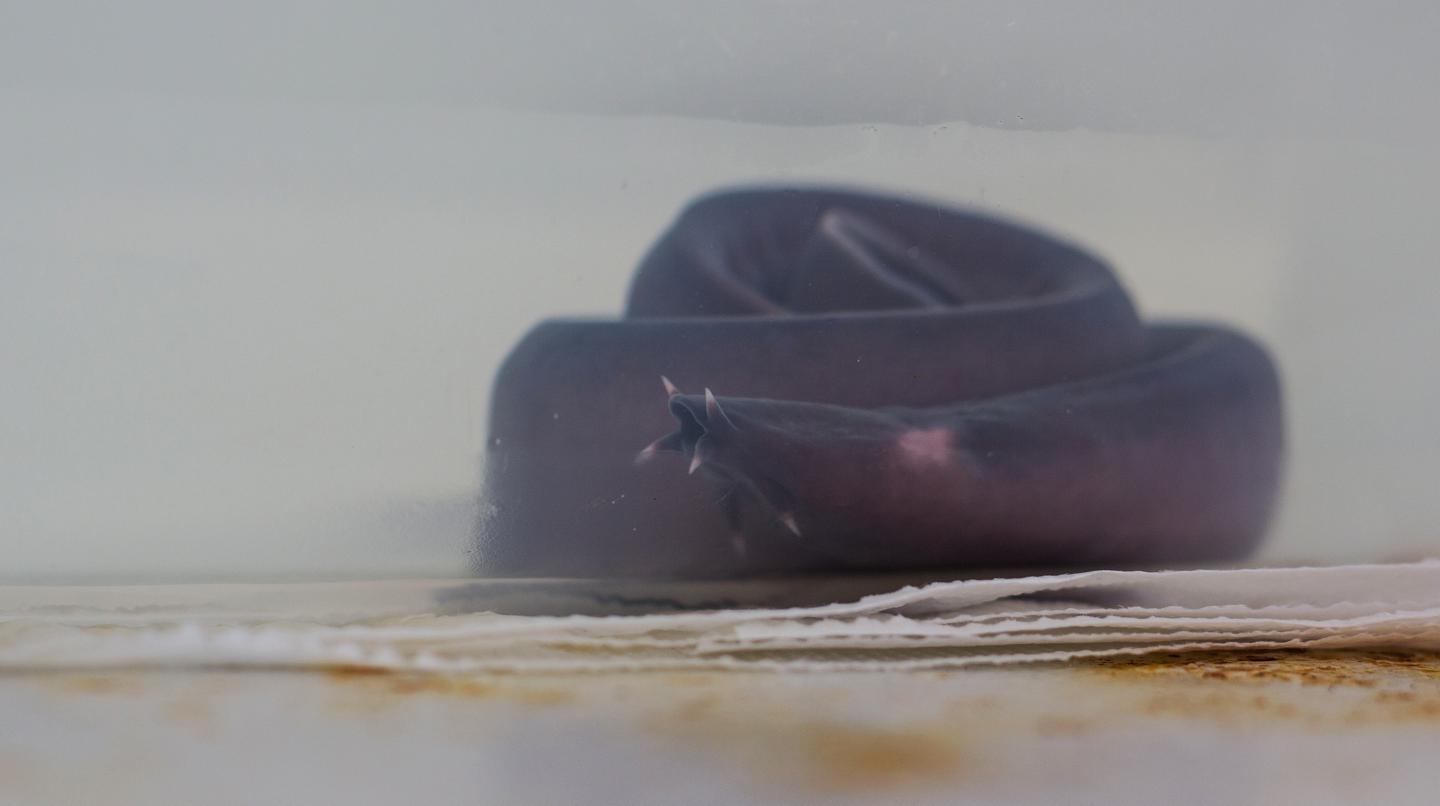
IMAGE

Credit: Ryan Wayne

The answer to the age-old mystery of the evolutionary origins of vertebrate eyes may lie in hagfish, according to a new study by biologists at the University of Alberta.

“Hagfish eyes can help us understand the origins of human vision by expanding our understanding of the early steps in vertebrate eye evolution,” explained lead author Emily Dong, who conducted the research during her graduate studies with Ted Allison, a professor in the Faculty of Science and member of the U of A’s Neuroscience and Mental Health Institute. “Our findings solidify the hagfish’s place among vertebrates and open the door to further research to uncover the finer details of their visual system.”

For years, hagfish eyes were thought to be different from those of vertebrates–so the researchers were surprised to discover hagfish eyes contain many of the same features. These include neurons that connect light-sensitive photoreceptors to ganglion cells, continued growth of the eye late into adulthood, and a hidden layer of support cells that are prominent in other vertebrates and are key to photoreceptor function.

“This is important because it broadens the picture of early vertebrate eye evolution,” explained Dong. “The fossil record can only provide us limited information, because soft tissues like eyes do not preserve well. And so we look to living members of these early lineages, such as the hagfish.”

Hagfish are the most ancient line of vertebrates still living today, representing vertebrates before the evolutionary appearance of the jaw or paired fins, such as limbs. As a result, studying hagfish provides important information about early evolution in vertebrates, setting the foundation for what scientists can learn by studying other animal models such as zebrafish and mice.

“The data shed light on the confusing and dimly lit evolutionary origins of the vertebrate eye,” added Allison, professor in the Department of Biological Sciences and Dong’s master’s supervisor.

###

Dong is now a PhD student at the University of Toronto. The research was funded by the Natural Sciences and Engineering Research Council of Canada and the Bamfield Marine Sciences Centre.

The study, “Vertebrate features revealed in the rudimentary eye of the Pacific hagfish (Eptatretus stoutii),” was published in Proceedings of the Royal Society B.

Media Contact
Katie Willis
[email protected]

Original Source

https://www.ualberta.ca/folio/2021/01/new-research-on-hagfish-provides-insight-into-evolutionary-origin-of-the-eye.html

Related Journal Article

http://dx.doi.org/10.1098/rspb.2020.2187

Tags: BiologyEvolutionMarine/Freshwater Biology
Share12Tweet8Share2ShareShareShare2

Related Posts

Wild fish reveal diverse decision-making strategies

Wild fish reveal diverse decision-making strategies

August 14, 2026
DNA Origami Reveals Hidden Molecular Movements

DNA Origami Reveals Hidden Molecular Movements

August 14, 2026

Study reveals how epigenetic clocks work and introduces new age-prediction tools

August 14, 2026

DNA Repair Mechanisms Show Preference for Certain Genetic Damage

August 14, 2026
Please login to join discussion

POPULAR NEWS

  • Machine Learning Monitors High-Rise Health on Thick Sediments Using Ambient Seismic Noise

    29 shares
    Share 12 Tweet 7
  • Cell Membrane Protein Quality Control Begins at the Ribosome

    29 shares
    Share 12 Tweet 7
  • Levidex RCT Shows Clinically Significant Quality-of-Life Improvements in Multiple Sclerosis

    29 shares
    Share 12 Tweet 7
  • ASTRO updates radiation therapy guidelines for pancreatic cancer

    29 shares
    Share 12 Tweet 7

About

We bring you the latest biotechnology news from best research centers and universities around the world. Check our website.

Follow us

Recent News

Machine Learning Monitors High-Rise Health on Thick Sediments Using Ambient Seismic Noise

Cell Membrane Protein Quality Control Begins at the Ribosome

Levidex RCT Shows Clinically Significant Quality-of-Life Improvements in Multiple Sclerosis

Subscribe to Blog via Email

Enter your email address to subscribe to this blog and receive notifications of new posts by email.

Join 85 other subscribers
  • Contact Us

Bioengineer.org © Copyright 2023 All Rights Reserved.

Welcome Back!

Login to your account below

Forgotten Password?

Retrieve your password

Please enter your username or email address to reset your password.

Log In
No Result
View All Result
  • Homepages
    • Home Page 1
    • Home Page 2
  • News
  • National
  • Business
  • Health
  • Lifestyle
  • Science

Bioengineer.org © Copyright 2023 All Rights Reserved.