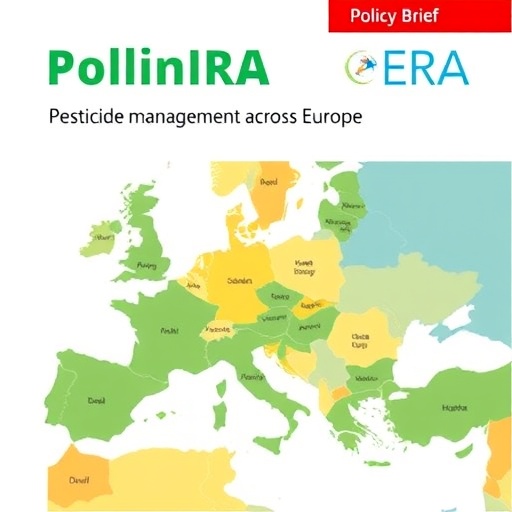
A groundbreaking policy brief emerging from the PollinERA project is challenging the status quo of pesticide regulation across the European Union. The existing regulatory framework evaluates pesticides individually, neglecting the complex, cumulative effects these chemicals exert on ecosystems at broader spatial scales. This fragmented approach often leads to inefficient bans that fail to address the root environmental challenges posed by aggregated pesticide use. The new brief advocates for a paradigm shift towards a regional pesticide management system grounded in ecological and toxicological realities rather than isolated chemical assessments.
Central to PollinERA’s proposal is the introduction of an annual toxic-unit budget assigned to distinct ecological regions across Europe. This budget would represent the environmental carrying capacity for pesticides, calculated with respect to toxicological impacts on non-target species and ecosystem health. Under this model, farmers would be mandated to log pesticide application digitally, enabling real-time monitoring of total pesticide load within their ecological region. Approval of pesticide applications would then be contingent on available capacity within that budget, ensuring that cumulative pesticide pressure remains below critical thresholds conducive to environmental sustainability.
The architects of this innovative framework—Christopher John Topping, Johan Axelman, and James Henty Williams—argue that this systems-first approach aligns pesticide regulation directly with several pivotal EU environmental directives. These include the Water Framework Directive, Natura 2000’s habitat protection mandates, and the newly instituted Nature Restoration Law. By situating pesticide use within region-specific ecological limits, the policy offers multifaceted advantages: enhanced environmental protection through scientifically grounded caps, simplification of a previously convoluted regulatory system, and robust resistance management by preventing overuse and reliance on single substances.
A particularly compelling aspect of the PollinERA policy brief is its emphasis on preserving farmer autonomy and fair market practices. The regional budget system is designed not only to protect nature but to facilitate equitable access to pesticide tools among agricultural stakeholders. By calibrating budget limits to ecological realities, the system incentivizes the development and deployment of lower-impact pesticide products, thereby encouraging market innovation aimed at sustainability. This paradigm introduces a positive feedback loop between environmental health and agricultural productivity, a rare synergy in pesticide policy debates.
Implementing this framework does not entail constructing an entirely new legal architecture. Instead, the PollinERA team outlines a strategy to embed the regional pesticide budget system within the ongoing EU Omnibus legislative process. They recommend three targeted amendments: first, integrating pesticide use conditions specified in Regulation (EC) 1107/2009 with regional ecological thresholds; second, mandating the creation of Regional Pesticide Management Plans as part of the Sustainable Use Directive (2009/128/EC); and third, synchronizing regional budget calibration with targets set forth by the Water Framework Directive and Nature Restoration Law. This incremental integration promises regulatory coherence and operational feasibility.
The practical challenges of monitoring and managing pesticide load at a regional scale are addressed by leveraging digital technologies. A mandatory digital registry for pesticide applications would be established, allowing continuous surveillance of toxic-unit consumption against the ecological capacity budget. This system could leverage geospatial information, real-time data capture, and advanced analytics to ensure transparency and compliance. Beyond compliance, the data infrastructure would support adaptive management capabilities, enabling policy adjustments based on observed ecological responses and resistance patterns.
PollinERA, supported by a four-year Horizon Europe grant, is pioneering this initiative as part of a broader effort to better understand and mitigate the interactions between pesticides and pollinators. The project is responding to limitations of current risk assessment methodologies that predominantly evaluate single pesticide exposures on honey bee populations. Instead, PollinERA advocates for comprehensive, ecologically valid assessments of multiple pesticide impacts across diverse pollinator species. This holistic perspective is essential for preserving vital ecosystem services pollination provides to agriculture and natural habitats alike.
Moreover, the systemic nature of this pesticide budgeting approach addresses longstanding regulatory inefficiencies. Conventional risk assessments focus narrowly on individual chemicals in isolation, ignoring synergistic and cumulative effects that emerge in real-world agricultural landscapes. This oversight has often led to regulatory decisions that inadequately protect vulnerable species and habitats, perpetuating biodiversity loss. By shifting from isolated substance evaluation to a systems-level ecological budget, PollinERA’s policy provides a sound scientific basis for sustainable pesticide governance.
The policy brief is complemented by a detailed technical support document and a commentary exploring operational frameworks and market incentives. Together, these resources elaborate on how regional pesticide management can foster equity among farmers by allocating fair shares of pesticide capacity, encourage the production of environmentally safer chemicals, and align agricultural practices with stringent EU environmental targets. Importantly, the brief argues that achieving these goals requires neither radical legislative overhaul nor costly new bureaucracies, but rather pragmatic amendments utilizing existing EU regulatory processes.
This innovative policy concept embodies a preventive and precautionary principle in environmental risk assessment. By proactively establishing caps on total toxic-unit inputs by region, it mitigates the risk of unforeseen ecological damage before it occurs. In doing so, it advances pesticide policy beyond reactive bans towards proactive stewardship of landscape-scale health. This systemic approach is well aligned with modern sustainability frameworks and EU’s ambitious biodiversity restoration and water quality objectives.
As the PollinERA project continues to develop and refine this regional pesticide budget proposal, it provides an inspiring blueprint for policymakers, environmental scientists, and agricultural communities seeking resilient and science-driven solutions to pesticide impacts. The integration of ecological science, digital monitoring, and pragmatic governance offers a promising pathway for harmonizing agricultural productivity with ecosystem preservation at the continental scale.
Subject of Research:
Pesticide regulation and environmental risk management with a focus on ecological systems and pollinators in the European Union.
Article Title:
A Regional Budget System for Pesticide Management: Reforming EU pesticide risk assessment beyond single-substance regulation.
News Publication Date:
Not specified
Web References:
PollinERA project website: https://pollinera-horizon.eu/
PollinERA policy brief: https://doi.org/10.3897/arphapreprints.e200193
Policy commentary: https://doi.org/10.3897/arphapreprints.e200192
Research Ideas and Outcomes journal: https://riojournal.com/
PollinERA open-access collection: https://doi.org/10.3897/rio.coll.249
Image Credits:
Pensoft Publishers, PollinERA project
Keywords:
Pollinators, Animal pollination, Pesticides, Pest control, Ecological risk assessment, Pesticide regulation, Sustainable agriculture, EU environmental policy, Water Framework Directive, Natura 2000, Nature Restoration Law, Horizon Europe
Tags: cumulative pesticide effectsdigital pesticide application monitoringecological pesticide budgetecosystem health and pesticidesenvironmental carrying capacity for pesticidesnon-target species pesticide impactpesticide regulation in EuropePollinERA project pesticide policyreal-time pesticide load trackingregional pesticide management systemsustainable pesticide use policytoxic-unit budget for pesticides