• HOME
  • NEWS
  • EXPLORE
    • CAREER
      • Companies
      • Jobs
    • EVENTS
    • iGEM
      • News
      • Team
    • PHOTOS
    • VIDEO
    • WIKI
  • BLOG
  • COMMUNITY
    • FACEBOOK
    • INSTAGRAM
    • TWITTER
Sunday, July 26, 2026
BIOENGINEER.ORG
No Result
View All Result
  • Login
  • HOME
  • NEWS
  • EXPLORE
    • CAREER
      • Companies
      • Jobs
        • Lecturer
        • PhD Studentship
        • Postdoc
        • Research Assistant
    • EVENTS
    • iGEM
      • News
      • Team
    • PHOTOS
    • VIDEO
    • WIKI
  • BLOG
  • COMMUNITY
    • FACEBOOK
    • INSTAGRAM
    • TWITTER
  • HOME
  • NEWS
  • EXPLORE
    • CAREER
      • Companies
      • Jobs
        • Lecturer
        • PhD Studentship
        • Postdoc
        • Research Assistant
    • EVENTS
    • iGEM
      • News
      • Team
    • PHOTOS
    • VIDEO
    • WIKI
  • BLOG
  • COMMUNITY
    • FACEBOOK
    • INSTAGRAM
    • TWITTER
No Result
View All Result
Bioengineer.org
No Result
View All Result
Home NEWS Science News Biology

New method of calculating protein interaction to speed up drug development

Bioengineer by Bioengineer
January 24, 2018
in Biology, Science News
Reading Time: 2 mins read
0
Share on FacebookShare on TwitterShare on LinkedinShare on RedditShare on Telegram
IMAGE

Credit: Image courtesy of MIPT Press Office

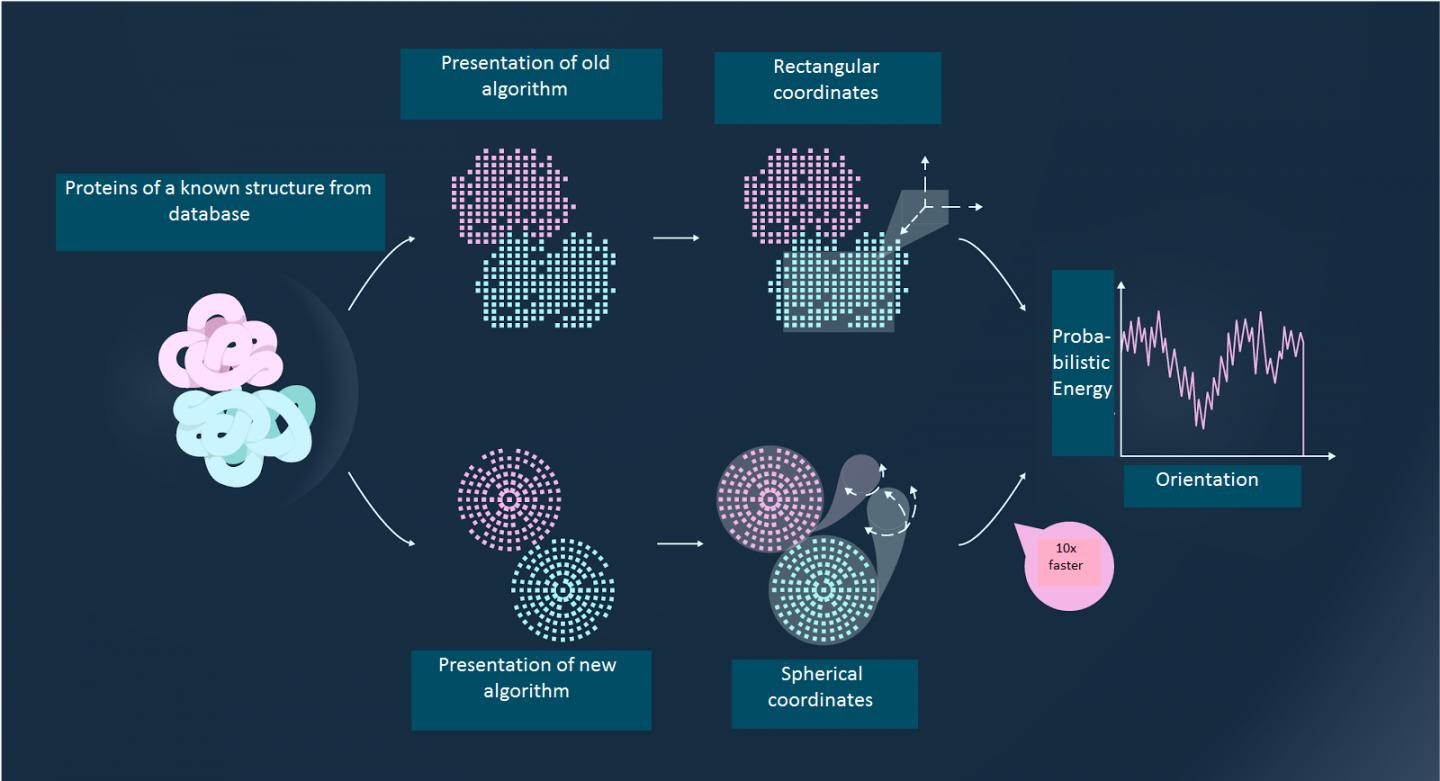
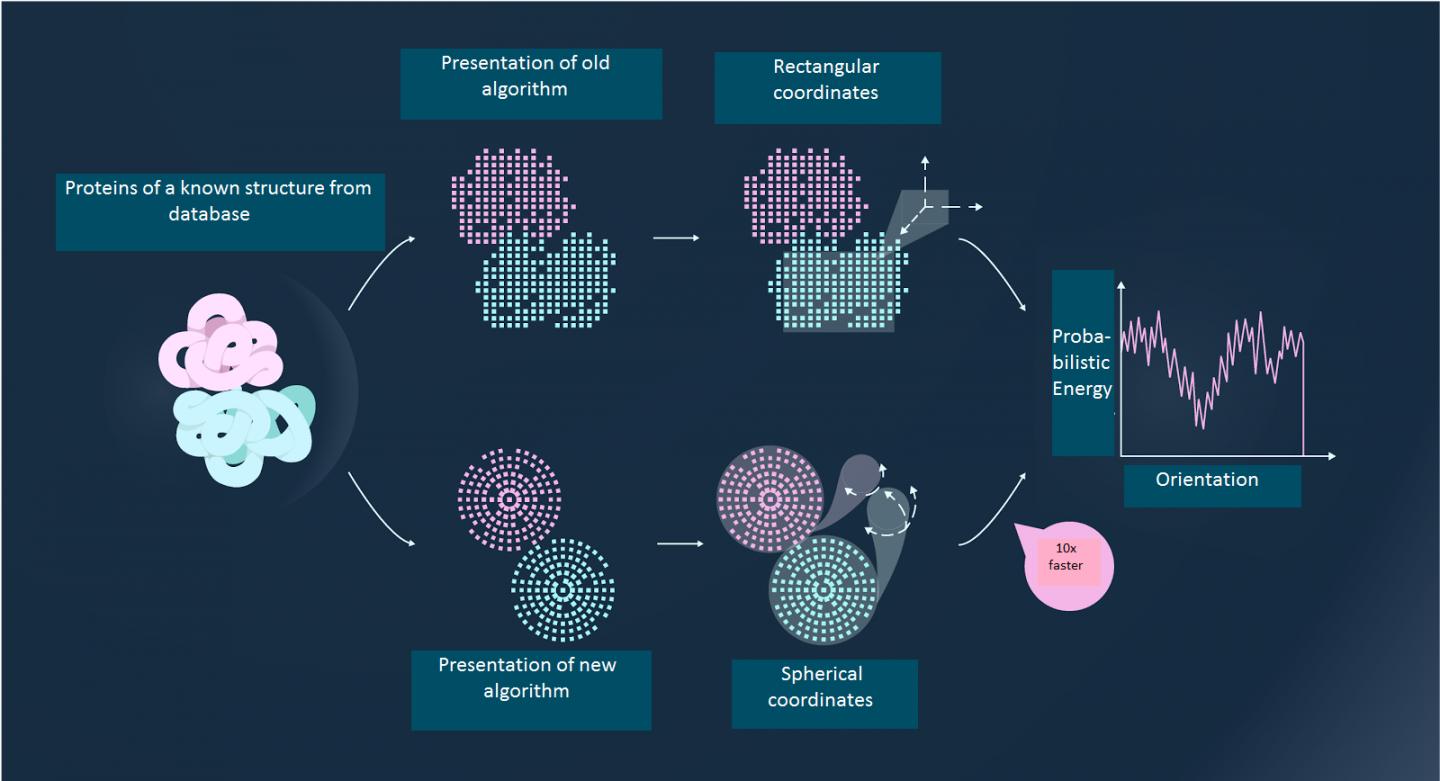
Biologists and mathematicians from MIPT, Stony Brook University and other scientific research centres have taught a computer to predict the structure of protein complexes in a cell 10 times faster than before. The study has been published in Proceedings of the National Academy of Sciences of the USA.

"The new method enables us to model the interaction of proteins at genome level. This will give us a better understanding of how our cells function and may enable drug development for diseases caused by "incorrect" protein interactions," says Dima Kozakov, a professor at Stony Brook and adjunct professor at MIPT.

A matter of skill

From all the possible alternatives of the orientation of two large molecules in relation to one another, in order to find the one that actually exists scientists solve the following problem: two proteins with a known structure are given. A prediction needs to be made of how they will look when "docked". This is known as the rigid docking method, where the structure of the elements is given and they need to be assembled in the best configuration. In scientific terms, this task is called protein-protein docking.

At first glance, this task appears to be simple and straightforward: assembling the structure of proteins is a matter of skill, just the same as putting together a toy construction set. But, according to the scientists, the computational complexity of such an operation is comparable to assembling all the possible pairs of 10,000 blocks of Lego.

The idea the researchers had was to present proteins as a combination of "quantum surfaces" – certain blocks described by the mathematical tool of quantum mechanics. Using this approach, it is possible to simultaneously calculate the interaction between multiple pairs of protein clusters, rather than examining each pair independently. The new method is up to 100 times faster than the best methods used previously, and it is still accurate. According to the scientists, the program takes 15 minutes to run on a personal computer and is a good alternative to experimental methods of determining protein interactions.

The new algorithm will soon become part of ClusPro – a popular automated system for calculating protein-protein interactions. This resource, which was developed earlier by the authors of the paper, now has more than 15,000 users worldwide. In the latest CAPRI round (Critical Assessment of PRediction of Interactions – a communitywide experiment to determine the structure of proteins), the ClusPro server was recognised as the best automated system for calculating protein-protein interactions.

"In normal cells there are thousands of different protein interactions. Explaining these interactions will help us to describe important processes: how the body works as a whole, and methods of treating certain diseases (such as cancer)," says Dima Kozakov commenting on the study.

Andrey Kazennov, a postgraduate student at MIPT, and Dmitry Padhorny, a postgraduate student at Stony Brook with a Master's degree from MIPT, also contributed to the paper.

###

@phystech_en

Media Contact

Sergey Divakov
[email protected]
@phystech

https://mipt.ru/english/

Share12Tweet8Share2ShareShareShare2

Related Posts

Pinning Ångström-Scale Solid Ionic Channels for Rare-Earth Element Separation

Pinning Ångström-Scale Solid Ionic Channels for Rare-Earth Element Separation

July 26, 2026
SPF2 and SGO2/CTF18 limit centromere-near crossovers by regulating SUMOylation

SPF2 and SGO2/CTF18 limit centromere-near crossovers by regulating SUMOylation

July 26, 2026

Gene transfer between infecting bacteria drives extreme antibiotic resistance in lungs

July 26, 2026

Substrate-Free Photosensitizer Radical Pairs Enable Hypoxia-Tolerant Multipath Photoredox Therapy

July 26, 2026
Please login to join discussion

POPULAR NEWS

  • Pinning Ångström-Scale Solid Ionic Channels for Rare-Earth Element Separation

    29 shares
    Share 12 Tweet 7
  • SPF2 and SGO2/CTF18 limit centromere-near crossovers by regulating SUMOylation

    29 shares
    Share 12 Tweet 7
  • Gene transfer between infecting bacteria drives extreme antibiotic resistance in lungs

    29 shares
    Share 12 Tweet 7
  • Substrate-Free Photosensitizer Radical Pairs Enable Hypoxia-Tolerant Multipath Photoredox Therapy

    29 shares
    Share 12 Tweet 7

About

We bring you the latest biotechnology news from best research centers and universities around the world. Check our website.

Follow us

Recent News

Pinning Ångström-Scale Solid Ionic Channels for Rare-Earth Element Separation

SPF2 and SGO2/CTF18 limit centromere-near crossovers by regulating SUMOylation

Gene transfer between infecting bacteria drives extreme antibiotic resistance in lungs

Subscribe to Blog via Email

Enter your email address to subscribe to this blog and receive notifications of new posts by email.

Join 85 other subscribers
  • Contact Us

Bioengineer.org © Copyright 2023 All Rights Reserved.

Welcome Back!

Login to your account below

Forgotten Password?

Retrieve your password

Please enter your username or email address to reset your password.

Log In
No Result
View All Result
  • Homepages
    • Home Page 1
    • Home Page 2
  • News
  • National
  • Business
  • Health
  • Lifestyle
  • Science

Bioengineer.org © Copyright 2023 All Rights Reserved.