

• HOME
  • NEWS
  • EXPLORE
    • CAREER
      • Companies
      • Jobs
    • EVENTS
    • iGEM
      • News
      • Team
    • PHOTOS
    • VIDEO
    • WIKI
  • BLOG
  • COMMUNITY
    • FACEBOOK
    • INSTAGRAM
    • TWITTER
Tuesday, September 15, 2026
BIOENGINEER.ORG
No Result
View All Result
  • Login
  • HOME
  • NEWS
  • EXPLORE
    • CAREER
      • Companies
      • Jobs
        • Lecturer
        • PhD Studentship
        • Postdoc
        • Research Assistant
    • EVENTS
    • iGEM
      • News
      • Team
    • PHOTOS
    • VIDEO
    • WIKI
  • BLOG
  • COMMUNITY
    • FACEBOOK
    • INSTAGRAM
    • TWITTER
  • HOME
  • NEWS
  • EXPLORE
    • CAREER
      • Companies
      • Jobs
        • Lecturer
        • PhD Studentship
        • Postdoc
        • Research Assistant
    • EVENTS
    • iGEM
      • News
      • Team
    • PHOTOS
    • VIDEO
    • WIKI
  • BLOG
  • COMMUNITY
    • FACEBOOK
    • INSTAGRAM
    • TWITTER
No Result
View All Result
Bioengineer.org
No Result
View All Result
Home NEWS Science News Technology

Substrate-Free Photosensitizer Radical Pairs Enable Hypoxia-Tolerant Multipath Photoredox Therapy

Bioengineer by Bioengineer
July 26, 2026
in Technology
Reading Time: 2 mins read
0
Substrate-Free Photosensitizer Radical Pairs Enable Hypoxia-Tolerant Multipath Photoredox Therapy
Share on FacebookShare on TwitterShare on LinkedinShare on RedditShare on Telegram

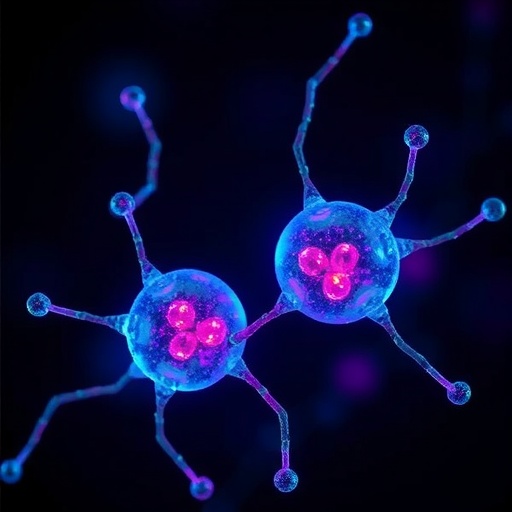
A new photodynamic therapy strategy could make cancer treatment less vulnerable to one of the tumor’s most reliable defenses: low oxygen. In a study highlighted this week, researchers report a way to generate photosensitizer radical-ion pairs without relying on a solid substrate. The approach supports “multipath” photoredox chemistry—meaning the light-driven reactions can proceed through more than one route—potentially boosting killing power even under hypoxic conditions.

Conventional photodynamic therapy depends on oxygen to convert activated photosensitizers into reactive species. But hypoxic tumors often blunt this step, limiting damage to cancer cells and reducing therapeutic consistency. By shifting the underlying redox mechanism, the team aims to circumvent oxygen dependence and widen the effective therapeutic window.

At the core of the work is a substrate-free process that creates radical-ion pairs directly upon irradiation. Rather than requiring a supporting material to mediate charge transfer, the system forms paired reactive states of the photosensitizer—species that can engage in electron and radical chemistry immediately. This design is intended to increase both reactivity and controllability.

The study describes how these radical-ion pairs enable multipath photoredox. In practice, this means multiple reactive outcomes—each tied to different electron-transfer and radical-generation pathways—can be triggered by light. Such redundancy could help explain stronger anticancer performance when oxygen levels are insufficient to sustain a single, oxygen-dependent reaction chain.

Importantly, the authors emphasize hypoxia tolerance. By enabling photochemistry that does not rely solely on dissolved oxygen, the system is designed to keep generating damaging intermediates inside the tumor microenvironment. This could be particularly relevant for aggressive cancers where hypoxic regions act as sanctuaries for resistant cells.

The researchers frame the strategy as a platform concept: if radical-ion pairs can be produced efficiently without substrates, other photoactive chemistries might be adapted as well. That could accelerate development of next-generation phototherapeutics with improved consistency across varied tumor oxygenation states.

While the headline is hypoxia tolerance, the broader significance is mechanistic. The work spotlights how controlling charge-transfer events—specifically, the formation and reactivity of radical-ion pairs—can reshape the reactive landscape produced by light.

As photodynamic therapy seeks to move beyond oxygen constraints, substrate-free photoredox may offer a promising viral-news angle: a simpler activation concept with potentially stronger outcomes, delivered by light and resilient to tumor biology.

Subject of Research: Hypoxia-tolerant photodynamic therapy via substrate-free photoredox
Article Title: Substrate-free generation of photosensitizer radical-ion pairs enables multipath photoredox for hypoxia-tolerant photodynamic therapy.
Article References: Yao, W., Yang, L., Chen, R. et al. Light Sci Appl 15, 331 (2026). https://doi.org/10.1038/s41377-026-02429-9
Image Credits: AI Generated
DOI: 10.1038/s41377-026-02429-9

Tags: electron transfer mechanismsenhanced photodynamic anticancer strategieshypoxia-tolerant cancer treatmenthypoxic tumor resistancelight-driven cancer therapymultipath photoredox chemistrynon-substrate-based photosensitizersoxygen-independent reactive speciesphotodynamic therapyradical chemistry in phototherapyradical-ion pairssubstrate-free photosensitizer


Share12Tweet7Share2ShareShareShare1

Related Posts

Polariton OLEDs Combine Narrowband Color, Angle Stability and High Efficiency Through TADF

Polariton OLEDs Combine Narrowband Color, Angle Stability and High Efficiency Through TADF

September 14, 2026
Sintering Rewritten: New Review Maps How Aluminum Powders Shed Their Oxide Skin and Gain Strength

Sintering Rewritten: New Review Maps How Aluminum Powders Shed Their Oxide Skin and Gain Strength

September 14, 2026

Polarization Superjunctions Push Gallium Nitride Power Transistors Toward Their Theoretical Limits

September 14, 2026

AI Assistant That Reads Your Voice Makes Virtual Lab Work Feel More Human

September 13, 2026

POPULAR NEWS

  • Ancient Chinese Herbal Formula Decoded: How Danggui Buxue Decoction Fights Chronic Kidney Disease

    29 shares
    Share 12 Tweet 7
  • Polariton OLEDs Combine Narrowband Color, Angle Stability and High Efficiency Through TADF

    29 shares
    Share 12 Tweet 7
  • Falls Are Rising Sharply Among Older Adults in Ireland, Landmark 15-Year Study Finds

    29 shares
    Share 12 Tweet 7
  • Sintering Rewritten: New Review Maps How Aluminum Powders Shed Their Oxide Skin and Gain Strength

    29 shares
    Share 12 Tweet 7

About

We bring you the latest biotechnology news from best research centers and universities around the world. Check our website.

Follow us

Recent News

Ancient Chinese Herbal Formula Decoded: How Danggui Buxue Decoction Fights Chronic Kidney Disease

Polariton OLEDs Combine Narrowband Color, Angle Stability and High Efficiency Through TADF

Falls Are Rising Sharply Among Older Adults in Ireland, Landmark 15-Year Study Finds

Subscribe to Blog via Email

Success! An email was just sent to confirm your subscription. Please find the email now and click 'Confirm' to start subscribing.

Join 85 other subscribers
  • Contact Us

Bioengineer.org © Copyright 2023 All Rights Reserved.

Welcome Back!

Login to your account below

Forgotten Password?

Retrieve your password

Please enter your username or email address to reset your password.

Log In
No Result
View All Result
  • Homepages
    • Home Page 1
    • Home Page 2
  • News
  • National
  • Business
  • Health
  • Lifestyle
  • Science

Bioengineer.org © Copyright 2023 All Rights Reserved.