Study by the University of Bonn shows to what extent cancer research can benefit from the results of mouse models
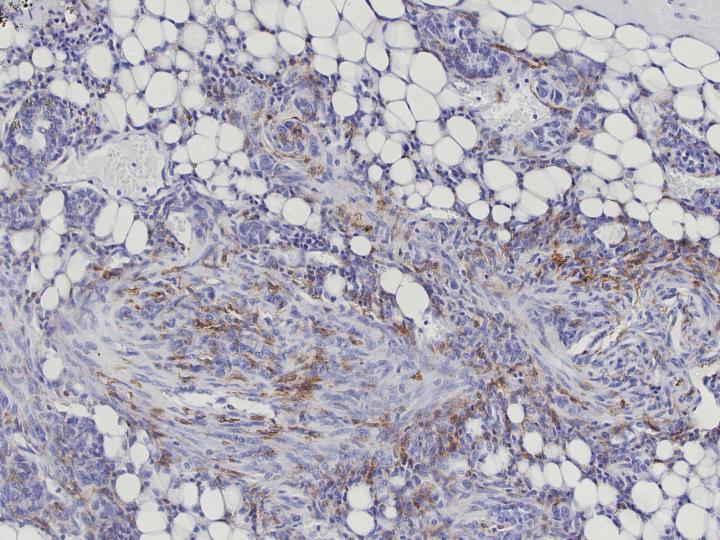
Credit: © Karin E. de Visser/the Netherlands Cancer Institute
Aggressive forms of breast cancer often manipulate the immune response in their favor. This manipulation is revealed in humans by the same immunological “signature” as in mice. This is shown by a study carried out by scientists from the University of Bonn together with Dutch colleagues. Their method makes it possible to obtain an indication of the prognosis of the disease using patients’ tumor tissue. The results are published in the journal Cell Reports.
When a tumor starts to grow in the body, it usually does not go unnoticed by the immune system: Macrophages, a certain form of the body’s own defense troops, migrate to the cancer cells. They are supposed to flow around the diseased cells, digest them and thus eliminate them. But sometimes tumor cells manage to escape their adversaries. Not just that: They even use the macrophages for their own purposes and grow even faster as a result.
To do this, they reprogram the immune cells: They ensure that certain genes in the macrophages are switched off and others switched on. This changes the genetic “signature” of the macrophages. “This changed signature in turn reveals whether the tumor has a good or bad prognosis,” explains Dr. Thomas Ulas from the LIMES Institute (the acronym stands for “LIfe and MEdical Sciences”) at the University of Bonn.
Gene activity also depends on the tissue
In order to identify the changes caused by the tumor, it is necessary to know which genes are normally active in the macrophages. However, this varies considerably, depending on the organ in which the scavenger cells perform their service. Experts also speak of “tissue painting”: The tissue makes its mark on the immune cells.
In addition, tumor-induced changes are not always identical, but differ from one patient to another. “Depending on which mutation is responsible for breast cancer, other functions are switched on or off in the macrophages,” stresses Ulas. It is therefore very difficult to study these complex correlations directly using patients’ tissue samples.
To overcome this obstacle, the scientists cooperated with a working group from the Netherlands. Tumor biologist Prof. Dr. Karin de Visser has been working for many years on mouse lines affected by certain, strictly defined types of breast cancer. “We have now searched these animals for the signature of the scavenger cells in the tumors,” says Ulas. To this end, the bioinformatics expert and his colleagues isolated macrophages from mice affected by breast cancer and compared them with those from healthy breast tissue. They were able to identify the genetic differences between the scavenger cells using state-of-the-art computer algorithms.
Mouse results transferable to humans
They also found almost identical signatures in the scavenger cells of many breast cancer patients. “In this case, it was possible to transfer the mouse results directly to humans,” explains Prof. Dr. Joachim Schultze, head of the Genomics and Immunoregulation team at the LIMES Institute. “However, the prerequisite was that the patients suffered from the same form of breast cancer as the animals.” The results also demonstrate how important it is to develop specific mouse models depending on the type of cancer.
The results can be used not just to predict tumor aggressiveness: After all, the signature also provides information on the cancer cells’ survival strategies. This may eventually lead to the development of new countermeasures. Ulas: “However, it will certainly take many years for new treatment options to emerge, if any.”
###
Publication: Sander Tuit, Camilla Salvagno, Theodore S. Kapellos, Cheei-Sing Hau, Lea Seep, Marie Oestreich, Kathrin Klee, Karin E. de Visser, Thomas Ulas und Joachim L. Schultze: Transcriptional signature derived from murine tumor-associated macrophages correlates with poor outcome in breast cancer patients. Cell Reports; DOI: 10.1016/j.celrep.2019.09.067
Contact:
Dr. Thomas Ulas
Head of the Bioinformatics Working Group
LIMES-Institute
University of Bonn
Tel. +49-228-7362722
E-mail: [email protected]
Media Contact
Dr. Thomas Ulas
[email protected]
49-228-736-2722
Related Journal Article
http://dx.